
Separation
Diapositivas del conjunto (4)
-
- Chromatography is the splitting of a mixture, where the components in the mixture split up depending on how much time they spend in either one of these two phases:
- Mobile phases - a moving phase
- Stationary phase - a phase where there is no movement
- The more time a component spends in the mobile phase, the more it moves
- Insoluble - not able to dissolve
- Solvent - able to dissolve other substances
- Setting it up:
- Take some paper and draw a start line near the bottom of the sheet. Use a pencil, as pen ink dissolves in solvent.
- Add a spot of ink to the start line and place the sheet in a beaker of solvent. The solvent used depends on what is being tested, as some compounds dissolve well in water, but sometimes solvents like ethanol are required.
- Ensure the ink isn't touching the solvent, as it will dissolve
- Place a lid on top of the beaker to stop it evaporating
- The solvent then seeps up the paper, taking the ink with it
- Each dye in the ink will move up the paper at different rates, so the dye will separate out, forming a spot of dye on parts of the paper
- If any of the dyes in the ink are insoluble, they will stay on the start line
- When the solvent ends up reaching the top of the paper, take the paper and leave it out to dry
- The result is a pattern of spots known as chromatography
-
- Filtration:
- When a substance is insoluble, we use filtration. The thick solid is left behind, whereas the liquid drains into the beaker.
- Evaporation:
- This is for soluble salts from a solution and involves putting the substance in a dish over a Bunsen burner. The solvent will evaporate and crystals will start to form. Continuous heating will eventually lead to dry crystals. However, this only works when salt doesn't break down when its heated.
- Crystallisation:
- Pour the evaporating solution into an evaporating dish and gently heat it. When you see crystals are forming, remove the dish from the heat and cool it. The salts will form crystals as it becomes insoluble in the cold, highly concentrated solutions.
- Rock salt is a mixture of salt and sand, but whereas salt dissolves in water, sand doesn't, so we must use both filtration and crystallisation:
- Grind the mixture to ensure the salt crystals are small and will dissolve easily
- Pour the mixture in water and stir, the salt will dissolve but the sand wont
- Filter the mixture. The sand wont fit through but the salt will
- Evaporate the water from the salt so it forms dry crystals
-
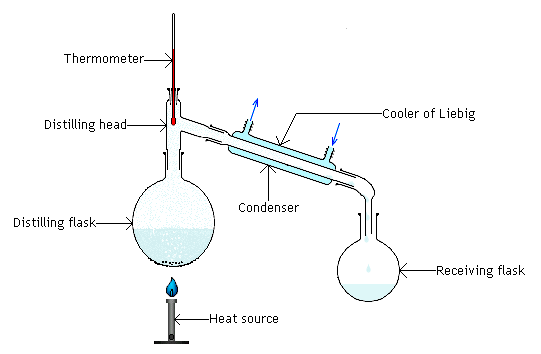
- Distillation is used to separate a liquid from a solution. The method is fairly simple:
- The solution is heated, and the part of the solution with the lowest boiling point evaporates first
- The vapour is cooled and condensed, and collected as liquid
- The other parts of the mixture remain in the flask
- This can be used to separate pure water from sea water.
- However, the one problem is that it only works when the boiling points are very different. The temperature has to be regulated to avoid the components mixing again.
-
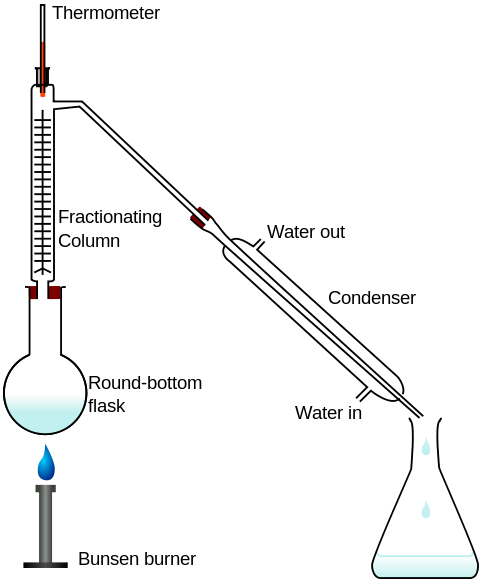
- Fractional distillation is used when you have a mixture of liquids with similar boiling points. The method goes as follows:
- You put the mixture in a flask and put a fractionating column on top
- The different boiling points mean they all evaporate at different times
- The liquid with lowest boiling point evaporates first and when the thermometer on top reaches the temperature of the biling point, it reaches the top of the column.
- Liquids with a higher boiling point also evaporate, but the top of the column is the coolest, so before they get there, they condense and go back into the flask
- When one liquid is collected, the temperature is raised for the next one
Información
- Descripción
- GCSE Core Science Diapositivas sobre Separation, creado por Rayan Rashid el 11/02/2019.
- Creado por
- Rayan Rashid
- Visitas
- 1
- Valoración