
Introduction to Sets
Diapositivas del conjunto (16)
-
- 1.Define what a set is?
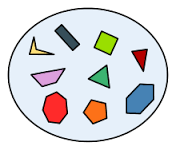
- A set can be defined as a collection objects.
- 2.What do you call the objects inside the set?
- you call it ELEMENTS or MEMBERS.
- Moving onto how we talk to sets on slide two
- Pie de imagen: A Collection of Objects
-
ListNotation method1 refer to set?
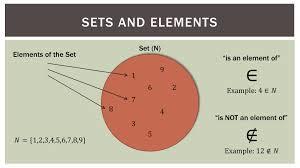
- Pie de imagen: Example of elements in a set
- The element belongs to the set inside the circle so
- lets call it the CIRCLE Set and nickname it as C.
- The element's / objects are represented by the E-SHAPED symbol
- So now we can talk to the circle by calling on the elements eg. 3 E C (three is an Element C for circle)
- Example two
- you can write it out in list notation below and refer to it aswell.
- list notation: C= {1,2,3,4,5,6,7}
- 2 E C or 5 E = {1,2,3,4,5,6,7,}
- 8 ∉ C = 8 is not an Element of C
- So two or five(in fact 1-7 also) is an ELEMENT of C!
-
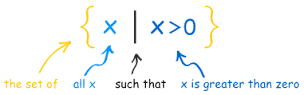
- Pie de imagen: How to refer to set using Set Builder notation example.
- The example shows how to read and write out a set
- on the left
- Below are other otherways aswell good to know these NB!!!
- {0, 2, 4, 6, 8},
- {x | x is an even non-negative integer less than 10},
- and
- {x | x ∈ Z≥, x is an even integer less than or equal to 8}..
- Z≥ refers to non-negative intergers(1,2,3,4....)
- Z refers to Integers that is positve
- and negative numbers inclusive (-1,-2,3,4).
-
How to know if a set is Equal?
- You can have more than one set so lets compare them to see if they are equal
- Lets call the 3x sets of Apples A,B andC
- all of them has the same amount and type of Appels
- so they EQUAL
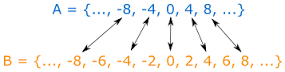
- So it makes sense to regard two sets as equal if they have precisely the
- same elements. So, for example {3, 4} = {4, 3}
- Another example thats Equal: {5, 7} = {5, 5, 7}
- Number 5 is listed twice in the set, it does not
- tell us anything we don’t already know. The numbers which are in {5, 7} are 5 and 7, and these are exactly the numbers that are in {5, 5, 7}. So these sets are equal.
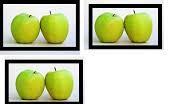
- Pie de imagen: Equality Example in sets
-
Meet the Farther: The Empty Set

- Pie de imagen: The set FAMILy: Hi i am the empty set
- A set that has NO ELEMENTS is called an EMPTY SET
- Ok! so lets talk to the empty set.
- In List notation we refer to it as = {}
- ∅
- In Set builder notation we refer to it
- {x < 1 | x ∈ Z+}
- the set of all the X's less than one SUCH that X is an
- ELEMENT of positive INTEGERS.
- There other ways to refer to an empty set to !
-
Meet the mother: The Union set
- The union of sets A and B is denoted by A ∪ B, and is the set of all those
- elements which belong to A or to B (or to both). i.e A={1,2,3} and B={3,4,5}
- AuB={1,2,3,4,5} (Think poker all in)
- AuB is the SET of all X'S SUCH that X is an ELEMENT
- of A or X is an ELEMENT of B
- A ∪ B = {x | x ∈ A or x ∈ B}.
- “if x ∈ A ∪ B, then x ∈ A or x ∈ B”, and
- “if x ∈ A or x ∈ B, then x ∈ A ∪ B”.
- Combined stated of mother Union below
- "iff" = if and only if -> is what it means
- “x ∈ A ∪ B iff x ∈ A or x ∈ B”.
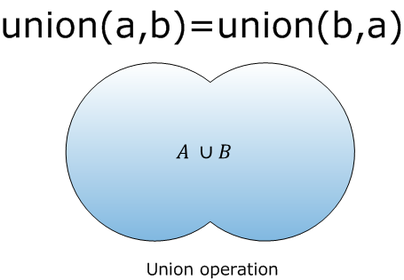
- Pie de imagen: All the elements of A an B added together
-
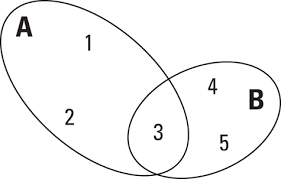
- Pie de imagen: An element that is both in A and B is 3 example
- Two or more sets that share one or more ELEMENTS
- in common this where they intersect.
- denoted by A ∩ B
- AnB = The set of the X'S SUCH that X's Element of
- A and X's an element of B (KEY WORD AND)
- A ∩ B = {x | x ∈ A and x ∈ B}
- KEY Word to remember is AND with Intersect in the SET BUILDER NOTATION.
- “x ∈ A ∩ B iff x ∈ A and x ∈ B”
- i.e
- Let A = {1, 2} and B = {0, 1},then A n B ={1}.
-
Meet Brother: Set difference(-)
- We minus set A from B (A-B) then get the difference by removal.
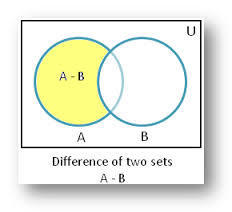
- Pie de imagen: Remove the elements A and B has in common write A only
-
Meet Uncle: Symmetric set Difference(+)
- SO basically we add(+) the sets for A and B BUT
- DONT WRITE the elements in COMMON!
- i.e
- Let A = { 3, 4 } and B = { 4, 5, 6 }
- A + B = { 3, 4 } + { 4, 5, 6} -> A+B ={3, 5, 6}
- REMEMBER OR used in SET BUILDER NOTATION.
- A+B = the SET of All the ELEMENTS SUCH that X's
- an ELEMENT of A or X's an ELEMENT of B but not BOTH
- A + B = { x | x ∈ A or x ∈ B, but not both.}
- “x ∈ A + B iff x ∈ A or x ∈ B, but not both”.
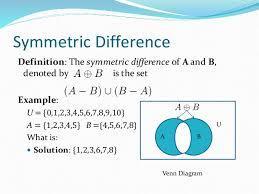
- Pie de imagen: Remember we ADD the sets and Dont write the in common elements.
-
- Two sets A and B are called disjoint if they have no elements in
- common, i.e. there is not a single element that live in both A and B,
- i . e . A ∩ B = ∅
- Let A = { 1, 2, 3, 4 } and B = { 5, 6 } with U = {1, 2, 3, 4, 5, 6}.
- Then we can say that A and B are disjoint. There are no elements that
- b e l o n g t o b o t h A a n d B , i . e .
- A ∩ B = ∅
- .
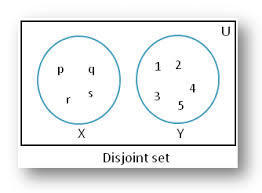
- Pie de imagen: They have NO Elements in COMMON
-
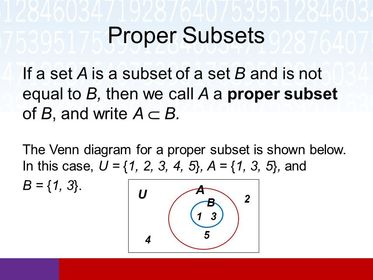
- Example: {1, 2, 3} is a proper subset of {1, 2, 3, 4} because the element 4 is not in the first set. Notice that if A is a proper subset of B, then it is also a subset of B
- Another example: Let C = { ∅, {∅} } with ∅ and {∅} being the elements of
- C. (The element {∅} is highlighted so that one can remember that this is
- one element of C.)
- How we write a sub set see below!!
- A⊆B
- Pie de imagen: NOTE ALL of A must be inB
-
- For example, if A={ 1, 3, 5 } then B={ 1, 5 } is a proper subset of A.
- REMEMBER reversed of subset ALL of B must be in A
- For example, if A={ 1 ,3 ,5} then B={ 1 ,5 } is a proper subset of A. The set C={1, 3, 5 } is a subset of A, but it is not a proper subset of A since C=A,C=A. The set D= { 1, 4 } is not even a subset of A, since 4 is not an element of A.
- How we write it: A ⊂ B
-
- The sum of a set or sets
- basically you count the ELEMENTS in a set or SETS
- Let A = {1, 2, 3, 4} and B = {5, 6} be subsets of U = {1, 2, 3, 4, 5, 6},
- then |A| = 4, |B| = 2 and |U| = 6,

- Pie de imagen: YEs you start counting
-
Meet Bully the dog: Compliment set
- Let A be a subset of a universal set U. Then the complement of A is
- defined as the set of all elements that belong to U but do not belong to
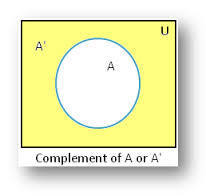
- Pie de imagen: All belongs to the COMPLIMENT oF A not the A in the white circle
-
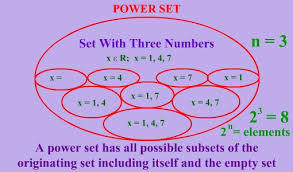
- Given a set A with n distinct elements, the power set of A, denoted by
- Ƥ (A), is the set that has as its members all the subsets of A.
- Let us list them: 0/, { 1 }, { 2 }, { 3 }, { 1, 2 }, { 1, 3 }, {2, 3} and {1, 2, 3}.
- These are all the members of Ƥ (B).
- The power set of B, i.e. Ƥ (B) is therefore
- Ƥ (B) = { 0/, { 1 }, { 2 }, { 3 }, { 1, 2 }, { 1, 3 }, { 2, 3 }, { 1, 2, 3 } }.
- The cardinality of Ƥ (A) is 2n, i.e. |Ƥ (A)| = 2n.
- Let B = {1, 2, 3}. Which sets are all subsets of B?
- Pie de imagen: Defined in picture example!!
-
Now you met the Family of Sets

- Pie de imagen: Kitty the Cat,Bully the dog, Happy the hamster
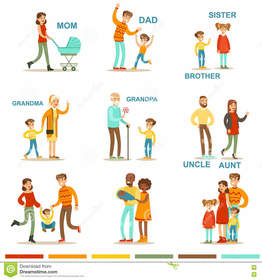
- Pie de imagen: Here they are now try to memorise them
Información
- Descripción
- Descrete Mathematics for explaining Sets
- Creado por
- Brendon Barends
- Visitas
- 84
- Etiquetas
- Valoración