
Sin título
Diapositivas del conjunto (4)
-
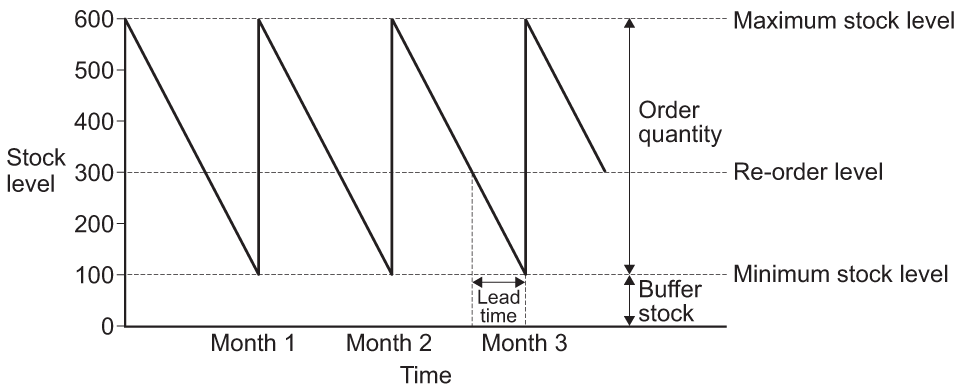
- Buffer inventory: Minimum amount of inventory you want to hold. Ensures production can continue in an emergency so customers are supplied.
- Lead time: How long it takes from an order to be placed before the materials arrive from the suppliers. Measured in days, weeks, months etc. Determines when stock has to be ordered to ensure the company does not fall below the buffer stock level.
- Re-order level: Level at which a new order must be placed for suppliers. It depends on the buffer inventory lead-time an the rate at which materials are used up.
- Re-order quantities: The amount a manager reorders of a particular item. It may depend on storage and the usage rate. The more often a manager reorders, the less quantity needs to be ordered.
- Problems:
- supplies are delayed - buffer inventory starts to be used
- usage rate faster than usual - increase in demand
- failure to reorder inventory - technology decreasing this risk
-
- Description: Motivation is an external factor achieved through money. Employees should be supervised closely and paid piece-rate. Time and motion studies determine efficient means of production and workers will be told and trained how to operate. (Motivated by money)
- Key Elements:
- Work study: encouraged division of labour (breaking down all the tasks into small jobs - efficient)
- Normal times: identified most efficient employees and adopted their approaches. Measured employees performance with "normal times"
- Equipment and training: Provided with equipment necessary to carry out tasks. Gave basic training and clear instructions
- Piece-rate pay: Paid per item made - efficient.
- Taylor's methods unpopular with workers as they forced them to work hard and threatened the jobs of less productive workers, resulting in strikes.
-
- Description: Accepted that employees could be motivated by meeting their social needs (sociological theory). Attention given to the social dimensions of work e.g. communication, group work, consultation. (Motivated by the social needs)
- The Hawthorne effect:
- Originally, he was assessing the impact of lighting conditions but productivity had changed regardless of the lighting. The employees were responding to working together and having a high level of attention. Motivation depends on:
- Type of job and supervision
- Group relationships, group morale and a sense of worth
- Implications of the Hawthorne effect:
- Managers must meet the needs of the employees
- Social environments and informal working groups were recognised as having a positive impact on productivity
- Employees should be provided with a range of activities e.g. social or sporting
- Work outings become a familiar part of employees' years e.g. Marks and Spencers' weekend breaks
- Managers gave more attention to teams and team working
- e.g. John Lewis makes their employees feel part of a community.
Información
- Descripción
- A level Business Studies Diapositivas sobre Sin título, creado por Bea Wagner el 25/07/2017.
- Creado por
- Bea Wagner
- Visitas
- 0
- Valoración