
Fichas
Brand Innovation, Heritage Brands, Elasticity and Architecture
Fichas del conjunto (34)
- 1what is innovation?the process through which inventions and new ideas become a business reality. it is more than invention as innovationcan happen with new products, processes, strategies and structures
- 2why is innovation important?-to develop competitive economy/foster competition in innovation
-to achieve future economic prosperity
-provides the co. with a competitive advantage
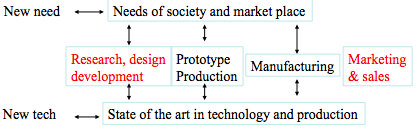
-fundamental to the long-term development of a brand - 3what are the 2 basic ways innovation may occur?-demand-pull (fulfilling market need)
-technology push (applying existing knowledge) - 4what are the 5 types of R&D? (burns & stalker)-pure research (advancing knowledge w/ no immediate commercial application)
-basic research (advancing knowledge with the hope that it will be useful)
-industrial research (transform pure/basic research to profitable use)
-design (development of final product for the customer) - 5what is the simple 1st generation - linear model of innovation (technology push/demand pull)tech push: science discovers>technology produces>firm MARKETS
demand pull: MARKET needs>technology responds>firm markets
(Rothwell) - 6what are some criticisms of Rothwell's linear modes of innovation?-very compartmentalised
-slow process
-no room for collaborative innovation e.g.between scientists and marketers - 7what is the 3rd generation - coupling model of innovation
- 8what is the 4th generation - integrated innovation model-multifunctional teams where all areas come together
-marketing has a role all the way through the innovation process
-quicker than previous models
-arguably more responsive to market needs - 9what is the 5th generation innovation process model?-greater overall organisational and systems INTEGRATION
-flatter, more FLEXIBLE organisational structures
-fully developed internal database structures
-electronically assisted product development - 10what are closed innovation models and what are their downfalls?-research the market, filter the research and use it to develop product
-assume companies do the innovating
-rely on idea that innovation is occurs only through desiging products
(Chesburgh) - 11where should innovation start and why?should start with innovation in service provision, sourcing decision. buying decisions THEN can have better innovation in product development
- 12what are the 5 types of innovation (where innovation can occur?)-raw material (change plastic to make tougher)
-product (change dashboard to make easier to read
-process (use robots to weld cars)
-marketing (using celebrities)
-organisation (outsourcing payroll) - 13the importance of innovation in business models-shifts focus to the 'how' of doing business, as opposed to the what, where
-focuses on a holistic perspective of how business is conducted, rather than on particular strategy or market
-emphasises value creation for all members of business (incl customers) as apposed to value capture - 14e.g. of co. that benefitted from business-model thinking in terms of innovation?-firm that manages brands such as Zara made business-model thinking a priority
-have innovative production process where generic activities such as dyeing, washing, ticketing are performed in-store, sewing is outsourced
-can bring garments to shop floor in record timing - 15what are characteristics of entreprenurial organisations?-focus more attention/resources on what they do not know yet (investment, R&D) than controlling what they already know
-measure success not by how far they've come, but how far they have yet to go - 16what are economic, policial and personal conditions that allow for innovation to thrive?E: changing economy, unemployment, downsizing, globalisation, competitino
Political: ideology, policy, regulation
Personal: education, support, social class, family history - innovator as craftsman, opportunist, organisation builder - 17what is open innovation?Open: 'not all smart people work for us', exertnal R&D can create value, don't have to originate research to profit from it, make best use of internal and external ideas
- 18what is closed innovation?Closed: 'smart people work for us', to profit from R&D, must do it ourselves, if we create the best ideas, we will win
- 19e.g. of co. that changed from closed to open innovation-P&G closed until financial troubles, there was an increase in pace of innovation, costs, consumer demands. co. required growth which exceeded ind growth rate, collaborated with external source
-when process began 10-15% innovation was external, when ended 50%
-6% growth rate in avge 2-3% industry - 20what are the challenges of using open innovation?-multiple owners of idea
-research co. need to change and adapt processes for different companies
-using external source creates gap in internal capabilities - 21what is user-led innovation?-Innovation by consumers and end users, rather than suppliers
-can be innovation in use, service, configuration of technology or novel technology - 22e.g. of user-lead innovationdiscovery that using the x-box can help stroke patients recover
- 23what is the role of lead users in user-lead innovation?-innovation by users tends to be done by "lead users"
-experience needs that will become general in marketplace months/years before majority of target market - so they are motivated to innovate themselves and often develop own solutions - 24what is an example of user lead innovation?inventions on 'dragon's den' tv show
- 25what are the common traits of good innovation?-strategic focus
-insight
-collaboratin
-process: streamline idea>evaluation>creation>market place
-organisation - 26what is a heritage brand?-core values and history
-use symbols consistently (may alter slightly, but maintain link, e.g. peugot changed a little and pepsi changes alot)
-brands that go forward but with a meaningful past (balmer) - 27what is a brand extension?endowing a new product with a well known brand name (e.g. apple)
- 28what is brand elasticity?how able a brand is to extend into distant product categories
e.g. Virgin quite elastic, virgin mobile, virgin airlines. not enough to extend into things like softdrink - 29what allows a brand to stretch?(volkner & sattler)
-difficulty in producing the extension product
-consumer's knowledge of the extensions product class
-comapny size
-order and direction of previous brand extensions
-consumers mood - 30what 4 things help brand extensions succeed?-Fit between parent brand and extension product (by extending on: appealing attribute e.g. good at cleaning, make more cleaning products, extending to be used within existing products (e.g. make ipod then make speaker)
-Parent brand conviction
-Parent brand experience
-Retailer acceptanceMarketing support - 31how does consumer's style of thinking effect their acceptance of brand extensions?-analytical vs holistic: holistic more positive about extension fit
-innovators (willing try new things)
-early adopter (respected opinion leaders)
-early majority (not opinion leaders)
-late majority (risk-averse)
laggards (highly risk-averse, traditional) - 32how can companies increase the fit of the brand extension with the parent brand?-link extension with the existing strong brand image
-create associations (e.g. through sponsorship)
-increase exposure to the extension - 33what is brand architecture?-how the brands fit with one another and with parent brand
-branded house (e.g. virgin, see virgin name on extensions)
-house of brands (e.g. Nestle, see a tiny nestle name on each product, each brand extension has own identity) - 34what should co's consider in regards to brand architecture?Number of brand levels
Role of the corporate brand
Relative weight of the brands
Degree of globalisation
Información
- Descripción
- Masters Degree (Brand Management) Marketing Fichas sobre Brand Innovation, Heritage Brands, Elasticity and Architecture, creado por Madeline Briscoe el 04/01/2016.
- Creado por
- Madeline Briscoe
- Visitas
- 69
- Valoración