
Fichas
Primitive Reflexes
Fichas del conjunto (10)
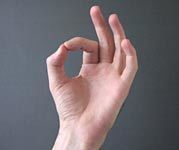
- 11. Sequentially touch the thumb of one hand to the pointer, then the middle finger, the ring finger, and the pinky. 2. Then go backwards from pinky to pointer. 3. Touch one finger per beat, for 60 seconds. MAY HELP WITH: * Poor Handwriting * Poor Manual Dexterity * Speech and Articulation IssuesFingers 1-2-3 to Integrate the Grasp (Palmar) Reflex
- 2Neck Roll1. Sitting up, drop head to chest.
2. Very slowly, take 4 seconds to tilt head up, looking at the wall, eyes are open.
3. With eyes open, tilt back the other way taking 4 seconds.
4. Now, with eyes closed, repeat the tilting.
5. Repeat eyes open, eyes closed for 3 seconds.
MAY HELP WITH:
* Motion Sickness
* Balance and Coordination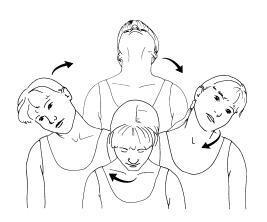
- 3Fly to the Moon Exercise (to Integrate the Tonic Labyrinthine Reflex)1. Lie on stomach
2. Lift chest off the floor, leaning on one elbow, other arm up.
3. Move one hand slowly to the side, then slowly stretch it away. The entire time, watch the fingers
4. Slowly bring thumb back to the nose, then repeat again for 30 seconds total
5. Repeat on other side
6. Rest with chest down or in child's pose (Yoga position) if back becomes tired
7. Repeat steps 1-5 two more times
MAY HELP WITH:
* Poor Posture
* Weak Muscle Tone
* Visual Problems with refocusing near to far and far to near
* Spatial problems (bumping into things)
* Poor sequencing and organization skills
* Poor sense of time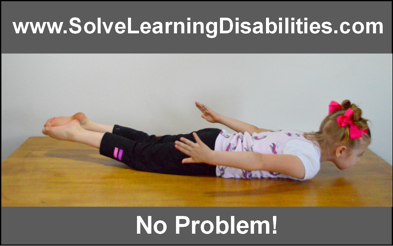
- 4Log Rolls1. Lie on back with arms overhead
2. Very slowly, take 8 seconds to completely roll over until you are lying on your back again, eyes are open.
3. With eyes open, roll back the other way taking 8 seconds.
4. With eyes closed, repeat the rolling
5. Repeat eyes open, eyes closed for 3 rounds
MAY HELP WITH:
* Motion Sickness
* Balance and Coordination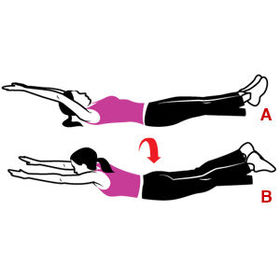
- 5—1. Lie on back with legs closed and hands at the side
2. Very slowly do the movements of a snow angel, by bringing the arms up and opening the legs as wide as possible. Arms stay on the floor as much as possible.
3. For 30 seconds, close the legs and bring the arms to the starting position
4. Every 15 seconds, take a second to readjust the arms and legs. This is a difficult exercise because the arms move over twice as fast as the legs.
5. Repeat 2 more times.
MAY HELP WITH:
* Bladder Control
* Poor Concentration
* Poor Short-Term Memory
* Sensory Integration Problems
* Auditory Processing Difficulties
* Near Focusing Problems
Difficulty with Reading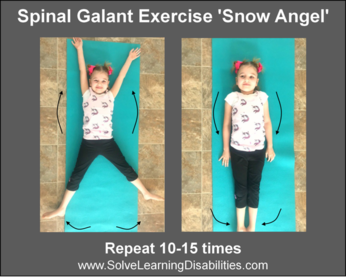
- 6—1. Lie on floor with left arm down at side, left leg straight
2. Head is pointed right, right arm is bent, thumb at nose, right leg is bent
3. Turn head to left
4. Right arm, with palm down, scrapes the floor until it reaches the knee
5. Straighten the right leg, pushing the foot along the floor until the body is straight. Wait 3 seconds
6. Bring left knee up to the left hand
7. With palm to the floor, bring left hand to the nose. Wait 3 seconds
8. Turn head to right
9. Straighten left arm, pushing palm
10. Straighten left leg, pushing foot, wait 3 seconds
11. Bring right knee up to the right hand
12. With palm to the floor, bring right hand to the nose
16. Wait 3 seconds
13. Repeat steps 3-16 two more times
14. Should look like a lizard pushing himself through the sand
MAY HELP WITH:
*Poor Handwriting
* Poor Expression of Ideas on Paper
* Visual-Perceptual Difficulties (reversals of b/d, u/n, saw/was)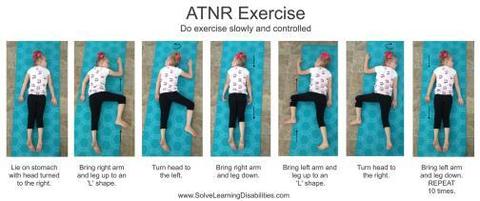
- 7—1. Start from a hands and knees table position, weight on arms, looking up to ceiling
2. Rock back until the head is down looking back between the knees
3. Slowly rock back up to the beginning point. It should be done one for every 2 seconds; complete 30
MAY HELP WITH:
* Poor Posture
* Poor Eye-Hand Coordination
* Tracking Problems
* Convergence Problems
* Near Focusing Problems
* Slow with Copying Tasks
* Attention Difficulties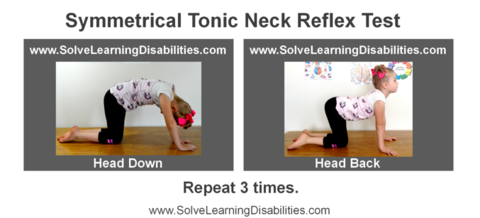
- 8Crossing Sit-Ups (works both hemispheres of the brain)1. Lie on back, with feet on the floor with knees up
2. Do sit-up while crossing the elbow to the opposite knee. Knees are up and feet planted, lift one leg.
3. When elbow is touching opposite knee, eyes are looking at a point across the room.
4. Alternate elbow to knee, completing 30. It takes 2 seconds to do one sit-up
MAY HELP WITH:
*Improved Concentration
* Improved Core Strength
* Faster Processing of Auditory and Visual Information
- 9Primitive ReflexesPrimitive reflexes are the first part of the brain to develop. In typical development, reflexes naturally inhibit in sequential order during the first year, and replacement reflexes called postural reflexes emerge.
Postural reflexes are more mature patterns of response that control balance, coordination, and sensory motor development. - 10What happens when primitive reflexes are retained?Can lead to developmental delays related to disorders like ADHD, sensory processing disorder, autism, and learning disabilities.
Persistence of primitive reflexes contribute to issues such as
- Coordination and Balance
- Sensory Perceptions
- Fine Motor Skills,
- Sleep, and Immunity
- Energy Levels, & Impulse Control
- Difficulty Concentrating
- All Levels of Social, Emotional, and Intellectual Learning.
Información
- Descripción
- Primitive reflexes and exercises to help
- Creado por
- jmarlatt
- Visitas
- 1.433
- Etiquetas
- Valoración