
Fichas
Paediatrics: Neurology and Development (Squint and Amblyopia)
Fichas del conjunto (9)
- 1What is a squint & what are the causes?Squints are common in childhood. They occur with misalignment of the visual axes of the eyes so that they appear to point in different directions. If a squint develops in first 7yrs, it can have a significant impact on visual development.
The causes of squint may be:
* Idiopathic
* Refractive error
* Visual loss
* Ophthalmoplegia (central or peripheral)
OHOP - 2What are the two main types of squint?Concomitant (non-paralytic) squint:
* Common & usually due to a refractive error in one or both eyes
* Often convergent
Non-concomitant (paralytic) squint:
* Rare & usually due to cranial (motor) nerve palsy
* Must exclude an intracranial lesion (eg brain tumour)
OHOP - 3Define convergent, divergent, & latent squints.* Convergent - bad eye turned inwards (cross-eyed appearance)
* Divergent - bad eye turned outwards
* Latent - a squint that is controlled by subconscious effort & is not always apparent. In certain situations, such as fatigue, control is lost & the squint will become ‘manifest’.
OHOP - 4What tests can be used to detect a squint?* Corneal light reflex test - use a pen-torch held at a distance to produce reflections on both corneas simultaneously. The light reflection should appear in the same position in the two pupils. If it does not, a squint is present. Minor squint may be difficult to detect.
* Cover test - when the fixing eye is covered, the squinting eye moves to take up fixation. The test should be performed with the object near (33 cm) & distant (at least 6 m), certain squints are present only at one distance.
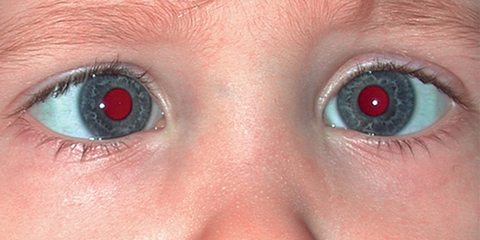
OHOP - 5—Corneal light reflex (reflection) test to detect a squint. The reflection is in a different position in the two eyes because of a small convergent squint of the R eye.
ITOP p61. - 6—The cover test is used to identify a squint. If the fixing eye is covered, the squinting eye moves to take up fixation. This diagram shows a L convergent squint.
ITOP p61.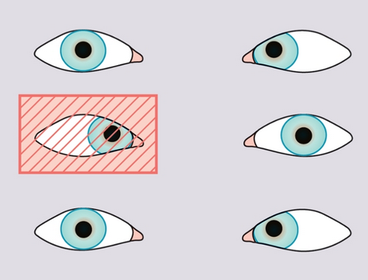
- 7Mx of squints.The aim of Rx is to get the ‘weaker’ squinting eye ‘trained up’ in order to prevent amblyopia. Rx's are usually under supervision of orthoptists in co-operation with ophthalmic surgeons.
* Correct refractive error - wear glasses
* Eye patch wearing on the good eye to ‘train’ weaker eye
* Eye muscle exercises
* Eye (muscle) surgery if large squint and above measures failing
OHOP - 8What is amblyopia & what causes it?Potentially permanent loss of visual acuity in an eye that has not received a clear image. Affects 2–3% of children. Usually affects one eye. Any interference with visual development may cause amblyopia:
* Refractive errors
* Squint
* Visual deprivation eg ptosis or cataract
ITOP p62. - 9Rx of amblyopia.Early Rx is essential as after 7 YO improvement is unlikely.
* Correct refractive error with glasses
* Eye patching - attempt to reverse amblyopia, by covering the better eye to force the ‘lazy eye’ to work
* Eye (muscle) SX
OHOP
Información
- Descripción
- SGUL LOB's for Paediatrics: Neurology and Development (Squint and Amblyopia).
- Creado por
- Andrew Street
- Visitas
- 24
- Valoración