
Flashcards
Definitions SHM and waves
Cards in this deck (57)
- 1Examples of oscillationsa pendulum, a swing, a car going over bumps
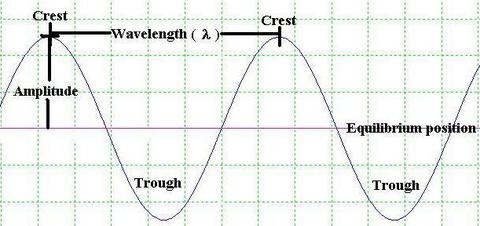
- 2Cycleone cycle is defined as one complete oscillation of the pendulum (A-B-A). (the term cycle is also used to describe circular motion; one cycle is one complete circle or 2pi radians)
- 3Equilibrium positionthe position where the pendulum bob would rest if not disturbed - this is position O
- 4Amplitude (x0)the amplitude is defined as the maximum displacement from the equilibrium position, this is distance OB or OA, (m)
- 5Time period (T)time taken for one complete cycle (seconds)
- 6Frequency (f)number of cycles that the pendulum makes per unit time. this is equal to 1/time period. (s^-1 or hertz (Hz))
- 7Angular frequency (w(curved "w" really...))found by multiplying f by 2pi (w=2pi f). this quantity is normally used when describing circular motion. an angular frequency of 2pi rads s^-1 means that a body makes one revolution per second. however, it is also used to describe an oscillation, 2pi being equivalent to one complete cycle. (s^-1 or Hz)
- 8When stretching a spring, the tension is......proportional to the extension
- 9Simple harmonic motion (SHM)the acceleration is proportional to the distance froma fixed point. the acceleration is always directed towards a fixed point
- 10When calculating cos wt, you must have your calculator set on......radians
- 11Interchange between KE and PE during SHMat the top of the swing the mass (pendulum) has maximum PE and minimum KE. at the bottom of the swing the mass has maximum KE and minimum PE
- 12Total energytotal energy=KE+PE
- 13Potential energypotential energy at any moment = total energy - KE
- 14Light dampingif the opposing forces are small, the result is a gradual loss of total energy. this means that the amplitude of the motion gets slowly less with time.
- 15Critical dampingcritical damping occurs if the resistive force is so big that the system returns to its equilibrium position without passing through it. this would be the case if a mass on a spring were suspended in for example oil
- 16Forced oscillationif a system is forced to oscillate at a frequency other than the natural frequency
- 17Resonanceincrease in amplitude that occurs when an oscillating system is forced to oscillate at its own natural frequency
- 18In phasesame displacement at the same time
- 19Out of phasedifferent displacement at same time
- 20Reflection (of a (water) wave)if a water wave hits a wall, the waves reflect
- 21Refractionchange of direction, waves are bending
- 22Interferencewhen two waves cross each other, they can add together (or cancel out) creating an extra big wave (or result in no wave!)
- 23Diffractionwhen (water) waves pass through a small opening the waves spread out
- 24Also wavesanything that reflects, refracts, interferes and diffracts can also be called a wave
- 25Wave pulse(if a string held between two people is displaced (flicked),) a disturbance can be seen to travel from one end to another
- 26Wave speedthe wave pulse travels with a certain speed, distance travelled by the wave profile per unit time (if a string held between two people is flicked and creates a wave)
- 27Transfer of energyas a string is lifted up, it is given PE. this PE is transferred along the string, and a wave can therefore be thought of as a transfer of energy
- 28Wave properties
- 29Example of transverse waveswave in a string, light. (the direction of disturbance is perpendicular to the direction that the wave profile moves)
- 30Example of longitudinal wavessound, compression wave in a slinky. (the disturbance is parallel to the direction of the wave)
- 31What type of waves can be polarized?only transverse waves. a wave is polarized if the displacemnt is only in one direction
- 32Constructive interferencetwo in phase waves add to give a wave of twice the amplitude
- 33Destructive interferencetwo out of phase waves cancel
- 34Wave poperties, two-dimensional waves
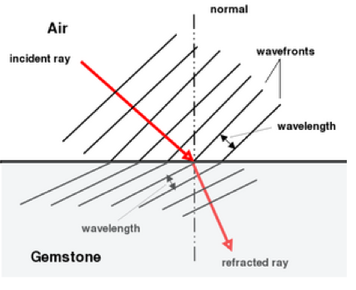
- 35Wavefrontthis is a line joining points that are in phase, straight or circular lines
- 36Raysrays are lines drawn to show the direction of the waves - they are always at right angles to the wavefront
- 37Circular wavefrontsproduced by a point disturbance. the rays are radial, as they are perpendicular to the wavefronts. (for example a waterdrop landing in a pool of water - point disturbance)
- 38Plane wavefrontproduced by an extended disturbance, for example a long piece of wood dipped into the water, or a point that is so far away that the circles it produces look like straight lines
- 39Reflectionwhen a wave hits a barrier, it is reflected. note that the reflected wave appears to originate from somewhere on the other side of the barrier, same as when looking at yourself in a mirror
- 40The laws of reflectiondescribes how waves are reflected of barriers. ~the angle of incidence = the angle of reflection. ~the incident and reflected rays are in the same plane as the normal
- 41Transmitted part of a wavethe part of the wave that passes through a medium; not reflected
- 42Refractionthe change of direction when a wave passes from one medium to another
- 43Snell's lawsin i(ncident)/sin r(efracted)=v1/v2
- 44Refractive indexthe ratio of the velocity of light in the two medias, found by using Snell's law. if the refractive index is large then the light is refracted by a large angle
- 45Refractive index of water, glass and diamondwater - 1,33. glass - 1,50. diamond - 2,42
- 46Diffractiontakes place when a wave passes through a small opening. if the opening is very small, then the wave behaves just like a point source
- 47Phase angleif the waves are completely out of phase then phase angle = pi. if not completely out of phase, the phase angle can be calculated from the path difference (d). phase angle (strange "t"-looking symbol)=2pid/lambda (wavelength)
- 48Standing (stationary) waveif a continuous wave is sent along a rope, the original and reflected wave superpose to produce a wave where the peaks simply move up and down but don't progress along the rope. occurs whenever two identical waves travelling at opposite directions superpose. the wave profile doesn't progress
- 49Antinodethe opposite of a node... maximum amplitude, 2A since two waves add together
- 50Nodethe opposite of an antinode... minimum displacement, A=0
- 51Differences between progressive waves and standing waves~the wave profile of a standing wave doesn't progress. ~all points in between teo nodes on a standing wave are in phase whereas points in a progressive wave that are closer than one wavelength are all out of phase. ~all points on a progressive wave have the same amplitude, but on a standing wave some points have zero amplitude (nodes) and some points have large amplitude (antinodes)
- 52Formula for calculating frequency for a standing wave (with nodes as ends)f=v/lambda
- 53Calculating wave speed (v) in a stringv= (square root of) T/u.
T= tension, u (greek letter "miu"(??)) =mass per unit length - 54Sound wavea propagation of disturbance in air pressure. the change in air pressure causes the air to move backwards and forwards in the direction of the propagation
- 55When a standing wave is formed in a closed pipe, only _____ harmonics are formedodd
- 56A standing wave in an open pipe will have ___________ at both endsantinodes
- 57The Doppler effect"eeeeeeeeeeeeoowwwwwww" sound, the sound on approach is a higher frequency than on retreat. can occur when the source of the sound is moving or when the observer is moving, or when both is moving
Information
- Description
- Simple harmonic motion and waves
- Created by
- Moa Lindström
- Views
- 133
- Tags
- Rating