
Flashcards
AD-AS Model
Cards in this deck (61)
- 1Aggregate Demand DefinitionAD is the total level of expenditure on domestically produced goods and services by households, firms, governments, and foreigns at each general price level for a given period of time
AD = C + I + G + X - M - 2Aggregate Demand 2 Factors of AD Consumption Expenditure (C)Consumption expenditure is spending by households on goods and services to satisfy current wants.
Induced consumption is the amount of consumption that changes when income changes. It is consumption that is directly influenced by level of income. (Movement along AD) - 3Aggregate Demand 2 Factors of AD Consumption Expenditure (C) 2 Induced consumptionInduced consumption is the amount of consumption that changes when income changes. It is consumption that is directly influenced by level of income. (Movement along AD)
- 4Aggregate Demand 2 Factors of AD Consumption Expenditure (C) 3 Autonomous consumptionAutonomous consumption refers to consumption that is independent of the level of income. (Shift in AD curve)
- 5Aggregate Demand 2 Factors of AD Consumption Expenditure (C) 3 Autonomous consumption Households' disposable incomeHouseholds' disposable income refers to the income that households have available for spending after deducting income tax, insurance etc
- 6Aggregate Demand 2 Factors of AD Consumption Expenditure (C) 3 Autonomous consumption 2 Households' disposable incomeFiscal Policy: If government increases personal income tax, households would have to pay more taxes and have less income for spending. AC falls, decrease in AD, ceteris paribus. This is shown by a leftward shift of the AD curve
- 7Aggregate Demand 2 Factors of AD Consumption Expenditure (C) 3 Autonomous consumption 2 Expectations of Future IncomesConsumers' optimism and pessimism with regard to their expectations of the future economic outlook will affect their ability and willingness to spend.
- 8Aggregate Demand 2 Factors of AD Consumption Expenditure (C) 3 Autonomous consumption 2 Expectations of Future Incomes 2If consumers expect rising future incomes, there is a tendency to increase consumption now. Anticipation of rising incomes makes individuals feel richer and encourage greater consumption. BUT
unbridled optimism -> irrational exuberance -> excessive spending -> inflation - 9Aggregate Demand 2 Factors of AD Consumption Expenditure (C) 3 Autonomous consumption 2 Expectations of Future Incomes 3If incomes expected to be stagnant in the future, people reduce consumption and raise savings. For economics in recession. "Paradox of Thrift" - when consumers save, it will lead to a contraction of the circular flow and hence NY.
- 10Aggregate Demand 2 Factors of AD Consumption Expenditure (C) 3 Autonomous consumption 3 WealthWealth owned include real assets like houses, jewellery, stocks and shares. If value appreciates, we feel wealthier. The more wealth that households have accumulated and the more they will spend and the less they will get out of any level of that incomd
- 11Aggregate Demand 2 Factors of AD Consumption Expenditure (C) 3 Autonomous consumption 3 Wealth 2A person's wealth might be suddenly doubled due to stock market booms and prices. The wealth effect from these windfall gain is likely to cause him to feel rich and hence will splurge at the place
- 12Aggregate Demand 2 Factors of AD Consumption Expenditure (C) 3 Autonomous consumption 4 Consumer credit and interest ratesCredit represents loans or borrowed funds. In reality, consumption can be financed from borrowed funds. Credit or borrowed funs are an important source of PP
- 13Aggregate Demand 2 Factors of AD Consumption Expenditure (C) 3 Autonomous consumption 4 Consumer credit and interest rates 2The main source of credit are banks and financial institutions. Thus, consumption is likely to rise of its cheap and easy to borrow from the banks. For eg, low interest rates can encourage people to purchase properties and cars, increasing consumer expenditure
- 14Aggregate Demand 2 Factors of AD 2 Investment Expenditure (I)Investment expenditure is spending by businesses or firms on new physical capital goods eg offices, factories, which are required for producing the output. Investment is a form of capital accumulation. Investment goods are meant to build up productive capacity, raise productivity and hence contribute to economic growth.
- 15Aggregate Demand 2 Factors of AD 2 Investment Expenditure (I) 2 Types of Investments Business Investment ExpenditureInventories refer to stocks of unsold finished goods and semi-finished goods. Investment in inventories or stocks.
Inventory levels can provide useful output decisions for companies to restock or destock. - 16Aggregate Demand 2 Factors of AD 2 Investment Expenditure (I) 2 Types of Investments Business Investment Expenditure 2Fixed domestic capital formation or investment in plant and equipment. Such fixed capital can be used over and over again to provide goods and services
- 17Aggregate Demand 2 Factors of AD 2 Investment Expenditure (I) 2 Types of Investments 2 Investment by households on new homesInvestment in residential construction (new housing). Addition of homes basically cos got ppl buying
- 18Aggregate Demand 2 Factors of AD 2 Investment Expenditure (I) 2 Types of Investments 3 Foreign Direct InvestmentFDI are foreign firm's fixed capital when they build plants in another economy. FDIs add on to the investment of the economy where the plants are built eg MNCs setting up regional headquarters in Singapore.
- 19Aggregate Demand 2 Factors of AD 2 Investment Expenditure (I) 3 Factors affecting Investment Interest RatesFirms might not have sufficient funds on hand to invest and most will borrow funds from financial institutions. The interest rate represents the cost of borrowing the funds to invest. It is profitable to invest if the MEI or expected rate of return is above market IR for loans
- 20Aggregate Demand 2 Factors of AD 2 Investment Expenditure (I) 3 Factors affecting Investment Interest Rates 2If interest rates fall, the cost of borrowing for firms will reduce and if MEI is higher than cost of borrowing, there is greater incentive for firms to invest, leading to an increase in investment.
- 21Aggregate Demand 2 Factors of AD 2 Investment Expenditure (I) 3 Factors affecting Investment 2 Business expectationsIf interest rate remain unchanged, the level of I may increase if businesses become more optimistic of the future economic outlook. Conversely, if business outlook is bleak, the expected returns will fall and level of I will fall.
- 22Aggregate Demand 2 Factors of AD 2 Investment Expenditure (I) 3 Factors affecting Investment 3 Corporate TaxIf there is an increase in corporate taxes, it reduces the MEI. AD decreases and shifts leftwards.
If corporate tax decreases, there will be an increase in after-tax profits, which increases the MEI. Ad shifts to the right. - 23Aggregate Demand 2 Factors of AD 2 Investment Expenditure (I) 3 Factors affecting Investment 4 Innovation and TechnologyNew technology and innovation help businesses save costs and improve quality of their products. As such, their profits should increase, causing MEI to increase and stimulate a demand for additional capital goods. There would then be an increase in demand for capital goods at any given interest rate.
- 24Aggregate Demand 2 Factors of AD 2 Investment Expenditure (I) 3 Factors affecting Investment 5 Cost of new capital goods Absolute costsIf cost of new equipment increases, the firms might revise downwards their MEI, as higher costs of paying for capital goods will reduce profit margins
- 25Aggregate Demand 2 Factors of AD 2 Investment Expenditure (I) 3 Factors affecting Investment 5 Cost of new capital goods 2 Relative costsIf there is a fall in the relative costs of capital goods, investment goods become relatively cheaper. Labour-saving investment increases. Firms decide to switch to using more machines to replace workers to cut costs, boost profits. I increase.
- 26Aggregate Demand 2 Factors of AD 3 Government Expenditure (G)• Government spending on recurrent expenditure (salaries of civil servants and operating costs of government services)
• Government spending on social capital or infrastructure. - 27Aggregate Demand 2 Factors of AD 3 Government Expenditure (G) 2 Factors Affecting Government Expenditure State BudgetThe state budget, subjected to influence of economic as well as socio-political objectives.
- 28Aggregate Demand 2 Factors of AD 3 Government Expenditure (G) 2 Factors Affecting Government Expenditure 2 Fiscal Policy, SS policiesMore public spending, the more it is injecting expenditure into the circular flow. AD increases.
- 29Aggregate Demand 2 Factors of AD 3 Net exports (X-M)Autonomous EXPORT revenue: Amount of export depends on spending decisions of foreign households.
Induced IMPORT expenditure: Import is dependent on income level of domestic consumers - 30Aggregate Demand 2 Factors of AD 3 Net exports (X-M) 2 Factors affecting Export Earnings (X)• Relative price levels (Rising export prices due to domestic costs)
• Exchange Rate (Fall in exchange rate, country's export become cheaper)
• Quality and branding - 31Aggregate Demand 2 Factors of AD 3 Net exports (X-M) 3 Factors affecting Import Earnings (M)A country's expenditure is based on its income. Affluence will result in higher demand for imported consumer goods such as luxury bags, cars etc
- 32Multiplier Effect DefinitionThe multiplier is defined as the number of times national income or output will expand as a result of an initial injection of autonomous expenditure
- 33Multiplier Effect 2 FormulaFinal Change in national income
=
Multiplier X Initiai injection of autonomous expenditure - 34Multiplier Effect 3 Marginal Propensity to ConsumeMPC
=
(Change in consumption)/(Change in Y)
MPC measures the proportion of the additional income that is spent on consumption. - 35Multiplier Effect 4 Succinct explanationAn injection or autonomous increase in expenditure (I or G) will generate income for individuals employed by firms in the capital goods industry. These individuals will spend a proportion of the additional income on consumption, depending on their MPC, and the rest will be withdrawn as as S, T, I.
- 36Multiplier Effect 4 Succinct explanation 2This spending further creates income for individuals employed in the consumer goods industry who will further spend their additional income on consumption. This cycle of spending and re-spending on consumption will continue until the increase in income becomes negligible and the change in withdrawals is equal to the change in injections.
- 37Multiplier Effect 4 Succinct explanation 3The eventual increase in national income is several times the initial increase in expenditure. The multiplier, k, represents how many times the national income increases with respect to initial change in expenditure.
- 38Multiplier Effect 5 Size of multiplierk = 1 / (1 - MPC)
- 39Multiplier Effect 6 Factors affecting multiplier size Determinants of Marginal Propensity to Save Social security in the countryHigher MPS: Government encourages savings Eg CPF in Singapore
Lower MPS: Western-developed countries have better and more generous social security schemes for their citizens. They are less worried about saving up for a rainy day and are more spend-thrift. - 40Multiplier Effect 6 Factors affecting multiplier size Determinants of Marginal Propensity to Save 2 Attitudes towards thrift in societyIt's in the title
- 41Multiplier Effect 6 Factors affecting multiplier size Determinants of Marginal Propensity to Save 3 Level of interest ratesHigher MPS: High interest rates. When the opportunity cost of consumption is higher than before, consumers may be more willing to save when they receive additional income
Lower MPS: Low interest rates. - 42Multiplier Effect 6 Factors affecting multiplier size Determinants of Marginal Propensity to Save 4 Level of IncomeHigher MPS: Richer people as more money is left after purchasing basic necessities. Or when a society becomes more affluent.
Lower MPS: Poor as basic necessities have to be purchased before there is any income left for saving - 43Multiplier Effect 6 Factors affecting multiplier size Determinants of Marginal Propensity to Tax Progressiveness of Tax SystemHigher the progressivity of the tax system, the greater the leakages, the smaller the k
- 44Multiplier Effect 6 Factors affecting multiplier size Determinants of Marginal Propensity to Tax 2 Extent of government benefits and transfer paymentsWelfare states have a higher MPT as large amount of tax revenue has to be collected to finance welfare benefits. Greater leakages, smaller k
- 45Multiplier Effect 6 Factors affecting multiplier size Determinants of Marginal Propensity to Import• Attitude towards foreign imports
• Openness of economy Eg Singapore has high MPM due to high dependency on imports - 46Aggregate SupplyAS shows the total output of goods and services that domestic firms would like to produce and sell at each general price level for a given period of time.
- 47Aggregate Supply 2 SRAS Changes in cost of productionA change in factor input prices would shift the upward sloping range of SRAS. If wages increases, it becomes more costly for firms to produce each unit of good or service. Hence, SRAS falls and shifts to the left from SRAS0 to SRAS1. Firms in aggregate are only willing and able to sell at a lower quantity of real national output at every GPL. OR cost-push inflation
- 48Aggregate Supply 2 SRAS 2 Supply ShocksA temporary supply shock causes an unanticipated shift in SRAS. Bumper harvests increases SRAS while natural disasters cause SRAS to decrease. After the temporary effects of harvests and disasters have been felt, there is not substantial damage to productive capacity.
- 49Aggregate Supply 3 LRAS Changes in productive capacityVertical range of AS will shift rightwards from AS0 to AS1 whenever productive capacity of the economy grows and expands over time. The corresponding level of full employment real national output also increases from Yfo to Yf1.
- 50Aggregate Supply 3 LRAS Changes in productive capacity Changes in quantity of available resources Size of labour forceLabour represents human resources that are needed in production. The increase in potential output is partly determined by the rate of growth of labour force over time. (from natural birth or foreign labour)
- 51Aggregate Supply 3 LRAS Changes in productive capacity Changes in quantity of available resources 2 Land and natural resourcesLand represents the geographical space as well as non-human natural resources needed in production. Discovery of new natural resources such as oil reserves, mineral deposits or fishing grounds could expand the productive capacity of the economy and fuel growth
- 52Aggregate Supply 3 LRAS Changes in productive capacity Changes in quantity of available resources 3 Investment in private capital stockPhysical capital is a man-made resource needed in production. Investing in capital improves quantity of capital stock such as factories and machinery.
- 53Aggregate Supply 3 LRAS Changes in productive capacity Changes in quantity of available resources 4 Investment in infrastructure or social capitalThe government can also increase the nation's productive capacity through investments in various forms of physical infrastructure such as transportation networks as well as telecommunication networks to support economic activity. Increases social capital
- 54Aggregate Supply 3 LRAS Changes in productive capacity Changes in productivity of available resources Investment in human capitalHuman capital refers to the skills and capability of the workforce. Education, skills training and upgrading. It raises the productivity of the workforce and can add more value to what they produce. Hence, productive capacity expands.
- 55Aggregate Supply 3 LRAS Changes in productive capacity Changes in productivity of available resources 2 Improvement in technologyNew technology enables production to be carried out more efficiently with the use of automation; robotics and computers. Improvements in communication technologies also reduce costs and increase productive capacity for business
- 56Aggregate Supply 3 LRAS Changes in productive capacity Changes in productivity of available resources 3 EntrepreneurshipDriven by calibre of its entrepreneurs. Entrepreneurs are the driving force behind production.
- 57—

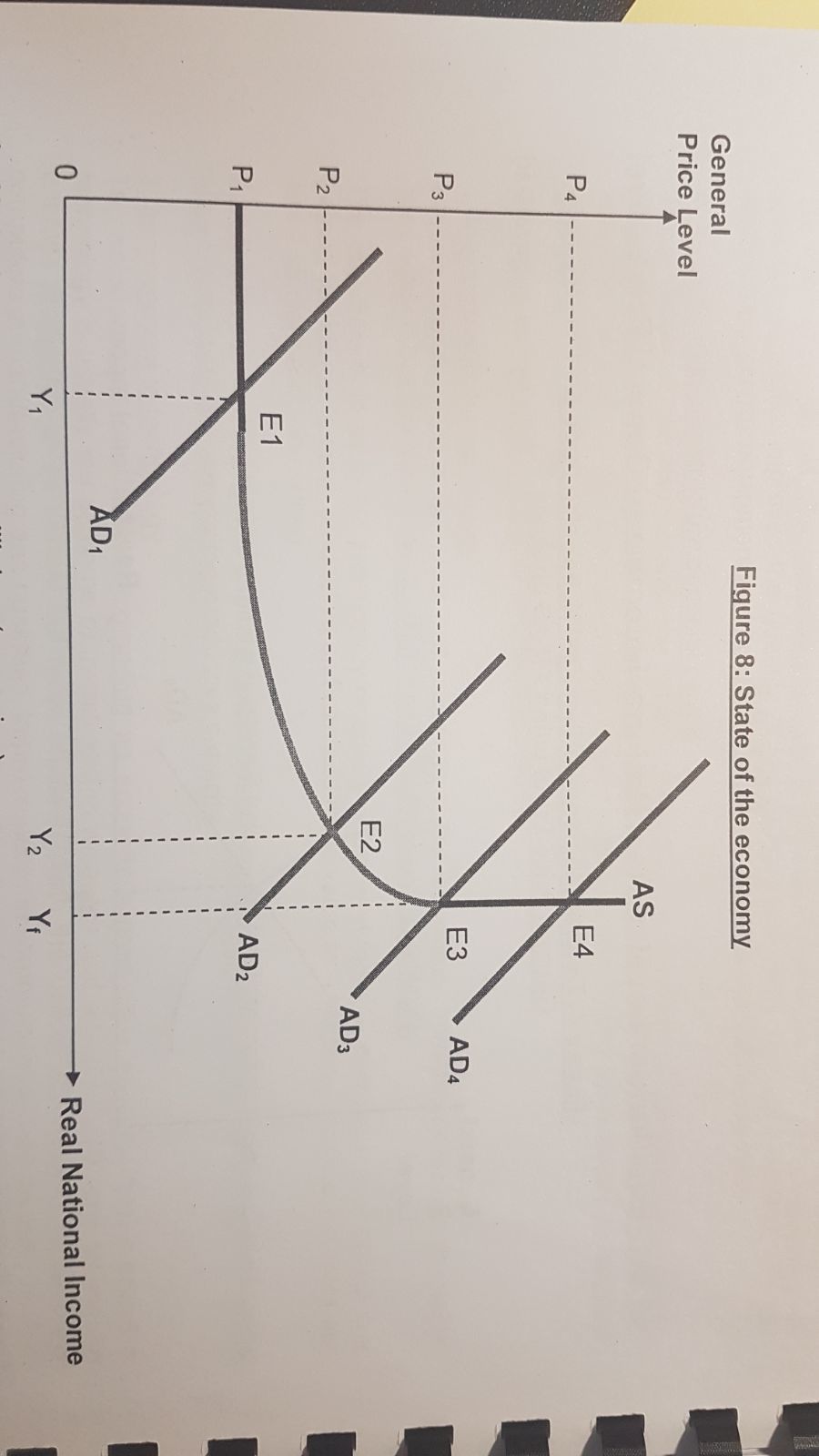
- 58E1: Under full-employment equilibrium (Recession)There is excess capacity since the economy is operating far below its potential capacity output Yf. Output is below full employment as AD is too weak. Unemployment is also a major problem.
- 59E2: Near full-employment equilibriumSpare capacity is limited. As AD increases from AD2 to AD3, the increase in AD for G&S outpaces the increase in real national output to meet this AD, putting inflationary pressures on the economy. Firms bid higher for scarce resources available.
- 60E3: At full-employment equilibriumAt this real national output level, full employment is achieved, with no cyclical unemployment
- 61E4: Over full-employment equilibriumReal national output cannot be expanded as the economy has reached its maximum productive capacity. An increase in AD from AD3 to AD4 is simply an increase in GPL from P3 to P4 without increase in real national output. Demand-pull inflation.
Information
- Description
- Economics 101 Flashcards on AD-AS Model, created by Ryan Kang on 20/09/2017.
- Created by
- Ryan Kang
- Views
- 0
- Rating