
Flashcards
Anatomy Practicals
Cards in this deck (44)
- 1What are exocrine glands?Ductless glands that secrete products into the bloodstream or to local surrounding tissue
- 2What is endocrine disease?Over-secretion, under-secretion or failure to respond (due to a malfunction in a receptor recognition mechanism)
- 3Define 'de novo'Product not produced from a precursor molecule (newly formed)
- 4What do endocrine glands rely on, in order to be effective?-Vascular system
-good blood supply
-glucose for energy to fuel protein/steroid production - 5How is release from endocrine glands regulated?-By signals in the blood
-Most are other hormones (releasing/inhibitory factors) - 6What tissue co-ordinates endocrine function?Hypothalamus
-Integrates the endocrine and autonomic nervous system
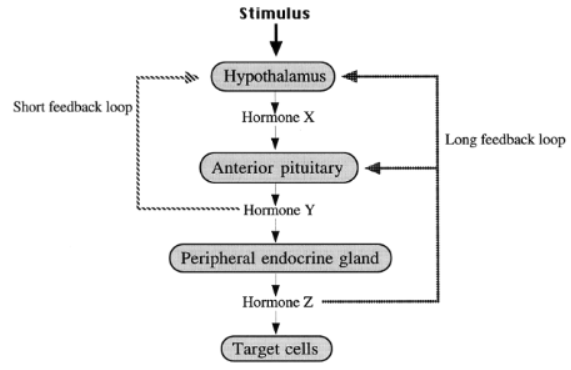
-regulates the pituitary gland - 7What pathway occurs from stimulus to response from a target cell?
- 8Products secreted by: -pineal gland -pituitary gland -thymus-Melatonin
-FSH, GH, LH, Prolactin, TSH, ACTH
-T cells - 9Products secreted by: -thyroid gland -adrenal gland -pancreas-T3/T4
-Adrenaline, steroids, aldosterone, cortisol
-Glucagon, insulin, somastostatin - 10Products secreted by: -ovary -testes-Oestrogen, androgen, progesterone
-Testosterone - 11Purpose of; -T3/4 -Calcitonin?Controls basal metabolic rate in body cells
Decreases blood Ca2+ levels (by suppressing breakdown of bone, inhibiting tubular reabsorption of calcium-more lost in urine). Opposes PTH in bone. - 12Where are the parathyroid glands? How many are there? Are they palpable?Located on the posterior side of the thyroid.
4- 2 superior and 2 inferior.
No unless they are swollen/enlarged. - 13What is secreted by the parathyroid glands? Function? Target tissues?PTH- regulates blood calcium levels
-Osteoclast activity increases, releasing Ca2+ from bones
-Stimulates Ca2+ reabsorption in the distal convoluted tubules of renal cortex
-Stimulates Ca2+ adsorption in small intestine by stimulating vitamin D activation - 14What can excess PTH do?Demineralisation of bones
-leads to osteoporosis
-kidney stones (excess Ca2+ in urine) - 15Where is the adrenal gland located?Upper pole of each kidney.
-Joined by fatty connective tissue
Between T11/12 - 16Describe the vascular supply of the adrenal glandsSuperior, middle and inferior suprarenal arteries
-arise from inferior phrenic artery, abdominal aorta and renal artery respectively. - 17Where is cortisol produced? Functions?Zona fasciculata
Stimulates gluconeogenesis in cells and glycogenesis in the liver
Suppresses immune functions
Induce fat mobilisation and muscle proteolysis - 18Where is aldosterone produced? FunctionsZona glomerulosa
Regulates salt balance
Stimulates Na+ reabsorption - 19Where are androgens produced? FunctionsZona reticularis
Group of sex hormones that control sex traits, development and sexual behaviour
Trigger growth of male reproductive system
Influence male/female sex drive - 20How is secretion from the adrenal medulla controlled?Sympathetic nervous system
- 21What is the venous drainage of the pancreas?Venous blood enters the inferior surface of the liver through the hepatic portal vein.
- 22Are endocrine products stored or released immediately?-Majority store their product until required in secretory granules with a highly concentrated form of the protein
-The thyroid gland stores its products in the colloid
-For steroid-secreting cells, the precursor cholesterol is stored in the cell - 23How is the thyroid gland an unique endocrine gland?-Only one to store its product extracellularly
-Thyrocytes secrete thyroglobulin at the apical membrane (into colloid) where it is iodinated - 24What cells are present in the thyroid?Thyrocytes- produce T3/4
Parafollicular (C) cells- produce calcitonin - 25What calls in the parathyroid secrete PTH?Chief cells
- 26What cells are present in the Islet of Langerhans and what do they produce? What other cells are present in the pancreas?Alpha- secrete glucagon
Beta- secrete insulin
Delta- secrete somatostatin
PP cells- secrete pancreatic peptide - 27Describe the adrenal gland layers (from most superficial) and what they produce1) Zona glomerulosa- Aldosterone
2) Zona fasciculata- Glucocorticoids eg. cortisol
3) Zona reticularis- Androgens eg. DHEA
4) Adrenal medulla- adrenaline/noradrenaline - 28Function of aldosterone-Regulates salt balance
-Stimulates sodium absorption and potassium excretion in the distal convoluted tubule of the kidney - 29Functions of cortisol-Stimulates gluconeogenesis in cells
-Stimulates glycogen break down in liver
-Suppresses immune function
-Induces fat metabolism/ muscle proteolysis if needed - 30Developmental origin of cells in adrenal medulla?Neural crest cells
- 31Type of cells in adrenal medulla? What are they innervated by?Chromaffin cells
Directly innervated by the splanchnic nerve (pre-ganglionic nerve) but it doesn't contain any postganglionic neural cells. Part of synpathetic nervous system - 32Cell types in anterior pituitary and what they produceSomatotrophs- somatotropin/GH
-Lactotrophs/mammotrophs- prolactin
-Gonadotrophs- FSH, LH and ICSH (males only)
-Thyrotrophs- TSH
-Corticotrophs- ACTH - 33What is contained in the posterior pituitary? What hormones does it produce?Unemyelinated axons of secretory neurones (cell bodies in hypothalamus)
ADH is produced in the supraoptic and oxytocin in the paraventricular nuclei of the hypothalamus and stored in the posterior pituitary - 34What are APUD cells?-Amine Precursor Uptake and Decarboxylation cells.
-They absorb amine precursors and produce active amines through intracellular decarboxylation
-Product is stored in secretory vesicles
-Found in: hypothalamus, hypophysis, para/thyroid, lungs, GIT and pancreas - 35Function of pineal gland? Where is it?-Contains pinealocytes which secrete melatonin
-Melatonin regulates the circadian rhythm of the body
-It is located midline between the 2 cerebral hemispheres just above the cerebellum - 36Which hormones produced form axons of the hypothalamus are transported to the anterior pituitary gland by the portal vessels?-GRH
-CRH
-GHRH
-TRH - 37Anatomical relations of the pituitary gland-Its in sella turcica of sphenoid bone
-Surrounded anteriorly, inferiorly and posteriorly by the sphenoid bone
-Dura surrounds it laterally and superiorly
-Optic chiasm is superior
-Lateral is the cavernous sinus
-Anterior is the sphenoid sinus (pituitary is accessed through here in transsphenoidal surgery) - 38Arterial supply of pituitary glandAnterior: superior hypophyseal artery
Posterior: superior/inferior hypophyseal artery, infundibular artery - 39Venour supply of pituitary glandShare the anterior and posterior hypophyseal veins
- 40Function of oxytocin?-Stimulates lactation
-Stimulates uterine smooth muscle contraction during labour
-Establishes maternal behaviour - 41Function of ADH?-Binds to receptors on kidney cells in the nephrons and promotes reabsorption of water back into circulation
-Also constricts arterioles increasing arterial bp. - 42Where is the sella turcica? Is it visible with medical imaging?On the superior surface of the sphenoid bone.
Not with MRI but visible with X-rays/CT - 43Define: acute chronicShort duration, rapid progression, urgent care
Long duration eg. >3 months - 44What visual symptoms may occur with a pituitary tumour?Bitemporal hermianopia (partial blindness where vision is lost in outer half of the eyes)
This is due to the tumour compressing on the optic chiasm causing a lesion
Information
- Description
- Topography of the Endocrine gland Histology of the Endocrine gland Topography of the Hypothalamus and Pituitary gland
- Created by
- Dolu Falowo
- Views
- 6
- Rating