
1099973
Description

Flashcards by Kristi Brogden, updated more than 1 year ago

|
Created by Kristi Brogden
about 12 years ago
|
|
| Question | Answer |
| What are nuclear chromosomes composed of? | A linear DNA molecule and proteins that confer many specialised functions |
| What are some of the functions conferred by the proteins? | Packaging and unfolding DNA within the nucleus |
| What are some of the functions conferred by the proteins? | Controlling: DNA replication DNA repair Genetic recombination |
| What are some of the functions conferred by the proteins? | Maintaining chromosome integrity by preventing loss of end sequences |
| What are some of the functions conferred by the proteins? | Governing chromosome segregation during cell division |
| What are some of the functions conferred by the proteins? | Regulating gene expression |
| What is the organised representation of all the chromosomes in a cell at metaphase called? | Its Karyotype |
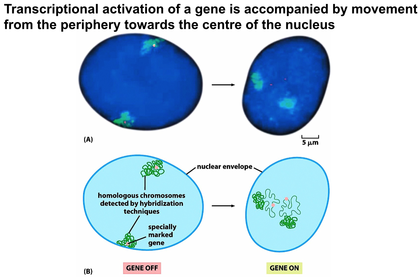
| What is the nucleus periphery composed of in interphase cells | Transcriptionally inactive DNA |
| What happens when a gene is transcriptionally activated? | |
| What is the structure of the 30nm chromatin fibre? | A supercoiled array of nucleosomes |
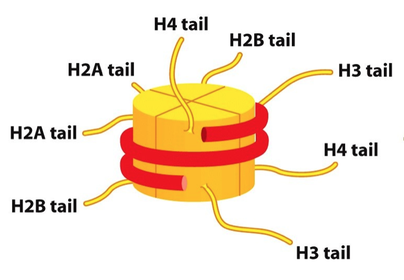
| What is the structure of a nucleosome? | |
| What are the protein subunits of the nucleosome? | Core histones. The N-terminal tails of the 8 core histone subunits project out from the nucleosome core |
| What is the purpose of the N-terminal tails? | They are free to interact with other proteins, facilitating regulation of chromatin structure and function. |
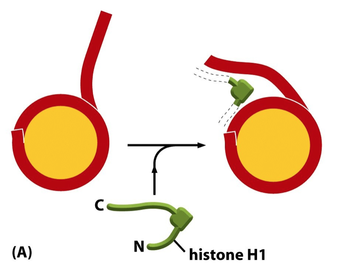
| What is an example of a linker histone? | |
| What is the purpose of linker histones? | They strap onto histone octamers and limit movement of DNA relative to it. This stabilises the formation of the 30nm Fibre |
| What are the advantages of DNA being packaged into chromatin? | It is compact, flexible and can be remodelled to accommodate protein complexes involved in gene transcription and DNA replication. |
| What are the advantages of DNA being packaged into chromatin? | Chromatin is engineered to permit flexible responses to altered transcription factor activity caused by changes in cell differentiation status and changes in environmental signals. |
| What specialised DNA sequences do chromosomes contain? | Telomere Replication origin Centromere |
| What are telomeres? | DNA sequences at ends of linear chromosomes that maintain chromosomal integrity. |
| What is a replication origin? | A DNA sequence where DNA replication is initiated |
| What is a centromere? | DNA sequence on which kinetochore assembles and mediates chromosome segregation at mitosis and meiosis |
| What is a kinetochore? | A protein complex that binds microtubules in the mitotic spindle |
| How are telomeres replicated? | By a specialised DNA polymerase called telomerase |
| What do kinetochore inner plate proteins bind to? | Alpha-satellite DNA repeats |
| What do kinetochore outer plate proteins bind to? | Protein components of mitotic spindle i.e. microtubules |
| How much of the DNA sequence of eukaryotic genomes encodes information for making cellular proteins? | 1.5% |
| How much of the human genome is made up of repeated DNA sequence elements? What are they? | 50% Most of the elements are copies of retrotransposons known as 'parasitic DNA' |
| What is different in the genomes of more complex organisms? | They have more protein coding genes and more non-protein-coding DNA |
| What are transposons? | Mobile genetic elements that jump around the genome |
| Name the three types of transposons in the human genome | DNA transposons Retroviral retrotransposons Non-retroviral polyA retrotransposons |
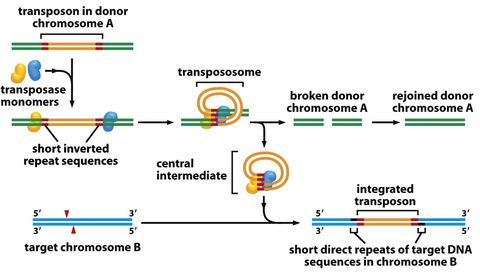
| How do some DNA transposons move? | |
| What is the mechanism on the previous slide called and what does it require? | Cut and paste mechanism. Requires transposon-encoded enzyme transposase. |
| How do retroviruses such as HIV replicate? | Via RNA intermediates, producing new DNA copies of the retrovirus that integrate at new genomic locations |
| What does this mechanism require? | Self-encoded reverse transcriptase |
| How do non-retroviral polyA retrotransposons replicate? | Via an intermediate using retrotransposon-encoded reverse transcriptase |
| How are L1 insertions known to cause human disease? | Some L1 insertions are known to disrupt genes and cause human disease e.g Haemophilia |
Want to create your own Flashcards for free with GoConqr? Learn more.