
Flashcards
F3 - Introduction
Cards in this deck (45)
- 1Financial accountingconcerned with the production of financial statements for external users. These are a report on the directors' stewardship of the funds entrusted to them by the shareholders
- 2Why is this important for investors?Investors need to be able to choose which companies to invest in and compare their investments.
In order to facilitate comparison, financial accounts are prepared using accepted accounting conventions and standards. - 3What standards help to reduce the differences in the way that companies draw up their financial statements in different countries.International Accounting Standards (IAS® Standards) and International Financial Reporting Standards (IFRS® Standards)
- 4Are financial documents private or public?The financial statements are public documents, and therefore they will not reveal details about, for example, individual products' profitability.
- 5Management accoutnantManagement require much more detailed and up-to-date information in order to control the business and plan for the future. They need to be able to cost-out products and production methods, assess profitability and so on.
- 6How is management accounts presented?In order to facilitate this, management accounts present information in any way which may be useful to management, for example by operating unit or product line.
- 7What is the four things management account is useful for?formulating strategy
planning and controlling activities
decision making
optimising the use of resources. - 8Uses of financial statementsInvestors
Employees
Lenders
Government agencies
Suppliers
Customers
The public - 9A sole traderThis is the simplest form of business where a business is owned and operated by one individual, although they might employ any number of people. With this form of entity there is no legal distinction between the owner and the business. To this end the owner receives all of the profits of the business but has unlimited liability for all the losses and debts of the business.
- 10PartnershipSimilar to a sole trader the owners of a partnership receive all the profits and have unlimited liability for the losses and debts of the business. The key distinction is that there are at least two owners. The joint owners, or partners, are jointly and severally liable for the losses the business makes (i.e. they are each fully liable in respect of all business liabilities).
- 11Limited liability companiesUnlike sole traders and partnerships, limited liability companies are established as separate legal entities to their owners. This is achieved through the process of incorporation. The owners of the company (the shareholders) invest capital in the business in return for a shareholding that entitles them to a share of the residual assets of the business (i.e. what is left when the company is wound up or liquidated). The shareholders are not personally liable for the debts of the company and whilst they may lose their investment if the company becomes insolvent they will not have to pay the outstanding debts of the company if such a circumstance arises. Likewise, the company is not affected by the insolvency (or death) of individual shareholders. Limited liability companies are managed by a board of directors who are elected by the shareholders
- 12Conceptual Framework for Financial ReportingThe framework presents the main ideas, concepts and principles upon which all International Financial Reporting Standards, and therefore financial statements, are based.
- 13The objective of financial reportingThe main objective is to provide financial information about the reporting entity to users of the financial statements that is useful in making decisions about providing resources to the entity, as well as other financial decisions.
- 14Should financial reports be fair?YES
In order to provide useful information to the stakeholders of a business the financial statements must fairly present the position and performance of that business (or show a 'true and fair view'). - 15Qualitative characteristicsFundamental qualitative characteristics
Enhancing qualitative characteristics - 16Fundamental qualitative characteristicsRelevance
Faithful representation - 17Enhancing qualitative characteristicsComparability
Verifiability
Timeliness
Understandability - 18Fundamental qualitative characteristicRelevance
- 19Qualities of relevancePredictive value enables users to evaluate or assess past, present or future events.
Confirmatory value helps users to confirm or correct past evaluations and assessments. - 20Making ChoicesWhere choices have to be made between mutually exclusive options, the option selected should be the one that results in the relevance of the information being maximised – in other words, the one that would be of most use in taking economic decisions.
- 21A threshold quality is:One that needs to be studied before considering the other qualities of that information
a cut-off point – if any information does not pass the test of the threshold quality, it is not material and does not need to be considered further.
information is material if its omission or misstatement could influence the economic decisions of users taken on the basis of the financial statements. - 22Faithful representationIf information is to represent faithfully the transactions and other events that it purports to represent, they must be accounted for and presented in accordance with their substance and economic reality and not merely their legal form. This is known as ‘substance over form'.
- 23To be a perfectly faithful representation, financial information would possess the following characteristics:Completeness
Neutrality
Free from error - 24CompletenessTo be understandable information must contain all the necessary descriptions and explanations.
- 25NeutralityInformation must be neutral, i.e. free from bias
- 26Free from errorInformation must be free from error within the bounds of materiality. A material error or an omission can cause the financial statements to be false or misleading and thus unreliable and deficient in terms of their relevance
- 27Enhancing qualitative characteristicsComparability,
verifiability,
timeliness
understandability
qualitative characteristics that enhance the usefulness of information that is relevant and faithfully represented. - 28The elements of the financial statementsAssets
Liabilities
Equity
Income
Expenses - 29What is equityThis is the 'residual interest' in a business and represents what is left when the business is wound up, all the assets sold and all the outstanding liabilities paid. It is effectively what is paid back to the owners (shareholders) when the business ceases to trade.
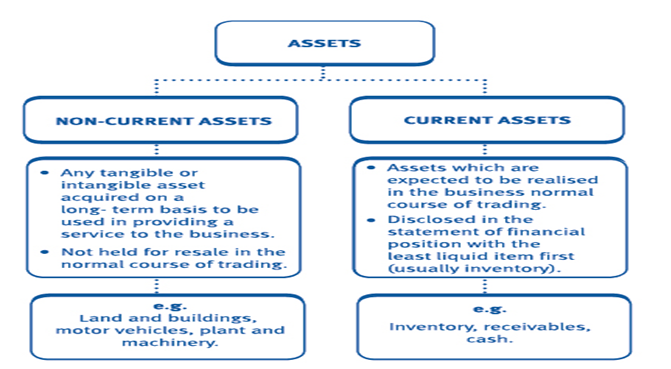
- 30Assets Non currents Assets and current assets
- 31Liabilities (12 months) Non current liabilities and current liabilities
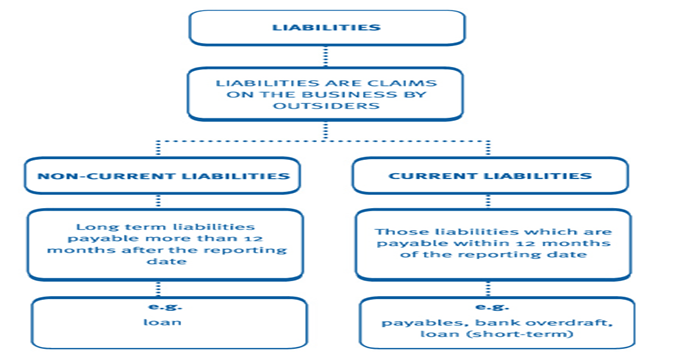
- 32the statement of financial positionThis statement summarises the assets, liabilities and equity balances of the business at the end of the reporting period. This used to be referred to as a 'balance sheet.' A specimen statement of financial position, including hypothetical monetary amounts is illustrated below
- 33Sole traders in sofpIn the case of a sole trader, the items included under the 'Equity' section of the statement would be replaced by a simple capital account.
- 34the statement of profit or loss and other comprehensive incomeThis statement summarises the revenues earned and expenses incurred by the business throughout the reporting period. This used to be referred to as a 'profit and loss account.' A specimen statement of profit or loss and other comprehensive income, including hypothetical monetary amounts, is illustrated below.
- 35the statement of changes in equityThis statement summarises the movement in equity balances (share capital, share premium, revaluation surplus and retained earnings - all explained in greater detail later in the text) from the beginning to the end of the reporting period. It applies only to limited liability companies and would not be required for a sole trader or partnership.
- 36the statement of cash flowsThis statement summarises the cash paid and received throughout the reporting period. Normally, it would be relevant to limited liability companies only, rather than to sole traders and partnerships. It will be explained in greater detail later in the text
- 37the notes to the financial statementsThe notes to the financial statements comprise a statement of accounting policies and any other disclosures required to enable to the shareholders and other users of the financial statements to make informed judgements about the business. The notes to the financial statements are usually more detailed and extensive for limited liability company financial statements, rather than for the accounts of a sole trader or partnership.
- 38Accounting concepts, other onesMateriality
Substance over form
The going concern assumption
The business entity concept
The accruals basis of accounting
Fair presentation
Consistency - 39MaterialityAn item is regarded as material if its omission or misstatement is likely to change the perception or understanding of the user of that information – i.e. they may make inappropriate decisions based upon the misstated information. Note that this is a subjective assessment made by those who prepare the financial statements (usually company directors) and it requires them to consider the reliability of the financial statements for decision-making purposes by users, principally the shareholders.
- 40Substance over formAs noted earlier, if information is to be presented faithfully, the economic reality must be accounted for and not just the strict legal form.
- 41The going concern assumptionFinancial statements are prepared on the basis that the entity will continue to trade for the foreseeable future (i.e. it has neither the need nor the intention to liquidate or significantly curtail its operations).
- 42The business entity conceptfinancial accounting information presented in the financial statements relates only to the activities of the business and not to those of the owner
- 43The accruals basis of accountingThis means that transactions are recorded when revenues are earned and when expenses are incurred. This pays no regard to the timing of the cash payment or receipt.
- 44Fair presentationFair presentation relates to preparation of the financial statements in accordance with applicable financial reporting standards, together with relevant laws and regulations.
- 45ConsistencyUsers of the financial statements need to be able to compare the performance of a company over a number of years.
Information
- Description
- Flashcards on F3 - Introduction, created by D A on 24/10/2017.
- Created by
- D A
- Views
- 1
- Rating