
1188726
Description

Flashcards by Danielle J. Gills, updated more than 1 year ago

|
Created by Danielle J. Gills
about 12 years ago
|
|
| Question | Answer |
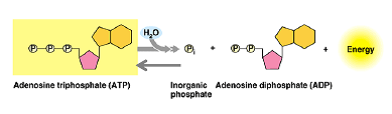
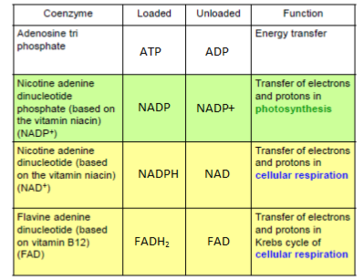
| ATP |
Adenosine Triphosphate
*ATP is the only form of energy directly used by the cell
* when ATP is broken down to ADP and inorganic Phosphate, energy is released for use within the cell
Image:
atp (image/png)
|
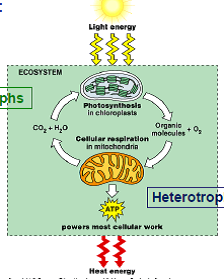
| Heterotroph | *organisms that ingest or absorb organic matter of other living or dead organisms and their products *consumer |
| Autotroph | *organisms which build organic compounds fro inorganic compounds *producer |
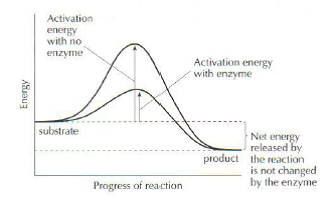
| Exergonic Reactions |
(Catabolic)
*release energy
* the energy of the reactants is greater than the energy of the products so energy is released
Image:
catabolic (image/png)
|
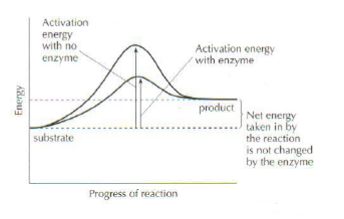
| Endergonic Reaction |
*anabolic- needs energy
*the energy of the products is greater than the energy of the reactants so energy is absorbed in the bonds of the products
Image:
anaboli (image/png)
|
| Types Of Reactions | Exergonic- those that release energy (catabolic) Endergonic- those that need energy (anabolic) |
| Enzyme Definition | a protein molecule that speeds up a chemical reaction at temperatures normally found inside cells, by lowering the activation energy. They are biological catalysts. |
| Active Site Definition | *The region on an enzyme surface that binds the substrate during the reaction. *tertiary folding of protein |
| Substrate | Reactant in an enzyme catalysed reaction |
| Products | Substance produced when the substrate has been changed by the enzyme |
| Enzyme Substrate Complex | intermediate compound formed during the reaction as the enzyme and substrate are interacting at the active site. |
| Intracellular Enzymes | Enzymes made inside the cell and remain there to speed up and control metabolism |
| Extracellular Enzymes | enzymes made inside the cell but achieve their effect outside of the cell e.g digestive enzymes |
| Cofactors | Organic molecules that are required by certain enzymes to carry out catalysis e.g vitamins, NAD,FAD |
| Coenzymes | inorganic molecvules that assist enzymes in biochemical transformations e.g ions such as Mg+ |
| The concept of the gene | *metabolism is controlled by enzymes *ALL ENZYMES ARE PROTEINS *genes code for proteins *enzymes which are not functioning usually suggest the gene is faulty (inherited condition) |
| Enzyme-Substrate Specificity | *Enzymes are specific and will only catalyse a certain reaction. for e.g maltase will only catalyse breakdown of the substrate maltose into glucose *active site matches the shape and chemical properties of the substrate |
| naming enzymes | named by attaching the suffix -ase to the substrate of which it acts on e.g. Sucrose- Sucrase Exceptions: pepsin & trypsin |
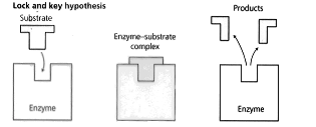
| Lock and key model |
*this theory states that each enzyme has a particular active site with a configuration only the substrate can fit
*active site is the 'lock' and the substrate is the 'key'.
*The enzyme than catalyses the reaction, releasing the products leaving the enzymes unchanged
*Active site is so specific it can only catalyse one reaction
Image:
lock_and_key (image/png)
|
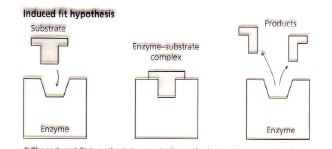
| Induced Fit Model |
*theory is that the active site is not a set structure for the substrate, but that as the substrate enters the active site, it induce it to change shape so that it fits the substrate more thoroughly
*the active site alters so that several different but similar substrates can bind to it successfully
Image:
induced_fit (image/png)
|
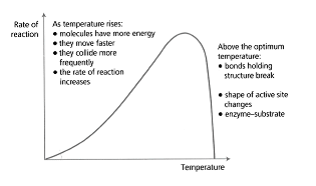
| effect of temperature on enzyme activity |
*high temperature results in the chemical bonds of the tertiary structure breaking and the enzyme is denatured
*therefore the active site alters
*the substrate can no longer fit into the active site- substrate complex is not formed.
*typical optimum temp 37 degrees
Image:
temp_on_enzymes_ (image/png)
|
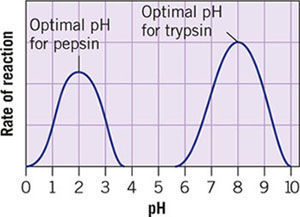
| effect of pH on enzyme activity |
*changing the pH outside the limited range in which the enzyme normally works results in denaturation
Image:
pH_on_enzymes (image/jpg)
|
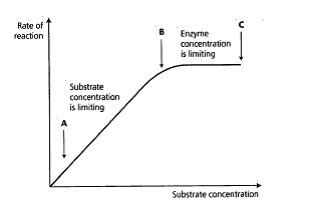
| effect of substrate concentration on enzyme activity | *the more substrate there is, the greater the chance of a substrate molecule binding to an enzyme. *once all the enzymes are all taken up, the enzyme cannot work any faster and the only way to increase would be to increase enzyme concentration. * Between B and C the enzyme concentration is limiting |
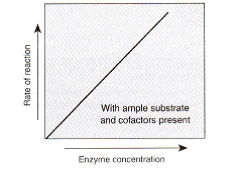
| Enzyme Concentration | *reaction rate increase with increasing enzyme concentration until the substrate becomes limiting |
| Enzyme Inhibition | *Build up of end products slow down reaction rate and eventually reverse the reaction *enzyme poisons and inhibitors- certain enzymes are destroyed by particular poisons or are stopped by inhibitors |
| Types of inhibitors | *competitive inhibitor- inhibitors mimic the substrate and block the active site *non competitive inhibitor- binds to another part of the enzyme causing active site to change shape |
| cycle of energy |
Image:
cycle_of_e (image/png)
|
| Coenzymes |
Image:
coenzyme.PNG (image/PNG)
|
| Equation for Respiration | |
| Photosynthesis Equation | |
| Photosynthesis | *the process by which plants capture light energy and use it to covert the inorganic substances, water and carbon dioxide, to glucose. *oxygen is released as a by-product *light energy is trapped by chlorophyll and the process occurs in the chloroplast |
| Chlorophyll | *green pigment molecule used to trap light in photosynthesis *chlorophyll absorbs most at the red and blue ends of the spectrum *these are the most effective wavelengths in photosynthesis |
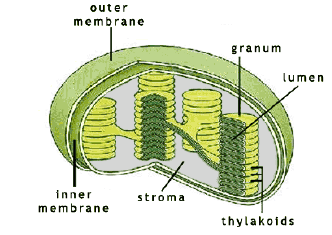
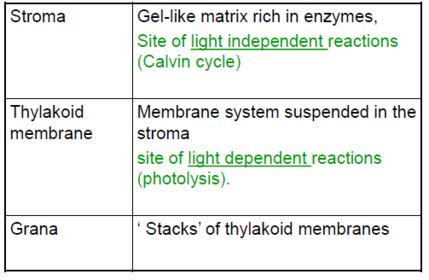
| chloroplast structure | |
| Structures in Chloroplasts | |
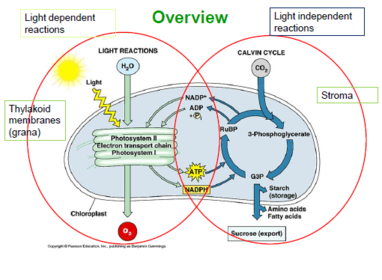
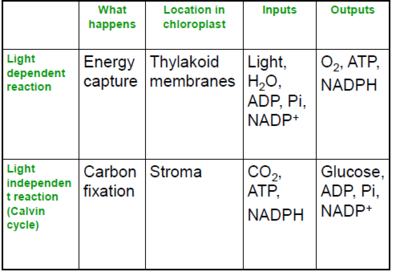
| Stages in Photosynthesis | Stage 1: light dependant reaction (photolysis) (water --> oxygen) Stage 2: light independent reaction (Calvin cycle) (carbon dioxide --> glucose) |
| Photosynthesis Overview | |
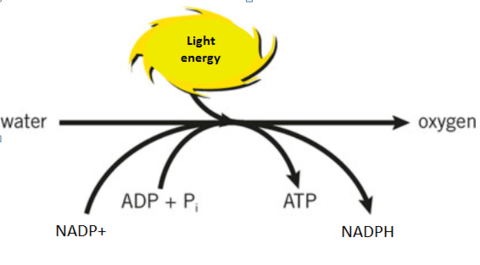
| Light dependant reaction (photolysis) | *occurs in thylakoid membranes-granum * light is trapped by chlorophyll *energy is used to split water into hydrogen ions (H+) and oxygen (released as a by product) *H+ picked up by carrier molecule (NADP+) and carried into the next stage *energy is used to make ATP, which is also used in the next stage |
| Photolysis equation | |
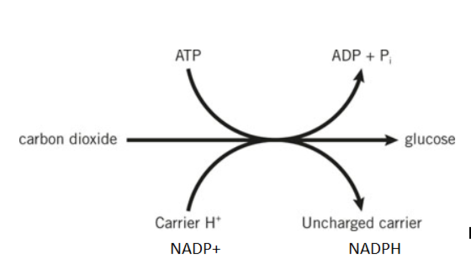
| Light Independent Reaction ( Calvin cycle) | *occurs in stroma * formation of glucose using H+ ions carried by NADPH *energy supplied by ATP from photolysis *Carbon dioxide used from atmosphere to make glucose *other carbohydrates can be produced from glucose |
| Calvin Cycle Equation | |
| Summary reactions of photosynthesis | |
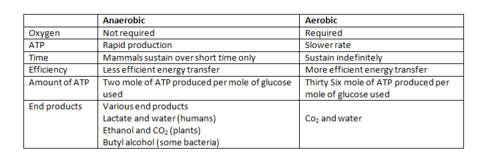
| Cellular Respiration | *process all living organisms use to obtain their energy * the controlled release of energy in the form of ATP from the substrate glucose in a series of chemical reactions *catabolic reaction *can be -AEROBIC (oxygen) -ANAEROBIC (no or low oxygen) |
| comparison of anaerobic and aerobic | |
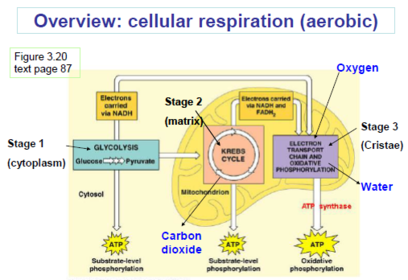
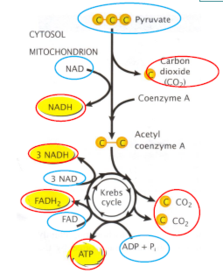
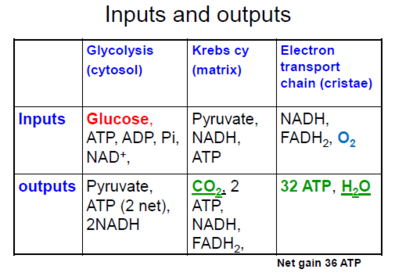
| Stages Of Aerobic Respiration | Stage 1: Glycolysis (cytosol) (glucose --> 2 pyravte) Stage 2: Krebs Cycle (mitochondrion) (pyruvate +acetyl coenzyme A --> Carbon dioxide) Stage 3: Electron Transport Chain (mitochondrion) (H+ electrons + oxygen --> water) |
| overview of cellular respiration | |
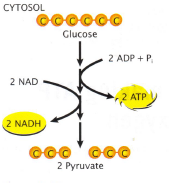
| Glycolysis | *occurs in the cytosol *breakdown of one molecule of glucose into two pyruvate molecules (3 carbon compound) and a small net yield of ATP *hydrogen ions are collected by acceptor (NAD) which becomes NADH *pyruvic acid can now go into either aerobic or anaerobic respiration pathways |
| Glycolysis Equation | |
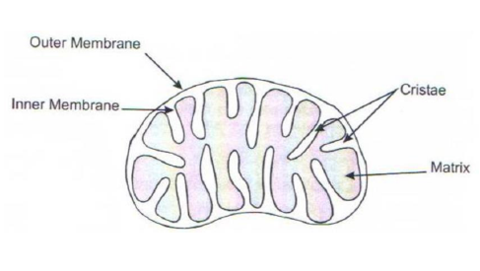
| mitochondria | *vary in length (1.5-10 micrometres long, 0.25-1 micrometres wide) *have a double membrane. *the inner one is highly folded to form cristae (increases SA) *contain DNA and ribosomes |
| mitochondrion structure | |
| Krebs Cycle | *occurs in matrix of mitochondria * if oxygen is present pyruvate molecules leave the cytosol and enter mitochondrion *pyruvate converted into acetyl coenzyme A *carbon dioxide is produced *acceptor molecules NADH and FADH2 (carrying electrons) move to the cristae for next stage |
| Krebs Cycle Equation |
Image:
krebs_cycle.PNG (image/PNG)
|
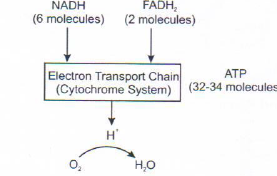
| Electron Transport Chain (oxidative phosphorylation) | *occurs in cristae of mitochondrion electrons are passed along CYTOCHROMES embedded in the membrane *oxygen is the final acceptor of electrons, together with H+ water is formed *electron transport produces large amounts of ATP |
| Electron Transport Chain Equation | |
| Summary of Respiration | |
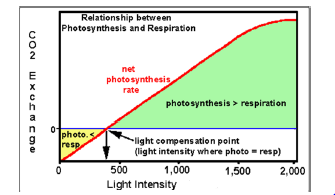
| Rates of respiration and Photosynthesis | *during the day rate of photosynthesis >respiration and glucose is converted into sucrose (used for energy or storage) *at night respiration > photosynthesis and the starch is converted back into glucose and used in cellular respiration |
| Photosynthesis vs. Respiration | *process appear to be the opposite of each BUT... *living things respire ALL the time *photosynthesis only occurs during the day (no sunlight at night) * as light intensity increases, rate of photosynthesis increases unless a factor become limiting |
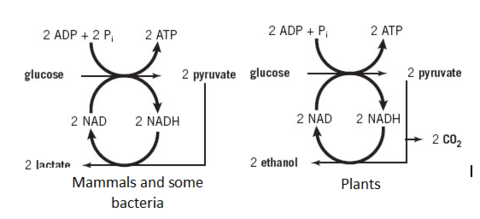
| Anaerobic Respiration | *the chemical breakdown of glucose in the ABSENCE OF OXYGEN *occurs in cytoplasm *first stage is glycolysis Products: (mammal muscle and some bacteria)-lactic acid and water (plants)- ethanol and carbon dioxide |
| Anaerobic Respiration Equation |
Image:
anaerobic.PNG (image/PNG)
|
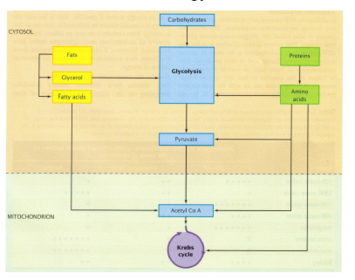
| In event of Starvation.. |
Image:
starvation.PNG (image/PNG)
|


Want to create your own Flashcards for free with GoConqr? Learn more.