
1235806


| Question | Answer |
| protozoa are ___cellular | unicellular |
| do protozoa have cell wall? | no cell wall pellicle, instead |
| are most hetero or photosynthetic? | heterotrophic |
| what is protozoa primary means of reproduction? | asexual sexual does occur, some |
| Phlyums I. Rhizopoda II. Tubulinea III. Euglenozoa IV. Metamonada V. Ciliophora VI. Apicomplexa VII. Heterokontophytos VIII. Dinoflagellata | phylums |
| whats in phylum rhizopoda or amoebozoa? | Class: Amoebae |
| Talk about Amoebae (phylum Rhizopoda) | unicellular no truly defined shape pseudopodia cyst (remains in ball until favorable conditions) while in cyst, cannot replicate |
| where are amoebae found? | freshwater, seawater, and moist soil |
| what is an example of a free-living amoebae? | Amoeba proteus |
| what is an example of an important amoebae pathogen? | Entamoeba histolytica |
| where does the Entamoeba histolytica live? | trophozoite lives in lower small intestine/colon |
| how does Entamoeba histolytica replicate? | binary fission |
| how many nucleated cysts does the Entamoeba histolytica have? | 4 nucleated cysts |
| where does the cyst pass out in? | feces |
| how is Entamoeba histolytica contracted? | contaminated food and water |
| most people infected with Entamoeba are ______ | asymptomatic |
| what is the most famous amoeba? | amoeba proteus free-living |
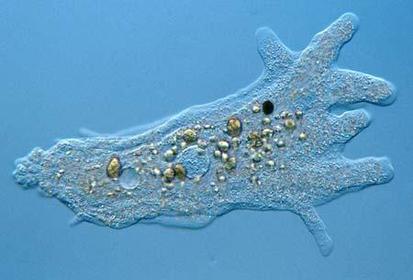
| amoeba proteus (Tubulinea) | |
| what is interesting about the Euglenozoa phylum? | Trypanosoma |
| what is trypanosoma | extracellular blood-borne flagellates |
| how is trypanosoma transmitted? | bite of a blood-sucking insect |
| what are the two divisions of trypanosoma? | 1. stercorarian 2. salivarian |
| what is stercorarian trypanosome? | contamination through feces on skin of face |
| what spread stercorarian trypanosome? | triatomid bugs |
| what is the most important stercorarian trypanosome? | Trypanosoma cruzi |
| what kind of parasite s the Trypanosoma cruzi? | tissue parasite time spent in blood is short spends most times in muscle and nerve cellls heart |
| what is the nick for the disease T. cruzi gives? | Chaga's disease Charles Darwin had it |
| when do the triatomid bugs bite? | bite at night, on face |
| what is the nick for triatomid bugs? | kissing bugs hide in plaster in walls of houses |
| what is the other trypanosome? | salivarian trypanosome |
| how is salivarian trypanosome injected? | through the salivary glands |
| flagellate protozoan that causes sleeping sickness in humans | trypanosoma brucei |
| trypanosome brucei that causes acute sleeping sickness | rhodesiense |
| trypanosoma brucei that causes chronic sleeping sickness | gambiense |
| what spreads trypanosoma brucei? | tsetse flise |
| what causes the symptoms of sleeping sickness? | invading the nervous system |
| who is the relative of trypanosome? | kinetoplastida |
| where do kinetoplastida live? | blood or tissues spread by vectors |
| what does the phylum metamonada mean? | change (meta) and unit (monus) variation in form that some cells can exhibit |
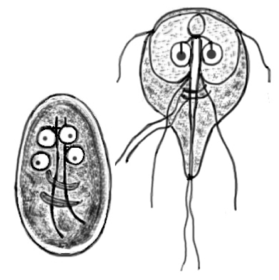
| giardia (metamonada) |
Image:
Giardia_lamblia (image/png)
|
| where does giardia live? | intestine |
| how is giardia spread? | drinking contaminated water resistant cysts |
| causes diarrhea, highly contagious, vomiting, and loss of weight | Giardia, part of phylum Metamonada |
| doesn't break down host cells, but instead the dense layer of parasites over the surface of the intestine interfere with absorption and trigger onset of disease | Giardia |
| beavers are particular carrier | Giardia |
| venereal disease | Trichomona vaginalis |
| phylum characterized by cilitates | Ciliophora |
| ciliates | move by short, hair-like processes or cilia |
| what is cilia latin for? | eyelash |
| example of Ciliophora | B. coli |
| where does balantidium coli live? | intestine |
| do animals in the phylum apicmoplexa move? | non-motile parasites |
| how do apicomplexa move? | body flexion use apical complex to invade host cells |
| linked with malaria | Plasmodium |
| ague | sweating sickness or the shakes |
| bad air | mal'aria |
| characterized by fevers occurnige very ___ or ___ hours | 48 or 72 hours |
| famous histories that had malaria | Alexander the Great silicy French troops on Haiti |
| who is the most frequent victim of Plasmodium aka malaria? | 5 years or younger |
| term for mosquito that carries the disease | anophele |
| what kind of parasite is plasmodium? | intracellular |
| where does plasmodium reproduce? | inside red blood cells |
| two plasmodium types that are hypnozoites | P. vivax and P. ovale |
| most common malaria type and also the MOST DANGEROUS | P. FALCIPARUM endothelial |
| Phlum Heterokontophytos has one type | Diatoms |
| what makes up cell wall of diatom? | silicia and cellulose |
| what are Diatoms composed of? | two halves called frustules fits together like a Petri dish |
| major component of marina phyoplanktin | Diatoms |
| major source of world's oxygen | diatom |
| used in polishing compounds, detergents, paint removers, component of firebrick, soundproofing products, and reflective paints | diatoms |
| what are diatoms? | plankton |
| what is a dinoflagellate? | plankton |
| dinoflagellate are ___ | photosynthetic cellulose |
| dinoflagellates are more closely related to ___ and ____ than they are to plants or algae | ciliates and apicomplexan |
| make up a large proportion of freshwater and marine plankton | dinoflagellate |
| two flagella of unequal length | motile dinoflagellates |
| dinoflagellates flagella | two flagella unequal length |
| abundance in marine water | red tide |
| produce neurotoxins and can poison humans who eat shellfish that have ingested planktonic dinoflagellates | dinoflagellates |
| neurotoxin of particular dinoflagellate may be more potent | Pfisteria |
| name for symptoms of memory loss, confusion, headache, respiratory difficulties, skink rash | PEAS |
| PEAS | possible estuary-associated syndrome |
| do protozoa have to be cultured? | no morphology helps |
Want to create your own Flashcards for free with GoConqr? Learn more.