
Flashcards
Things Missed/Important Chapter 4
Cards in this deck (88)
- 1what is a serovar?subdivision of a species distinguishable by strain on the basis of antigenicity
- 2flagella proteinsH antigens
- 3what are flagella proteins (H antigens) helpful in?identifying serovars of gram-negative bacteria
- 4what is peptidoglycan composed ofpolymer of disaccharide
(1) NAM
(2) NAG - 5why are antibiotics successful?interfere with peptidoglycan synthesis
- 6antibiotics interfere with _____ synthesispeptidoglycan
- 7what happens when antibiotics interferes with peptidoglycan synthesis?produces weak wall
- 8what is peptidoglycan in gram-positive bacteria linked by?polypeptides
- 9what is absent in gram-negative bacteria?teichoic acids
- 10what are the two types of teichoic acids?lipoteichoic
wall teichoic - 11where does the lipoteichoic acid link to?plasma membrane
- 12where does the wall teichoic acid link to?peptidoglycan
- 13what do teichoic acids do?regulate movement of cations
- 14what's good about teichoic acid for a bacteria?provide antigenic variation
aka more identities - 15what's good about outer membrane in gram-negative bacteria?protection from phagocytosis
complement proteins
antibiotics - 16what is the outer membrane composed of?Lipopolysaccharides
lipoproteins
phospholipids - 17what does the Lipid A function asendotoxin
- 18what does the lippolysaccharide function ?endotoxin
antigen determinant (O polysaccharde) - 19what is the periplasm?between outer membrane and plasma membrane
- 20why is periplasm important?area of high metabolic activity
- 21what are some examples of atypical cell wallsmycoplasma
archaea
acid-fast cell walls - 22do mycoplasma have cell walls?no
lack cells
sterols in plasma membrane - 23talk about archaea cell wallswall-less or walls made of pseudomurein
- 24what does pseudomurein lackNAM and d-amind acids
- 25what does archaea appear as in gram staingram-negative
- 26what do acid-fast cell walls look likegram-positive
- 27what are acid-fast cell walls made of?mycolic acid (waxy lipid)
thin layer bound to the thin layer of peptidoglycan - 28examples of bacteria with acid-fast cell wallsmycobacterium
nocardia - 29what is staining?coloring the microbe with a dye that emphasizes certain structures
- 30what is a smearthin film of a solution of microbes on a slide
- 31why is a smear fixedto attach the microbes to the slide and to kill the microbes
- 32colored ionchromophore
- 33basic dye chromophorecation
- 34acidic dye chromophoreanion
- 35staining background instead of cellnegative staining (does not use heat fixing)
- 36what are simple stainsuse a basic dye
- 37what is the purpose of a simple stainhighlight entire organism
- 38what is a mordantintensify staining
- 39what are differential stainsdistinguish between bacteria
- 40what are examples of differential staingram stain
acid-fast stain - 41is acid-fast decolorized by acetone-alcohol?no
- 42what precedes staining?fixing
- 43examples of basic dyescrystal violet, methylene blue, malachite green, and safranin
- 44which dye is more common and why?basic dyes because the chromatic in this dye is positively charged, providing attraction to the negative-bound bacteria
- 45what is an acidic dye?negative chromatophore, stains outside of bacterial cell instead, aka negative staining
- 46examples of acidic dyeseosin, acid fuchsin, and nigrosin
- 47what is acidic dye useful foroverall cell shape, size, capsules
- 48what is mordant good on?flagella
coats it - 49examples of simple stainsmethylene blue, carbolfuchsin, crystal violet, safranin
- 50primary stain in acid-fast staincarbolfuchsin
- 51decolorizing agent in acid-fast stainacid-alcohol
- 52counterstain in acid-fast stainmethylene blue
- 53capsule stainnegative stain
- 54endospore primary stainmalachite green (heated)
- 55endospore decolorizerwater
- 56endospore stain counterstainsafranin
- 57flagella staincarbolfuchsin
mordant on flagella - 58penicillin _____ peptide _____ in peptidoglycaninhibits bridges
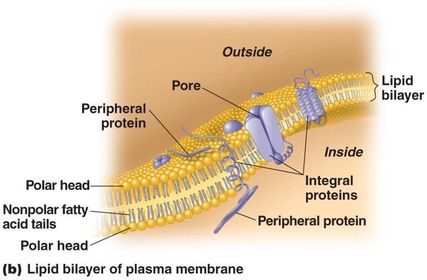
- 59what is plasma membrane composed of
- 60eukaryotic plasma membranes contain ____ and ____sterols and carbohydrates
- 61do prokaryotes have sterols?no, therefore less rigid than eukaryotic plasma membranes
- 62only one prokaryote has sterols in plasma membrane, which is itmycoplasma
- 63what is gram-positive cell wall more susceptible tocomplement and phagocytosis
- 64what is gram negative cell wall more susceptible tomechanical breakage
- 65what are chromatophores, aka thylakoidsinfoldings containing photosynthetic pigments, enzymes
- 66what can damage plasma membrane?alcohols
quaternary ammonium (detergents)
polymyxin antibiotics - 67what happens when something damages plasma membrane?cell leakage
- 68what is osmosis through lipid layer calledsimple diffusion
- 69what is osmosis through aquaporins (water channels)facilitated diffusion
- 70endospores are resting cells of ____gram-positive bacteria
- 71what are endospores resistant todesiccation, heat, chemicals
- 72what is sporulationendospore formation
- 73what is germinationreturn to vegetative state of endospore
- 74who has cell wall?plants, fungi, algae
- 75what happens when you don't have peptidoglycan?safe from antibiotic effect
- 76are inclusions found in eukaryotic cells?no
- 77what are inclusions in prokaryotesstore lots of different thing
- 78most important inclusionmetachromatic inclusion
stores inorganic phosphates - 79what is metachromatic granulephosphate reserve
- 80what is another name for metachromatic granulevolutin
- 81what are gas vacuoles forstore air for buoyancy
- 82proteins composing phospholipid bilayertransmembrane proteins, integral proteins, and peripheral proteins
- 83what color do endospores turn out with their staining?starts as green, when safranin (red) is applied, stains remainder of the cells red or pink
- 84what does peroxisome dodestroys H2O2, oxidates fatty acids
- 85what is centrosomeprotein fibers and centrioles, for mitosis
- 86which bacteria is sensitive to tetracycline?gram-negative
- 87which bacteria has periplasmgram-negative
- 88explain gram stain processCrystal violet-iodine crystals form in cell
Gram-positive
Alcohol dehydrates peptidoglycan
CV-I crystals do not leave
Gram-negative
Alcohol dissolves outer membrane and leaves holes in peptidoglycan
CV-I washes out
Information
- Description
- Flashcards on Things Missed/Important Chapter 4, created by newsha on 05/09/2014.
- Created by
- newsha
- Views
- 13
- Rating