
Flashcards
IGCSE Biology - AQA (Subjects covered in description)
Cards in this deck (29)
- 1Name the 5 parts of an average animal cell, and their functions.ANIMAL CELL
Mitochondria - where most of the energy released in respiration
Nucleus - Controls cell activity
Cell membrane - controls passage of substances in and out
Ribosomes - where protein synthesis occurs
cytoplasm - where most of the chemical reactions take place - 2Nucleus - To control the activities of the cell Cytoplasm - most of the Chemical reactions take place here Cell membrane - Controls what goes in and out of the cell Mitochondria - This is where most of the energy is released in respiration Ribosomes - Where protein synthesis occurs Chloroplasts - which absorb light energy to make food A permanent vacuole filled with cell sap.Name the 7 parts of an average plant cell, and their functions
- 3What do plant and algal cells have, that animal cells don't?A cell wall, which strengthens the cell
- 4What does a bacterial cell consist of?A cytoplasm and a membrane, surrounded by a cell wall.
The genes are not in a distinct nucleus, some are located in circular structures called plasmids. - 5What is a yeast cell, and what does it consist of?A single-celled organism.
They have a nucleus, cytoplasm, and a membrane, surrounded by a cell wall. - 6Name and describe a specialised cell.Sperm cell - A streamlined head, containing DNA, and an enzyme to help penetrate the embryo. A tail, to swim towards the embryo, and the section just below the head contains mitochondria, for energy.
- 7Name and describe another specialised cell.Embryonic cell - It's walls immediately strengthen after one sperm has entered it, preventing others from joining with it.
- 8What does a nucleus contain? What is contained within that?A nucleus contains chromosomes. Each chromosome carries a large number of genes.
- 9What are the different forms of genes called, and what do they do?Alleles, which produce different characteristics.
- 10What is mitosis?Mitosis is the asexual division of body cells, to produce additional cells during growth, or to produce replacement cells.
- 11What happens during mitosis?Copies of the genetic material are made.
The cell then divides once to form two genetically identical body cells. - 12What is meiosis?When a cell divides to form gametes. This is sexual reproduction
- 13What happens during meiosis?Copies of the genetic information are made.
The cell then divides twice to form four gametes, each with a single set of chromosomes. - 14What happens when gametes join at fertilisation? (4 points here)They form a single body cell with new pairs of chromosomes. This cell then divides by mitosis to form many cells. As an organism develops, these cells differentiate to form different kinds of cells
(They go from undifferentiated to specialised) - 15name 2 differences between animal and plant cell differentiationMost animal cells differentiate at an early stage, whereas many plant cells retain the ability to differentiate throughout life.
In mature animals, cell division is mainly restricted to repair and replacement. - 16Where are stem cells found?Bone marrow and human embryos
- 17What are stem cells, and what can they do?they can be made to differentiate into many different types of human cell.
They are undifferentiated. - 18What happens in therapeutic cloning?An embryo is produced with the same genes as the patient. This means that stem cells from the embryo will not be rejected by the patients body, therefore they can be used in medical treatment.
- 19What can stem cell treatment help to cure?Conditions such as paralysis.
- 20What are tumours?The result of abnormal, uncontrolled cell growth.
- 21What are the differences between Benign and malignant tumours?Benign tumours do not invade other tissues, malignant tumours do.
Malignant cells may enter the bloodstream and circulate to other parts of the body to form secondary tumours. - 22What causes tumours?Chemical carcinogens, e.g those found in tobacco smoke, or burnt toast, and by ionising radiation, e.g. UV and X-rays.
- 23What is the relationship between tissues, cells, organs and organ systems?A tissue is a group of cells with similar structure and function. An organ is made up of tissues. An organ system is made up of several organs that together perform a particular function.
- 24Give 3 examples of animal tissue, and their functions.Muscular tissue - which can contract to bring about movement.
Epithelial tissue - which covers some part of the body.
glandular tissue - which can produce substances such as enzymes and hormones. - 25Give 3 examples of an animal organ, and their functions.Stomach - To break down and digest food in order to extract key nutrients.
Lungs - To create energy from aerobic respiration.
Large intestine - To absorb water from the remaining indigestible food matter, then pass waste material from the body. - 26Give an example of an organ system, what it contains, and its function.The nervous system, made up of the spinal cord, brain and nerves. It receives and interprets stimuli, and the brain uses this information to coordinate all of your actions.
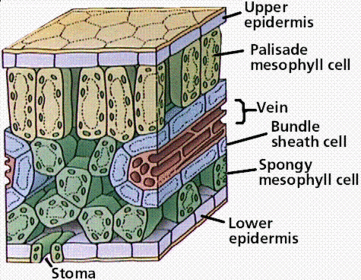
- 27Give 4 examples of plant tissues, and their functions.Epidermal tissue - which covers the plant
Palisade mesophyll - which carries out photosynthesis.
spongy mesophyll - which has air spaces in which the diffusion of gases can take place.
xylem and phloem - which transport substances around the plant. - 28Give 3 plant organs.Stems, roots and leaves.
- 29Take a look at the structure of a leaf!
Information
- Description
- Cell structure, cell division, tissues, organs and organ systems.
- Created by
- Sam.
- Views
- 58
- Rating