
16026312
Description

Flashcards by Juliette Carroll, updated more than 1 year ago

|
Created by Juliette Carroll
about 7 years ago
|
|
| Question | Answer |
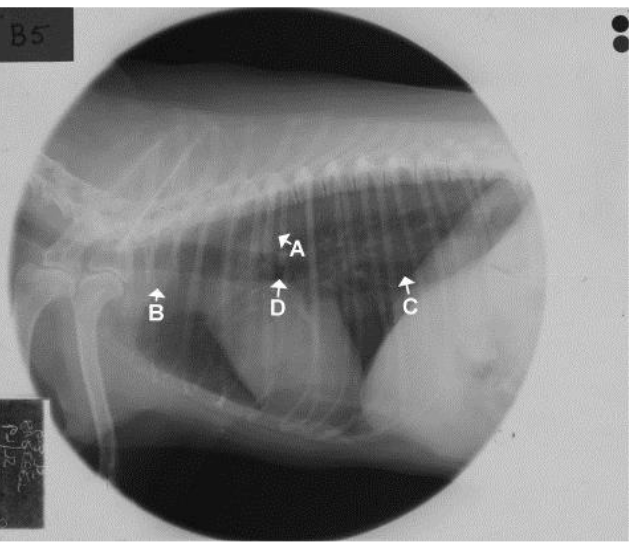
| Name structures A, C and D | A: Aorta C: Lung tissue D: Tracheal bifurcation |
| What is the difference between an X-ray and a radiograph | A radiograph is the image produced X-ray is the beam fired to produce an image |
| What does the total number of X-rays generated depend on? | Voltage Electric current Time |
| Briefly describe what X-rays are | Electrons (cathode) generated within a vacuum Accelerated across space to a target (anode) Electron-target interaction generates X-rays |
| How is a radiograph produced by passage of X-rays through a body? | X-rays penetrate tissue Photons are either absorbed by tissue, pass through to expose film/digital sensor or are scattered |
| Which types of tissues absorb high amounts of radiation? | Thicker tissues and those with a high atomic number |
| What colour are radio-opaque tissues on a radiograph? | White |
| What colour are radiolucent tissues on a radiograph? | Black |
| What causes the white colour of radio-opaque structures? | More x-rays absorbed and fewer exposing film so image whiter |
| What causes the black colour of radiolucent structures? | Little absorption of x-rays |
| List the following materials from least to most radio-opaque? Bone Air Fat Soft tissue Metal | Air Fat Soft tissue Bone Metal |
| What is collimation? | The use of a collimator to narrow the beam of x-rays projected at an animal |
| What is the purpose of lead gowns/gloves? | To protect the wearer from x-ray scatter (not main beam) |
| List the 6 steps you should take when reading a radiograph | Comment on film quality (over/underexposed?) Identify body part Identify projection (positioning) Identify species Estimate age of animal Identify important features |
| How does an a) overexposed b) underexposed radiograph look? | a) Very black b) Very white |
| How is positioning of an x-ray stated? | The plane that the beam is first passed through is stated first and then the one it comes out of is stated second eg. dorsoventral |
| Why should x-rays be taken in at least 2 orthogonal planes? | To clarify whether or not what you are looking at is on top or on bottom |
| List 3 ways you can tell dogs and cats apart on radiographs | Clavicle ossified in cats but cartilaginous in dogs Cats have slimmer and straighter long bones Dogs have an os penis |
| Which features can we use to estimate age? | Growth plates Calcification of costal cartilages which happens with age |
| What is being referred to in a "left lateral" radiograph? | The side which the animal is lying on |
| How is a barium meal gotten into the animal? | Injested |
| What can a barium meal be used for? | Highlighting obstructions in the GI tract and/or rate of movement through it |
| When can x-rays be useful when animals are pregnant? What care needs to be taken when x-raying pregnant animals? | To tell how many there are and/or if there's any left after birth Should only do very late in the pregnancy |
| How can contrast media used in the urinary tract be given? | Intravenously Per urethra |
| How can contrast media be useful when x-raying joints/synovial structures? | Can outline joint space Identify irregular surfaces Identify leaks from traum eg. stepping on a nail |
Want to create your own Flashcards for free with GoConqr? Learn more.