
16144874
Description

Flashcards by AsimAli Rehman , updated more than 1 year ago

|
Created by AsimAli Rehman
almost 8 years ago
|
|
| Question | Answer |
| What are the 3 subatomic particles that make up an atom? | - Proton - Neutron - Electron |
| What is the relative charge of a proton? + What is it found? | - +1 - in the nucleus |
| What is the relative charge of a electron? + What is it found? | - -1 - on the electron shell |
| What is the relative charge of a neutron? + What is it found? | - 0 - In the nucleus |
| Why are atoms electronically neutral? | As the number of protons are equal to the number of electrons, so they cancel each other out. |
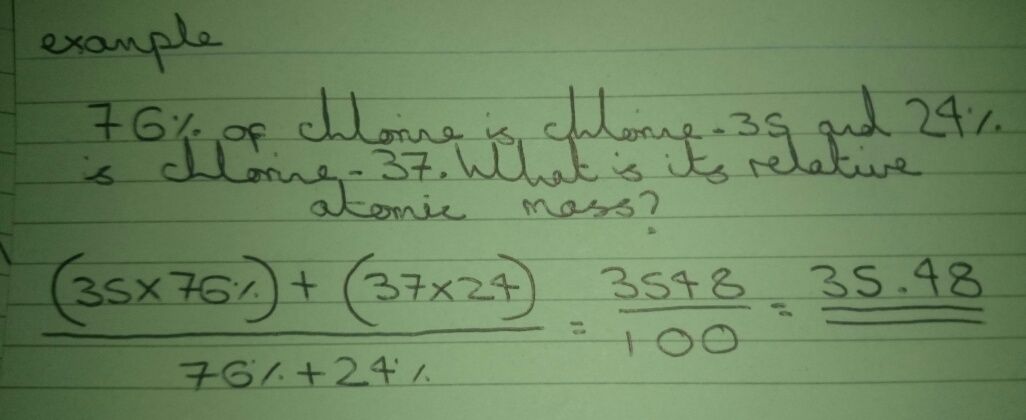
| What is an isotope? | Is the same element with a different mass number. Same number of protons but different neutrons. |
| Asim | |
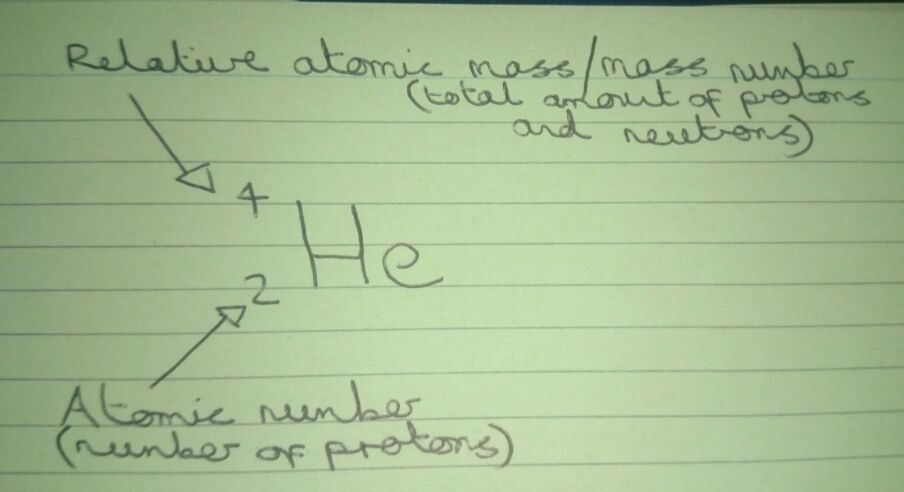
| number of protons = Atomic number number of neutrons = Mass number - Atomic number Number of electrons = number of protons | Asim |
| Asim | |
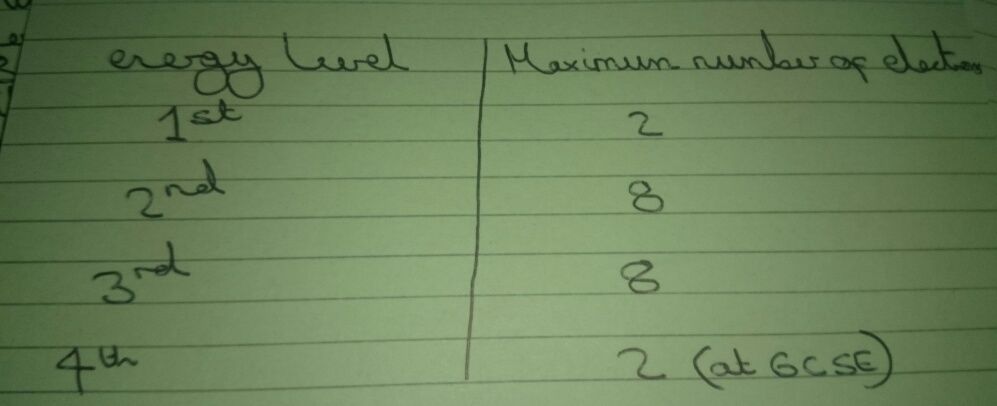
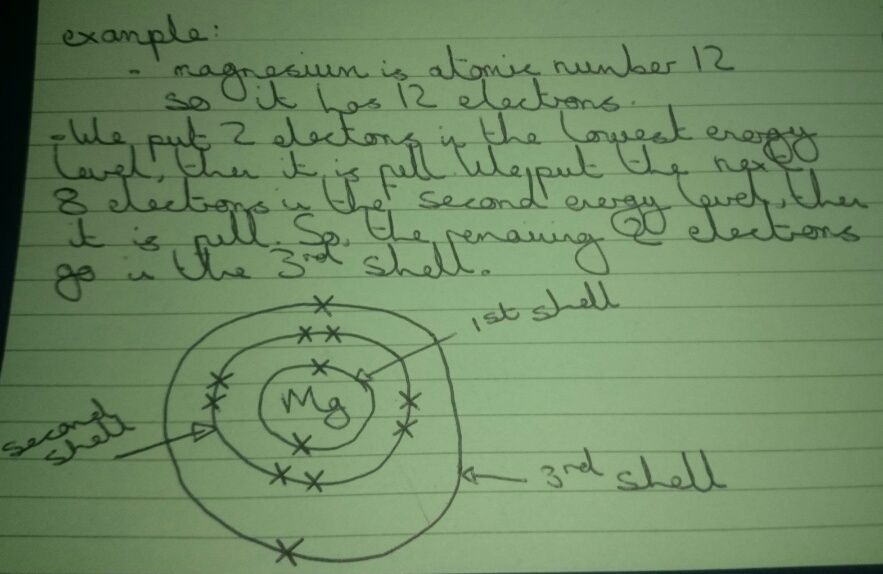
| Electronic structure : Electrons are found in energy levels. Each energy level can only contain a certain amount of electrons. The lowest energy level or first shell (closest to the nucleus) is filled first. Once it is full of electrons the second energy level starts to be filled, when this is filled then the third starts to be filled and so on. | |
| Electronic structure. | |
| What is the link between group number of electrons in the outer shell (highest energy level) ? | Elements in the same group number will have the same number of electrons on the outer shell. Eg) Iodine is in group 7 so it will have 7 electrons in the outer shell. |
| Potassium is more reactive than sodium. Explain why, in terms of electronic structure? | As potassium has 19 electrons and sodium only eleven, potassium would have more energy levels (shells) so therefore their electrons are further away from the nucleus meaning there are less forces of attraction between the nucleus and electrons so the electrons are easily lost so then making potassium more reactive than sodium. |
| What are the typical properties of metals? | - High melting points except for mercury. - very conductive of heat + electricity - high density - Can be re-shaped (malleable) - React with non-metals to form positive ions. - No reaction (with metals) - Metal oxides and metal hydroxides are alkaline. |
| What are the typical properties of non-metals? | - Low boiling points - very poor conductors of heat + electricity - low density - Brittle, dull, soft, transparent - Cannot be deformed - React with non-metals to form molecules. - React with metals to form negative ions and ionic compounds. |
| What are the nobel gases and why are they unreactive? | The nobel gases are found in group 0 and are non - metals. They are unreactive as their outer shell is full. |
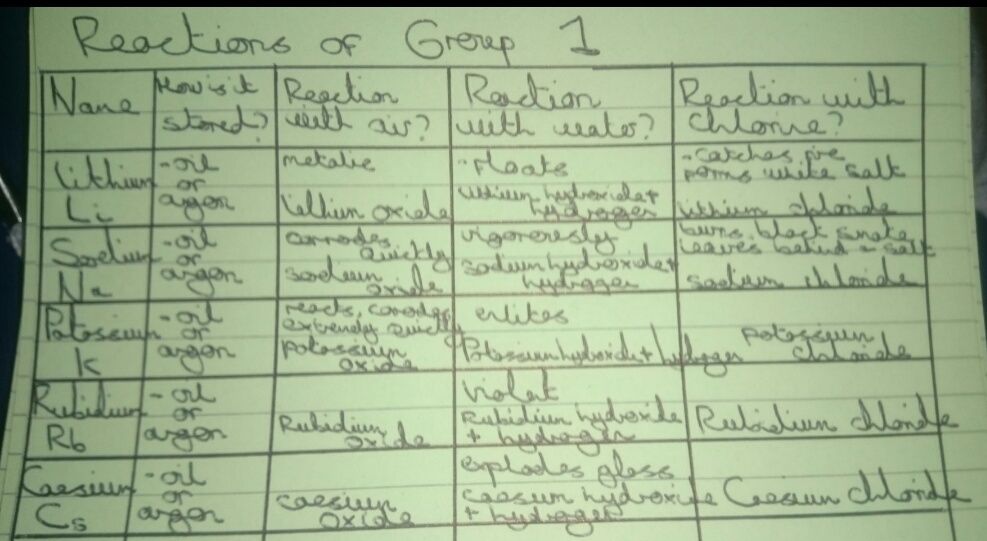
| Group 1 | |
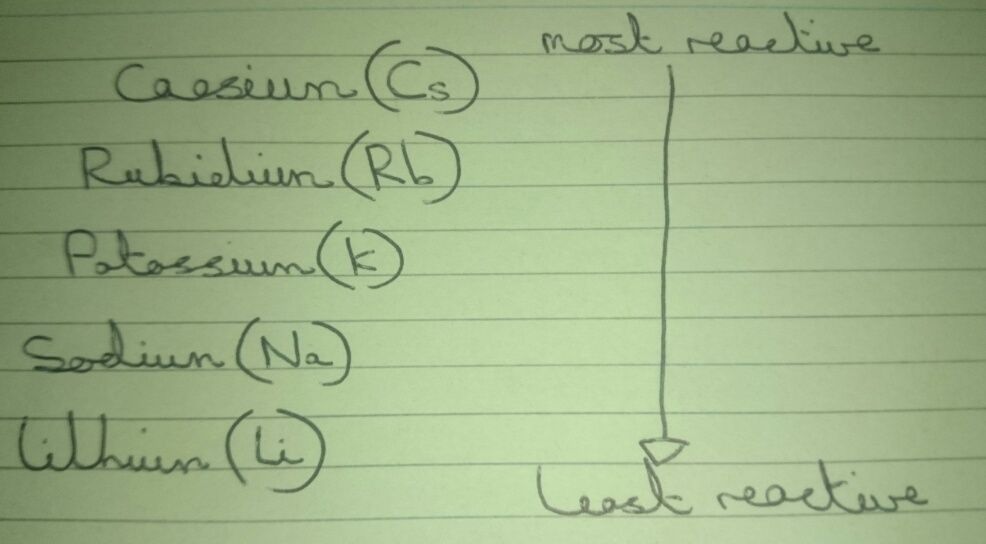
| Reactivity | |
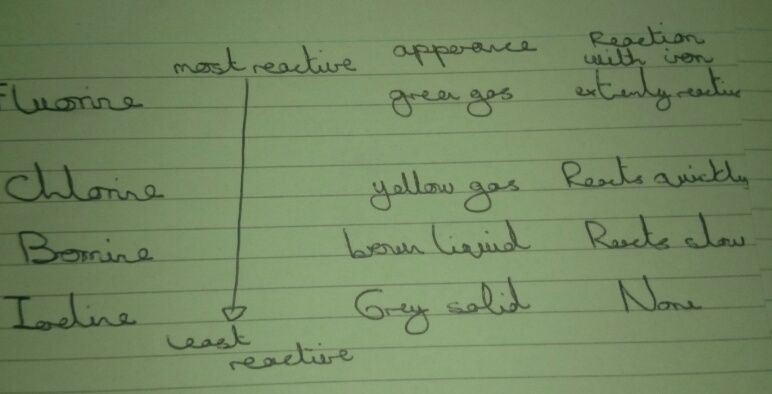
| What are the halogens? | They are non-metals and are diatomic (2 atoms together) They are in group 7 |
| Reactivity | |
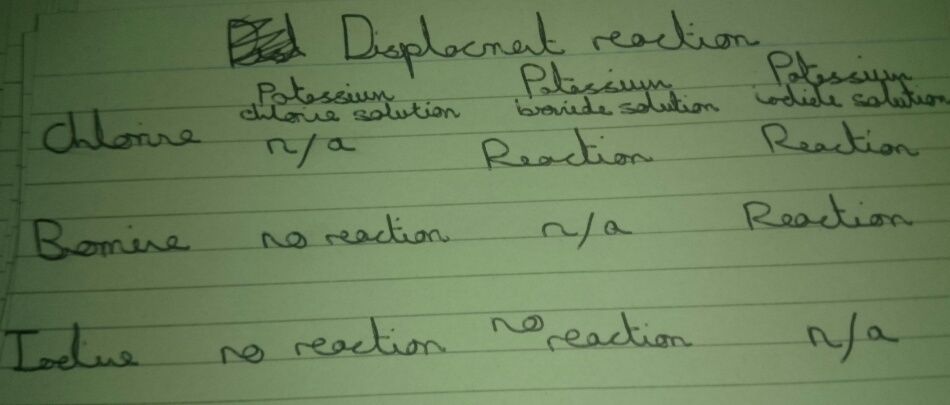
| Displacment reaction. | |
| The peridic table Group> vertical column Period> Horizontal column | Asim |
| What did Mendeleev do and why did he leave gaps in his version of the periodic table? | He arranged the elements in order of atomic weight but left spaces for elements that he predicted would be discovered in the future and swapped the order of a few elements based on their properties. Also to prove that he was right and is table worked. |
| How can you test for hydrogen? | A splint is lit and held near the opening of a tube. The gas is flammable, the mixture ignites with a distinctive 'squeaky pop' sound. |
Want to create your own Flashcards for free with GoConqr? Learn more.