
17040417


| Question | Answer |
| What is the notation for a polar coordinate? | (r,θ) |
| What equations do we use to convert from Polar form to Cartesian form? | x = rcosθ y = rsinθ |
| What equations do we use to convert from Cartesian form to Polar form? | r = root(x^2 + y^2) tanθ = y/x |
| Convert (3,4) into polar form | root(3^2 + 4^2) = 5 tanθ = 4/3 , tan-1(4/3) = 0.927 (5,0.927) |
| The origin is also called.... | The pole (the point where the r value is measured from) |
| The x-axis is also called.... | The initial line (where the angle θ is measured AC from) |
| On a polar graph, 5/4π is also equal to.... | -3/4π (CW) , 13/4π (AC + 2π) , π/4 (AC if r is flipped to be negative) |
| Remember to +/- π depending on..... | The quadrant of the polar graph (or depending on if the angle is CW or AC) |
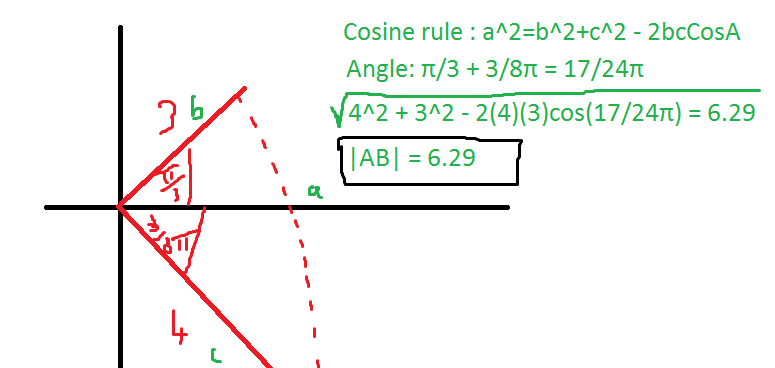
| A(3,π/3) , B(4-3/8π) , Find |AB| | |
| Write y=x^2 as a polar equation | rsinθ = (rcosθ)^2 rsin = r^2cos^2θ Given that r≠0 , we get the polar equation: sinθ=rcos^2θ |
| Write (-2,4) in polar form for both r>0 and r<0 | r = root(2^2+4^2) = 2(root 5) tanθ = 4/2 , tan-1(2) = 1.11 r>0 ; π-1.11 = 2.04 , so (2(root 5) , 2.04) r<0 ; (-2(root 5) , 1.11) |
Want to create your own Flashcards for free with GoConqr? Learn more.