
Flashcards
Biology 3.1.2 Transportation of oxygen and carbon dioxide
Cards in this deck (22)
- 1What is the fancy name for red blood cells?Erythrocytes
- 2How are red blood cells adapted to their function?They are biconcave to increase their SA:V ratio
Haemoglobin is close to the plasma membrane so exchange of substances can occur easily - 3Why do red blood cells have no nucleus, no mitochondria, and no endoplasmic reticulum?So there is more space for haemoglobin
- 4What is the fancy name for oxygen leaving the haemoglobin?Dissociation
- 5What type of protein is haemoglobin?Globular
- 6How many polypeptide chains does haemoglobin have?Four
- 7What allows haemoglobin to attract oxygen?The haem group has an affinity to oxygen so attracts it
- 8What is meant by the symbol "pO2"?Partial pressure of oxygen
The measure of oxygen concentration - 9Is there a high or low partial pressure of oxygen at respiring tissue?Low
- 10What is oxygen affinity?The tendency for a molecule to bind with oxygen
- 11What happens to the oxygen affinity of partial pressure of oxygen increases?It increases (positive correlation)
- 12Where does fetal blood obtain all its oxygen? Explain how this happensThe mother's blood in the placenta
The two don't mix but pass close enough to each other to allow diffusion to occur fro one to another - 13Does fetal haemoglobin have stronger, weaker or equal affinity for oxygen?Stronger affinity
- 14True or false - Fetal blood can obtain oxygen at a lower pO2 due to its greater affinity for O2True
- 15What are the three ways CO2 is transported in the blood?Carried dissolved in plasma
Combining with haemoglobin
Diffuses into red blood cells - 16Inside the red blood cell, a reaction takes place with CO2 and H20, what is the product? CO2 + H2O ---- ???H2CO3 (carbonic acid)
- 17The carbonic acid inside the red blood cells dissociates. What is produced? H2CO3 ----- ?? + ??H2CO3 ---- H+(ion) + HCO3- (hydrogen carbonate ion)
- 18What happens to the H+ ions?They combine with haemoglobin forming haemoglobic acid which causes the release of oxygen
- 19What happens to the hydrogen carbonate ions?They diffuse into the plasma where they are carried around the body
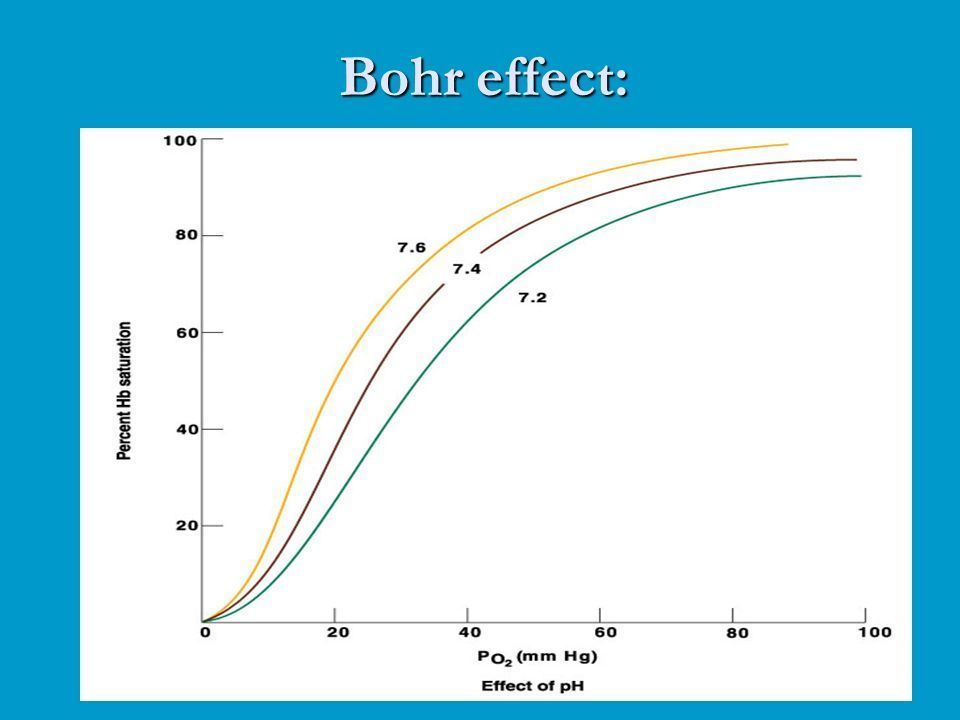
- 20What is the bohr effect?Where oxygen is more readily released from oxyheamoglobin in areas of more CO2
- 21If a tissue has an increased concentration of CO2, what effect will it have on the curves in the bohr shift graph?The curve will shift to the righ
- 22Why do we need the bohr shift?SO that oxygen can be more readily supplied to respiring tissue
Information
- Description
- User has deleted their subject information Flashcards on Biology 3.1.2 Transportation of oxygen and carbon dioxide, created by Deleted user on 22/04/2019.
- Created by
- Deleted user
- Views
- 12
- History
-
- Created by Sam Gunnell · Apr 21, 2019
- Copied by Sam Gunnell · Apr 22, 2019
- Rating