
1878738
Description

Flashcards by scarlettjaynem, updated more than 1 year ago

|
Created by scarlettjaynem
over 9 years ago
|
|
| Question | Answer |
| How are Esters Formed? | Condensation reaction between a carboxyllic acid and an alcohol |
| How can you tell is an Ester has been made? | An oily layer will have formed and an aroma let off |
| How are esters prepared in the lab? | In a water bath and using a condenser |
| Why is the ester reaction heated using a water bath as opposed to an open flame? | The alcohol used is flammable, this would be dangerous with an open flame |
| What is produced upon the hydrolysis of an ester? | a carboxyllic acid and an alcohol |
| What are esters used for? | fruit flavourings non-polar industrial solvents |
| What are the three types of fats and oils? Give an example of each. | Marine - blubber Animal - goose fat Vegetable - Olive oil |
| Why is there a difference in the melting point of fats and oils? | Differing number of C=C bonds |
| Which have a higher melting point, oils or fats? | Fats, no C=C bonds |
| Fat as an energy source | Slow release energy releases more energy per gram than carbohydrates extra energy is stored as fat |
| Structure of fat | One mol of glycerol to 3 mols of fatty acid |
| How are all fats and oils similar? | They are all esters of the same alcohol |
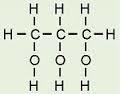
| What is this? | Glycerol |
| What is used to catalyse the hardening of oils? | Nickel |
| What is the hardening of oils? | hydrogenating to reduce the number of C=C bonds, thus reducing the melting point and degree of saturation |
| What is a saturated carboxyllic acid? | Carboxyllic acid with no C=C bonds |
| What is an unsaturated Carboxyllic acid | Carboxyllic acid with C=C bonds |
Want to create your own Flashcards for free with GoConqr? Learn more.