
Flashcards
Pharmacology - Foundations
Cards in this deck (53)
- 1Pharmacology is commonly divided into: 1. 2.1. Pharmacodynamics: what drugs do to the body
2. Pharmacokinetics: what the body does to drugs - 2Ligands include...1. drugs
2. endogenous signaling molecules
- hormones
-neurotransmitter
*Drugs elicit their desirable and many of their undesirable effects by mimicking
or blocking the actions of hormones and neurotransmitters - 34 Major Classes of Receptors Targeted by Drugs• Ligand-Gated Ion, Channels Change in intracellular ion concentration, acetylcholine
•Enzyme-Linked Receptors, Protein
phosphorylation, insulin
•G-Protein Coupled Receptors, Intracellular 2° messenger (e.g. cAMP), b-adrenergic receptor
• Ligand-Activated Transcription Factors, in the nucleus, estrogen receptor takes hours - 4Strength and/or number of chemical bonds is an important determinant of 1. 2.1. Affinity of ligand for receptor
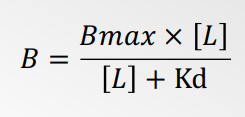
2. Functional effect of ligand on receptor - 5—B = Fraction of total receptors bound
Bmax = Maximal fraction of total receptors bound
[L] = Concentration of ligand
Kd = Equilibrium Dissociation Constant
• Ligand concentration at which 1/2 of Bmax is achieved
• A measure of the inherent affinity of the ligand-receptor interaction - 6Graded Dose-Response CurvesEmax -the maximum response achieved by the ligand
ED50 -the ligand dose at which 50% of Emax is achieved
- also referred to as ligand potency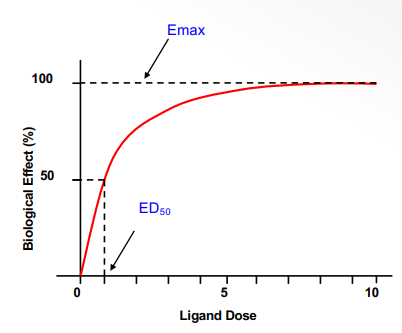
- 7Quantal Dose-Response CurvesAll or nothing - unliked graded which is a continious state this is yes or no
• useful to describe population rather than individual responses to drugs
• based on plotting cumulative frequency
distribution of responders versus the log
dose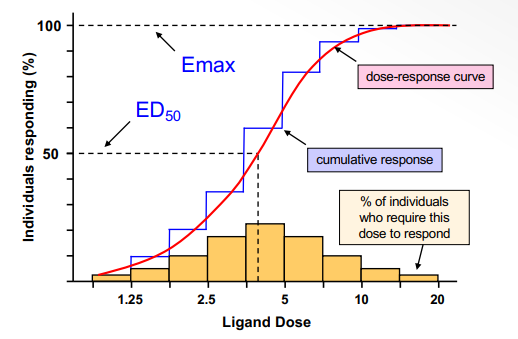
- 8Agonists: Potency• related to the amount (e.g. dose) of drug needed to produce an effect of a given magnitude
• usually expressed as ED50 (dose to achieve 50% of the maximum effect achievable with that agonist
• which drug works quicker with a smaller dose - 9Agonists: Efficacy• related to the maximum effect that can be achieved with a particular agonist
• usually expressed as Emax (the maximum
effect that can be achieved with that agonist)
• which drug works better - 10Maximum efficacyis generally defined by the maximum effect achieved with the endogenous receptor agonist
e.g. hormone or neurotransmitter - 11Pharmacological Antagonists• Bind to receptors, but do not activate signal transduction mechanisms
• Biological effects derive from blocking ability of agonist (e.g. drug, hormone, neurotransmitter) to
bind and/or activate a receptor - 12Competitive Antagonists-bind reversibly to the receptor
-inhibition can be overcome by increasing agonist concentration
-primarily affect agonist potency - 13Non-Competitive Antagonists-bind irreversibly (e.g. covalently) to the receptor or reversibly/irreversibly to a site on the
receptor different from the agonist (allosteric)
-inhibition cannot be overcome by increasing agonist concentration
-primarily affect efficacy - 14Competitive Antagonists: Effect on Agonist Dose Response CurvesCompetitive antagonists DO NOT reduce the number of receptors available for activation by the agonist
-agonist now has reduced potency, but
ED50 = 10 retains maximum efficacy
right curve shift - 15Non-Competitive Antagonists: Effect on Agonist Dose Response CurvesNon-competitive antagonists DO reduce the number of receptors available for activation by the agonist
• agonist retains maximum potency,
but now exhibits reduced efficacy
curve is lowered, emax is lowered - 16Most endogenous receptor ligands such as hormones and neurotransmitters are full agonists• Example: Epinephrine
• Full agonist of cardiac β1-adrenergic receptor that promotes rate (chronotropy) and force (inotropy) of heart contraction - 17Endogenous pure antagonists are comparatively rare• Example: Kynurenic acid
• NMDA receptor antagonist
• Physiological role unclear but may play a role in neurotransmission and neuropathologies - 18Some drugs (full agonists, partial agonists) mimic the effect of endogenous agonists• Enhanced function, replacement for a deficit in production of endogenous agonist
- Example: isoproterenol
• full agonist that mimics epinephrine at cardiac β1-adrenergic receptor
- Example: buprenorphine
• Partial agonist that mimics endogenous endorphins at µ-opiod receptor - more desired because of lower risk
• Safer analgesic than morphine (full agonist) due to reduced risk of respiratory depression with
overdose - morphine might only be used for conditions of severe pain
• Superagonists (>100% Emax) exist but are not common in clinical practice - because of safety issues - 19Other drugs (antagonists, partial agonists) are used to block the effect of endogenous agonists• Reduce the potency and/or efficacy of endogenous agonists (e.g. hormones,
neurotransmitters)
• Example: propanolol = Pure antagonist of epinephrine at cardiac b1-adrenergic receptor, lower rate/force of heart contraction
• Partial agonists can function as competitive antagonists with respect to full agonists - might not be desirable to have a full agonist - 20Drug Desensitization• effect of a drug often diminishes when given continuously or repeatedly
• desensitization, tachyphylaxis, refractoriness, resistance, tolerance = SAME phenomenon
2 mechanisms
1.receptor-mediated
2. non-receptor-mediated - 21Receptor Mediated Desensitization1. Loss of Receptor Function
• rapid desensitization due to change in receptor
conformation
• usually due to feedback of cellular effects of agonist
• Example: phosphorylation of specific amino acids in
G-protein coupled receptors blocks coupling to Gproteins
2. Reduction of Receptor Number
• slower, long-term desensitization due to change in receptor number
• usually due to feedback of cellular effects of agonist
• Example: phosphorylation of specific amino acids in G-protein coupled receptors causes
removal from cell surface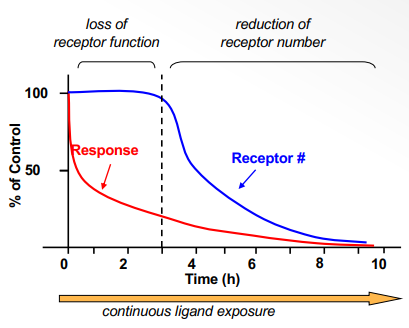
- 22Non-Receptor Mediated Desensitization1. Reduction of Receptor-Coupled Signaling Components
• Depletion of signaling molecules required for biological response
• Example: prolonged stimulation of G-protein coupled receptors can lead to depletion of intracellular secondary messengers
2. Increased Metabolic Degradation
• Increase in the rate of metabolism and/or elimination of drug
• Lowers plasma drug concentrations
• Example: barbiturates induce the expression of metabolic enzymes that degrade these
drugs
3. Physiological Adaptation
• Reduction or amelioration of drug effects due to opposing homeostatic response
• Very few well characterized mechanisms - 23Adverse Drug Effects 1. 2. 3.1. Side effect - used too broadly, specifically means the drug is targeting something OTHER than what you're targeting
2. Toxic reaction - directly related to what the drug is supposed to be doing, can be too high of a dose
3. Allergic reaction - not dose dependent, unpredictable, and not related to desired effect of the drug - 24Therapeutic IndexA measure of drug safety that considers dose required for a toxic or other adverse drug effect versus that required for the desired beneficial effect
**In general, a larger T.I. indicates a
clinically safer drug, but this still isn't an end all be all rule**
is this the curve for a mild headache or renal failure?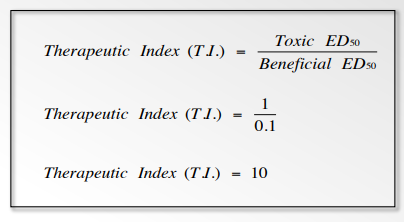
- 25Therapeutic Window – Relationship to Blood LevelsA measure of drug safety that considers the range of blood concentrations a drug that are associated
with toxic (other adverse drug effects), therapeutic benefit or lack of effect within a population - 26Therapeutic Window – Relationship to Dose-A measure of drug safety that considers the range of dosages of a drug that are associated with toxic (other adverse
drug effects), therapeutic benefit or lack of effect within a population
- no benefits, big bad, and sweet spot window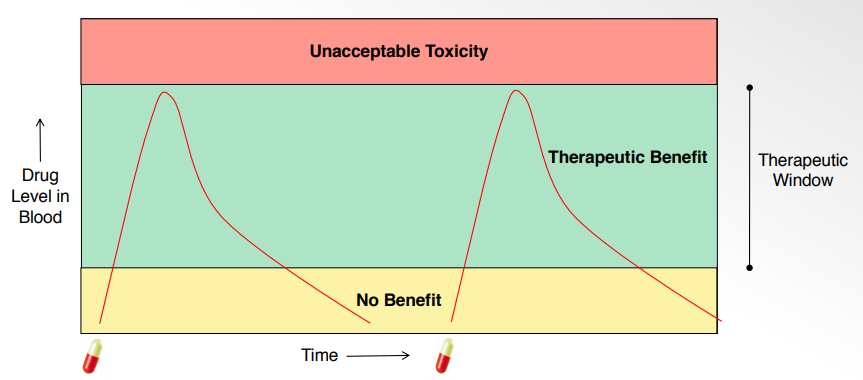
- 27Cyclesporine drug case example- used to suppress immune system activity = promote survival of transplant organs
- immune disorder and inflammatory disorders can be treated with this too
- dose dependent = more suppression
- increased risk for infections = toxic reaction because this is the intention of the drug
- kidney damage = side effect, not the intention of the drug
- rash, hives = could be allergic reaction, a risk of most drugs - 28Small (narrow) Therapeutic Window GraphExample: Assume that clinical target is beneficial effect in >90% of patients and toxicity <10% patients
Warfarin - could have fatal hemorrhages, the drug is safe over a small dosage window
Blot clotting time must be monitored closely for this to be safe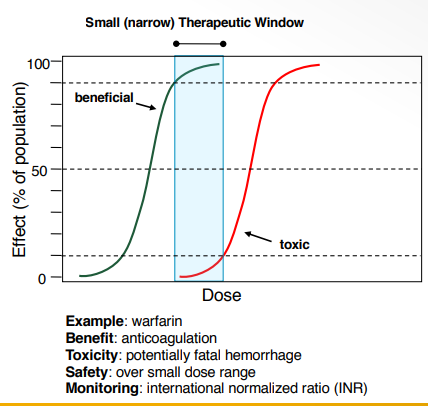
- 29Large (wide) Therapeutic WindowExample: Assume that clinical target is beneficial effect in >90% of patients and toxicity <10% patients
Aspirin = lower efficacy, can lead to GI bleeding, in general much safer, have to give a very high dose for it to become dangerous, don't need monitoring with ongoing use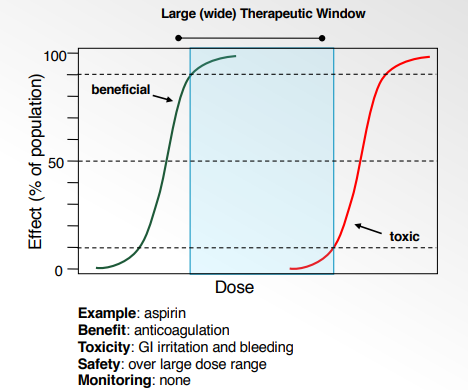
- 30Pharmacokinetics:• The quantitative study and characterization of the time course of drug concentrations in the body
• Utilizes simplified mathematical representations to model complex
physiological processes (absorption, distribution, metabolism, excretion)
• Describes the time course of drug concentrations in the body
• Can be related to drug effects (pharmacodynamics)
** Determines what dose and for how long each person will receive a drug** - 31AbsorptionMeasuring between site of administration to the distribution site, most likely the blood
- 32Drug distributionMovement from the distraction site such as the blood, and ending up at the drug target site
- 33A D M EAbsorption
Distribution
Metabolism
Excretion - 34Enteral Route1. Oral drugs
2. Gastric feeding tube
3. Rectal
desired effect is systemic (non-local), substance is given via the digestive tract - 35Routes for Drug Administration• enteral
• parenteral
• topical - 36Oral Route• Subject to first-pass effect
- Metabolism by intestine and liver enzymes
- Reduces amount of drug that ultimately reaches the systemic
circulation (bioavailability)
• Not suitable for drugs that:
-Rapidly metabolized
-Acid labile
-Known to cause GIT irritation - 37Parenteraldesired effect is systemic (non-local), drug is given by route other than digestive tract
1. Injection (most common)
2. Transdermal (nicotine patches)
3. Transmucousal
- Buccal (nitroglycerine)
- Insufflation (cocaine)
-Inhalational (general anesthetics) - 38Injection route• Most commonly intravenous, intramuscular or subcutaneous
PROS
• Intravenous injection is the most rapid means for delivery of drugs to systemic circulation = 100% bioavailability
• Bypasses first-pass effect
• Suitable for acid labile (easily broken down) drugs
CONS
• May require professional administration
• Costs associated with injection materials and disposal
• Requires sterile preparation - 39TopicalTopical
local effect, substance is applied directly where its action is desired
• epicutaneous (application onto the skin)
- local anesthesia
• inhalational
- asthma medications
• eye drops
- antibiotics for conjunctivitis
• ear drops
- antibiotics and corticosteroids
• intranasal
- decongestant nasal sprays
• vaginal
- topical estrogens, antibacterials - 40Rate and extent of oral drug absorption is affected by:1. Concentration difference across membrane
2. Size
3. Polarity
• Highly polar drugs are less efficiently absorbed
4. Ionization
• Highly ionized drugs are less efficiently absorbed
• Variable depending on drug structure (-COOH, -NH2)
• Dependent upon environmental pH
– Stomach: 1-3
– Duodenum: 5-7
– Rest of small intestine: 7-8
– Concentration difference across membrane - 41Physiological Factors That Affect Oral Drug Absorption1) Gastrointestinal Motility
• Decreased stomach emptying slows onset and/or rate of drug absorption
• Can be decreased by food, disease, drugs (opioids)
2) Metabolism
• Many drugs are metabolized by enzymes in enterocytes
• Contributes to “first-pass effect”
3) Changes in pH of Gastrointestinal Tract
• Affects ionization (charge) of acidic and basic drugs
• Can be altered by food, disease, other drugs (e.g. antacids) - 42extent of distribution is based on1. Blood flow (lung, kidney, liver > brain, skeletal muscle >
adipose, bone)
2. Ability of drug to traverse cell membranes (passive
absorption)
3. Degree of binding to blood proteins (e.g. serum albumin)
4.Unique properties of drug/tissue - 43Volume of distribution• The apparent volume of fluid
into which an administered
drug is dispersed
• “Apparent” because assumes
equal partitioning throughout
body (i.e. plasma concentration is equal to that of all other volumes)
•A small Vd (< 42 L) infers retention within the plasma volume
• A large Vd (> 42 L) infers retention in volumes outside of plasma
***As Vd increases, the dose (Q) of drug required to achieve a
particular initial plasma concentration (Co) also increases - 44Factors Contributing to a High Volume of DistributionPhysiochemical properties of drug
• high lipophilicity = high Vd
•low polarity = high Vd
•low ionization = high Vd
• low molecular = high Vd
Physiological properties of tissues
• Bones/Teeth = calcium (Vd = 100 L)
• Thyroid = Iodine-containing drugs are transported into this organ
• Adipose= Can accumulate large amounts of lipid-soluble drugs - 45Factors Contributing to a Low Volume of Distribution1. Physiochemical properties of drug
• Low lipophilicity, high polarity, high ionization and high molecular weight = low Vd
2. Binding to blood proteins
• Many drugs bind to blood serum albumin
• Albumin-bound drug is generally therapeutically inactive
• Binding is reversible
- Displacement by another drug can occur
- Can lead to a potentially dangerous increase in blood concentration of free (active) drug
- Of greatest concern for highly bound (>90%) drugs that have a small/narrow therapeutic
window/index
• e.g. Warfarin (Vd = 8 L) - 46BioavailabilityThe amount of administered drug that reaches the systemic
circulation in unchanged form following administration by any route - 47Phase I metabolismCreation or unmasking of small polar or
reactive functional groups
more often the rate limiting step - 48Phase II metabolismAddition (conjugation) of large polar
groups to small reactive functional groups - 49Cytochrome 450• 57 individual genes
• Multiple physiological roles
• Families 1, 2 and 3 are most relevant to drug metabolism
• Major contributors to Phase I metabolism
• Extremely broad substrate range
• Expression levels vary among individuals
• Enzymatic activity can be inhibited by drugs and diet components
• Expression levels can be induced by drugs and diet components - 50CYP3A4Cytochrome P450 3A4 (CYP3A4)
• Most relevant to human drug metabolism:
• Most abundant CYP in intestine (first-pass effect) and liver (first-pass effect,
systemic metabolism)
• Metabolizes 50-70% of drugs
- subject to inhibtion and inducers = have to carefully watch this enzyme - 51Inter-individual Differences in Drug Metabolism1) Diet and Environment
• Dietary components and co-administered drugs
• Smoking, occupational exposure
2) Age
• Children exhibit many differences from adults
• In general, drug metabolism is reduced in elderly
3) Disease
• In general, drug metabolism is reduced with disease (especially liver)
4) Genetic Factors
• Polymorphisms (genetic variants) exist for many drug metabolizing enzymes
• Affects expression level, inherent enzyme activity, response to inducers - 52Pharmacogenetics• Poor Metabolizers
– Markedly reduced CYP2D6 expression and/or activity
– Most common in Caucasians (5-10%)
• Intermediate Metabolizers
– Moderately reduced CYP2D6 expression and/or activity
– Most common in East Asia and Subsaharan Africa (15-30%)
• Extensive Metabolizers
– Normal CYP2D6 expression and activity
– Most common phenotype in all ethnic groups (50-90%)
• Ultrarapid Metabolizers
– Elevated CYP2D6 expression and activity
– Most common in Middle East, North Africa and Oceania (10-40%) - 53CssThe concentration of a drug or chemical in a body fluid – usually plasma – at the time a “steady state” has been achieved, and rates of drug administration and drug elimination are equal
rate of administration = rate of elimination
Information
- Description
- Med 1 Foundations Flashcards on Pharmacology - Foundations, created by Sarah Purcell on 16/09/2019.
- Created by
- Sarah Purcell
- Views
- 4
- Rating