
Flashcards
TNK108 DATANÄT
Cards in this deck (37)
- 1What transport services does an app need?Data Integrity
Timing
Throughput
Security - 2What layers does the OSI-model consist of?Application
Presentation
Session
Transport
Network
Data Link
Physical - 3What layers does the TCP/IP-model consist of?Network
Internet
Transport
Application - 4What does the protocol for the application layer define?Type of messages exchanged.
Message syntax.
Rules for how and when processes send and recieve msgs. - 5What does DoS stand for and how is it utilized?Denial of service:
Attackers overwhelm the target with data - 6When does packet loss occur?When the buffer/queue is full
- 7What factors affect queueing delay?Time waiting at output link for transmission
Congestion level at router - 8What factors affect transmission delay and what formula is used to calculate it?Packet Size (bits) - L
Link Capacity (bits/s) - B
d(trans) = L / B - 9What is the difference between packet- and circuit switching?Packet Switching - Msgs are broken up into packet at the application layers and sent over multiple links to reciever.
Circuit Switching - One link is set up to reciever and used to its full capacity. - 10What is the pros/cons of packet switching?Pros - Better utilization of network, connectionless.
Cons - Higher chance of delay and loss. - 11What does "store and forward" mean?That the entire message must arrive at a router before it can be transmitted to the next link.
- 12Name three types of guided physical media?Coxial cable
Twisted Pair
Fiber - 13What is the difference between guided/unguided media and give an example of each?Unguided - Doesn´t use a physical direct link between sender/reciever. ex. Wifi
Guided - Uses a physical link between sender/reciever. ex Fiber - 14What are the differences between the Client/Server model and P2P (Peer-Peer) model and give an example of how these are used?Client/Server - Uses server between sender and reciever to store data. ex. Email via server.
P2P - Direct communication between two hosts. ex. Skype - 15What factors affect propagation delay and what is the formula used to calculate it?Distance between sender and reciever, distance of used link (m) - D
Propagation speed of wave signal (b/s) - S
d(prop) = D / S - 16What formula is used to calculate the nodal delay? a) dnodal = dproc – dqueue + dtrans + dprop b) dnodal = dproc + dtrans – dqueue c) dnodal = dproc + dqueue + dtrans + dprop d) dnodal = dproc + dqueue – dtrans – dpropc) dnodal = dproc + dqueue + dtrans + dprop
- 17What service is provided by the Internet Protocol (IP)?Adresssing, providing nodes with unique IP-adresses used for routing and forwarding.
- 18What is the key difference between Collision Avoidance (CA) and with Collision Detection (CD), and where are they used in?CA - Avoids any error that might occur. Can send Reguest to Send in order to accomplish this.
CD - Dectects error on a link that is being used an corrects it. - 19What is the purpose of ARPAdress Resolution Protocol
It connects the IP and MAC adress. - 20What is the service provided by DNS?Domain Name System
It connects domain name of (for example)
a website and the IP-adress. - 21What is the difference between routing and forwarding?Routing - Sets a table of routes for packets heading to different destinations.
Forwarding - Sends a data packet to the right interface in a router. This makes sure the packet is sent to the correct next hop. - 22True or false? HTTP response messages cannot have an empty message body.False
- 23True or false? The size of the TCP rwnd can change throughout the duration of the connection.True
- 24Which cause of delay typically dominates in highly utilized multi-hop networks and why?Queueing delay
- 25Transmission delay does not depend on a) Packet length b) Distance between the routers c) Transmission rate d) None of the aboveb) Distance between the routers
- 26Propagation delay depends on a) Packet length b) Transmission rate c) Distance between the routers d) None of the mentionedb) Transmission rate
c) Distance between the routers - 27In the transfer of file between server and client, if the transmission rates along the path is 10Mbps, 20Mbps, 30Mbps, 40Mbps. The throughput is usually a) 10Mbps b) 20Mbps c) 40Mbps d) 50Mbpsa) 10 Mbps
- 28What is the difference between IP and MAC-adresses?IP-adresses are attached to network devices via software.
MAC adresses are unique within a network (local network) and attached to hardware. - 29How big is the MAC address space? The IPv4 adress space? IPv6?MAC: 2^48
IPv4: 2^32
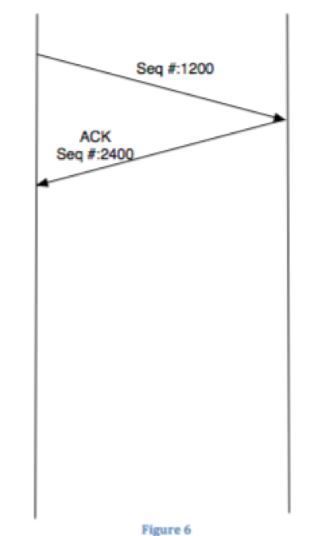
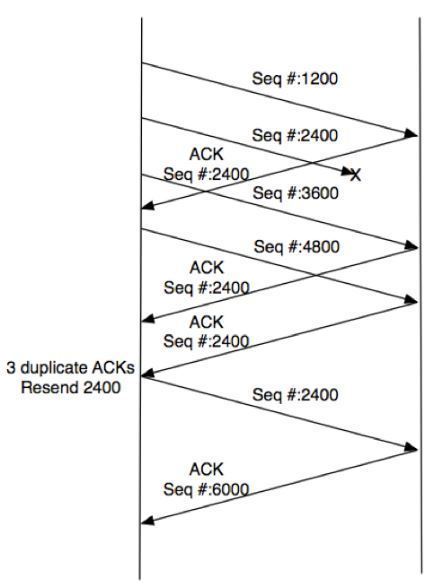
IPv6: 2^128 - 30Assume a TCP sender transmits 4 TCP segments with respective sequence numbers 1200, 2400, 3600, 4800. The sender receives four acknowledgements with the following sequence numbers, 2400, 2400, 2400, 6000. Complete Figure 6 to show what TCP segments are exchanged between sender and receiver.Seq #2400 doesn´t arrive but the sender sends the rest and the reciever acknowledges them but keeps asking for #2400
- 31What is always done in the beginning and ending of a communication between two hosts using a TCP-connection?An Handshake
- 32What are the two types connections for HTTP? And what are their differences?Non-Persistent: The connection is closed after the server sends the requested object to the client.
Persistent: The connection only closes after a certain amount of time of no information shared. - 33What is the main difference between s TCP and a UDP - connection?TCP - Requires handshake before sending data between sender/reciever.
UDP - No handshake, each packet has the destination IP and port attached to it. - 34What is the pros and cons of a UDP connection?Pros - Faster, especially when sending heavy amount of data.
Cons - Risk of loss, out of order. - 35What is the main service of the transport layer?Providing a logical connection between applications running on different networks.
- 36What does rdt stand for and what is the main problem with rdt2.0?Reliable Data Transfer
If a ACK or NACK is corrupted, the sender doesn´t know what to do. (one cannot simply send again...) - 37What is the main difference between rdt2.0 and rdt2.2?rdt2.2 is a NAK-free protocol.
Information
- Description
- Flashcards on TNK108 DATANÄT, created by Tobias Aspegårdh on 08/01/2020.
- Created by
- Tobias Aspegårdh
- Views
- 102
- Rating