
Flashcards
AVO
Cards in this deck (31)
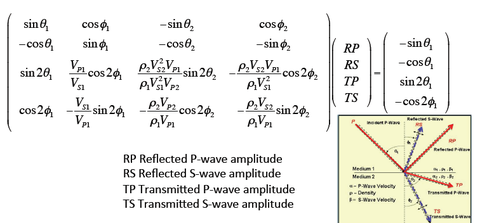
- 1Zoeppritz equation
- 2Can Zoeppritz equation be simplified? Shuey 3-term approximation For the reflection coefficient R(theta) as function of Vp, Vs and Density
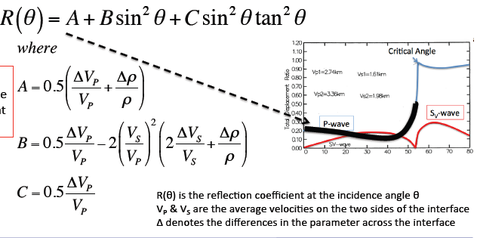
- 3Shuey's 2-term Approximation of Zoeppritz Small incidence angle approximation Smaller than .... How many degrees?40 Degrees
Ro = Intercept, Normal incidence RF G=AVO gradient
Theta = x-axis but we plot sin^2theta
R(theta) = Ro + G sin^2(theta) - 4AVO Intercept and grandientRo = Zero-offset Normal reflection coefficient is controlled by the contrast in Acoustic impedance
G= Gradient, is more complex in terms of rock properties Vp, vs , density - 5AVO Sands classification Rutherford and Williams
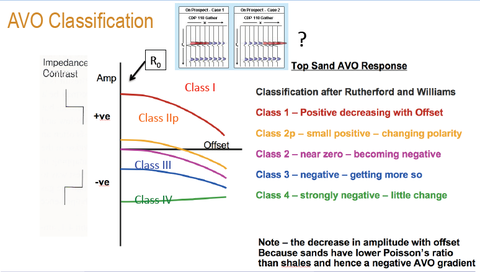
- 6Description of AVO classification Type of sands I, IIType 1: Hard sands with hydrocarbons, little sensitivity with fluids (+ve always and decreasing with offset)
Type 2: Transparent sands with hydrocarbons often show DIM SPOTS, could be small +ve that change polarity with offset or near zero becoming -ve - 7Description of AVO sands classification Type III and IVType 3: Classic AVO anomaly, negative amplitude that becomes more negative with offset. High fluid sensitivity and relatively soft sands
Type 4: (Rare) Soft sands with gas overlain by relatively stiff cap-rock shales
(strong -ve with no change) - 8AVO Classification with depth
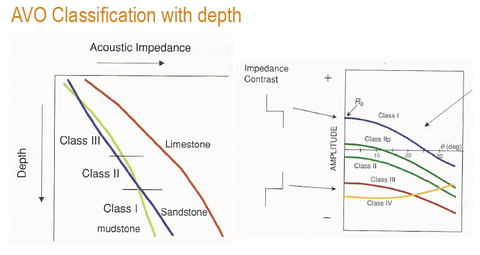
- 9AVO Classification and its response in seismics Bright Spot, Dim Spot and polarity reversal.
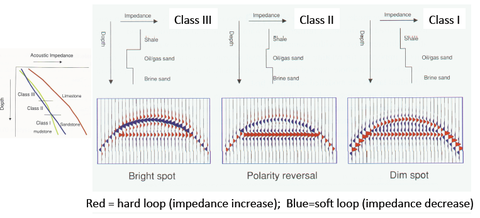
- 10Dim SpotLow amp seismic. It primarily results from the decrease in acoustic impedance contrast when a hydrocarbon (with a low acoustic impedance) replaces the brine-saturated zone (with a high acoustic impedance) that underlies a shale (with the lowest acoustic impedance of the three), decreasing the RC
- 11Bright SpotA bright spot primarily results from the increase in AI contrast when a hydrocarbon (with a lower AI) replaces the brine-saturated zone (with a higher AI) that underlies a shale (with a higher AI still), increasing the RC. Local High amplitude as opposed to the Dim spot (Local low amp)
- 12AVO in sands Cementation trend and Hydrocarbon trend
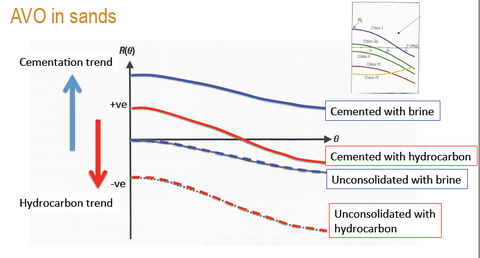
- 13Brine, Oil and gas filled sand AVO responsesSchematic shale-over-sand model:
Brine gets slightly less +ve with offset
Oil gets slightly more +ve with offset
Gas gets strongly more –ve with offset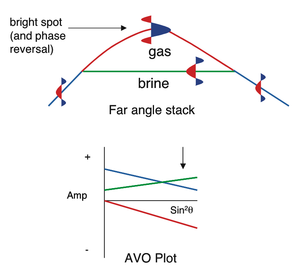
- 14AVO Computing angle of incidenceComputing angle of incidence To=Zero-offset TWT
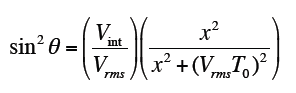
- 15Measuring AVO on real gathers is not straight forward...Residual Moveout may distort the measurement
Scaling issues between near and far offsets, as the Spherical divergence correction might be applied inaccurately
Is much easier to use AVO qualitatively to look for lateral variations than quantitatively (Porosity e.g) - 16Advantages of partial offsets / angle stacksS/N ratio is higher
The horizon int can be used for the near and far vol (amp slices along horizons)
Partial stacks remove Residual moveout
Scanning the far traces amp from a sub-vol is a more efficient way to determine anomalous amp as Class III
Pre-stack migration re-locate the stacks - 17Oil Sands and their amplitudesNears = Small Amp
Mids = Moderate mid amp
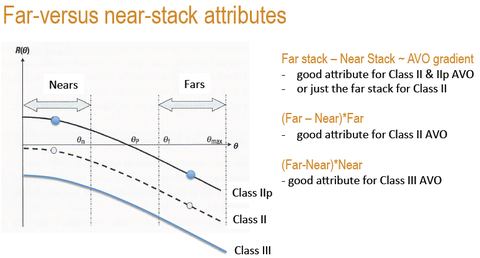
Fars = High far amp - 18Far versus near stack attributes AVO Class II and III
- 19AVO Cross plot definitionAVO crossplots Ro and G can be calculated for each loop on every CMP gathers by measuring the amplitude and then finding the best fit for a plot R(theta) vs sin(theta)^2
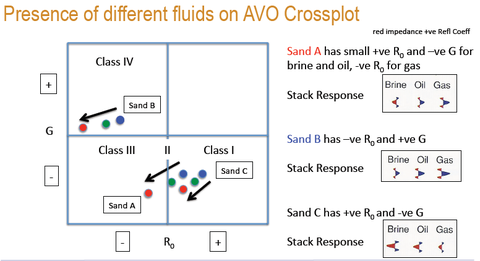
- 20What happens to Ro and G when you pass from brine to oil to gas?In general, the trend is that G and Ro will move towards the negative values
- 21Presence of different fluids on AVO crossplot 4 quadrants 3 Types of sands A,B,C
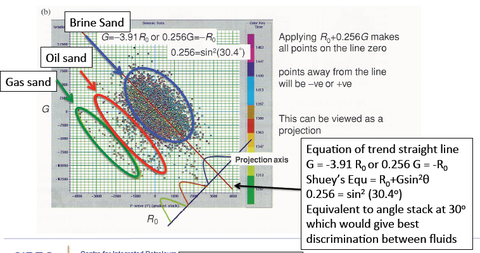
- 22To differentiate AVO fluids in the cross plots is not to say that one is more negative than another you need a reference line to be plotted as you zero, and so everything below (-ve) and everything above (+ve) Equivalent to which angle stack???
- 23Lambda - mu estimationsUse of lamé parameters to differentiate fluid content on sands from pre-stack data
Invert the P and S reflectivity from pre-stack data and using the density
mu*rho= ImpedanceS^2
Lambda*rho= impP^2-2impS^2 - 24AVO WORKS ALWAYS?For a certain depth interval
Need Fwd 1d reflectivity model previously to analyse if will work - 25AVO Attributes Smith and Gidlow fluid factorFirst, generate P and S wave reflectivity sections.
Secondly, Estimate gamma=Ro/So for a non-hydrocarbon water wet bkgd window
Thirdly, estimate for each sample the fluid factor
dF(t) = Gamma( Ro - So)
Lastly, Analyse dF=0 for non-hydro zones - 26AVO Attributes Ro * G Intercept * GradientWhen hydrocarbon sands are Class III Ro*G is +ve because both are negative
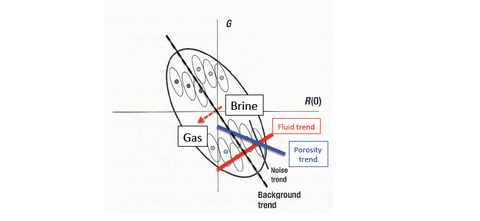
When brine sands are class I Ro*G will give -ve because Ro is positive and G is negative - 27AVO MAIN TRENDS FLUID CONTENT MORE NEGATIVE FROM BRINE TO GAS POROSITY TREND MOSTLY POSITIVE
- 28AVO DETECTION OF OVERPRESSURE DIFFERENTIATE BETWEEN GAS SANDS AND OVERPRESSURE Vp/ Vs ratioVp/Vs ratio in overpressure zones HIGH
Vp/Vs ratio in gas sands is LOW - 29Aki and Richards Simplification Assumptions taken What you can calculate from the gradient ??Vp/vs ratio equal to 2.0
sen(theta) = tan (theta) Angles smaller than 40 degrees
Zero offset both reflection coefficients
R(theta) = Ro + (Ro + 2 So) sin^2(theta)
Ro= intercept
Ro + 2 So = Gradient - 30S wave reflectivity calculated from the AVO gradient, the Reflectivity of P-WAVE at zero offset assumes that ?Is equal for non-hydrocarbon and for hydrocarbons
- 31Castagna and Smith discovered that the difference between Ro - So is a good??Gas Sand discriminant
Because changes in pore fluid will affect Vp and not vs and...
The changes in lithology will affect both Vp and Vs.
Information
- Description
- Flashcards on AVO, created by Vanerahal on 18/04/2015.
- Created by
- Vanerahal
- Views
- 3
- Rating