
Flashcards
Recombination
Cards in this deck (45)
- 1Reasons for recombinationcrucial for generating diversity
(without recombination genomes would be relatively static)
over a long period of time gradual accumulation of mutations results in small-scale alterations. Recombination increases the rate of evolution by bringing together combinations of favourable alleles and getting rid of deleterious alleles. - 2List 3 ways recombination contributes to disease1. antigenic variation
2. Immunoglobulin (antibody) class switching
3. Defects in DNA repair (cancer) - 3How does recombination effect the combination of favourable allelesWithout recombination the combination of two favourable alleles within a single progeny would be very slow.
with recombination this outcome arises rapidly due to genetic exchange. - 4All organisms carry a burden of deleterious alleles caused by mutation. In what way does recombination avoid accumulation of deleterious alleles?recombination between 2 individuals carrying 2 different deleterious mutations = progeny lacking them (rapid method)
slow method --> back mutation
without recombination a species has no escape from the continuous accumulation of deleterious alleles. - 5Recombination can be broadly divided into:- homologous recombination (perfect)
- non-homologous recombination (introduces error) - 6List instances in nature when recombination occurs. (mnemonic)(DAT MSC)
1. During bacterial conjugation
2. Site specific recombination
3. Transposition
4. DNA repair
5. Meiosis
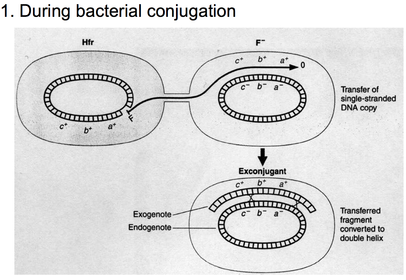
6. Generation of antibodies - 71. Bacterial conjugationhorizontal gene transfer between bacterial cells by conjugation tube (cell-to-cell contact).
F-plasmid can integrate itself into genome and get transfered form one bacteria to another via conjugation tube.
It copies itself = recombination of old and new strand.
Homologous recombination as the 2 sequences are similar.
one of the mechanisms how antibiotic resistance spreads in hospitals. - 8Bacterial conjugation diagram
- 92. Site-specific recombinationhomologous recombination occuring between DNA molecules with very short sequences in common.
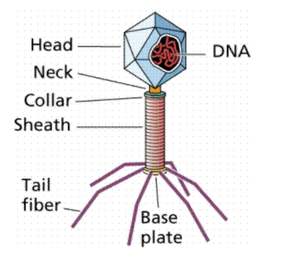
e.g. important in the infection cycle of bacteriophage lambda (λ) --> 2 possible pathways (next card) - 10what is λ bacteriophage?a virus (obligate intracellular parasite) that infects bacteria --> in reality kills and lyses bacteria cells
used commonly as a model organism in molecular genetics; used as a vector for cloning of recombinant DNA - 11Describe λ bacteriophage infection cycles (obligate intracellular pathway) use E. coli as an example2 pathways : lytic and lysogenic pathway (nxt pg)
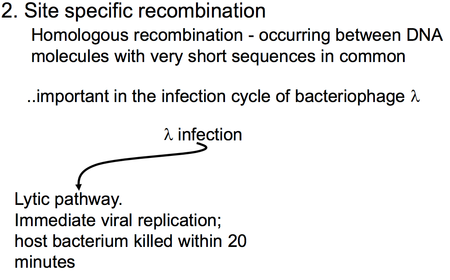
lytic pathway = no recombination, immediate viral replication and bacterium killed within 20m:
- Adsorption and penetration (DNA or RNA is injected into bacteria by phage).
- arrest of host cell gene expression, phage genetic info is expressed, taking over host cell and redirecting machinery to phage replication --> phage replication, formation of new virus particles.
- host cell bursts open, ejects new viruses into environment at which point host is destroyed (lysed).
= takes 20 minutes at 37C - 12lytic recombination pathway diagram
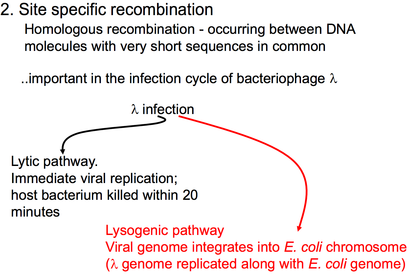
- 13Describe λ bacteriophage lysogenic infection cycles (obligate intracellular pathway) use E. coli as an examplelysogenic pathway (recombination involved, viral genome integrates into E. coli chromosome):
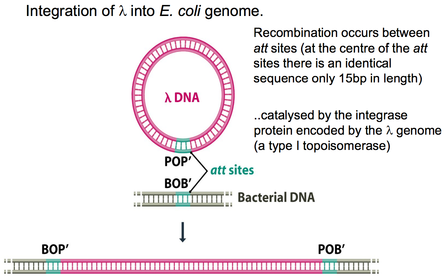
- upon entry λ DNA circularises and aligns specific att region with att region on E. coli genome.
-recombination occurs between att sites (contains an identical 15bp sequence), catalysed by integrase protein encoded by λ genome (type I topoisomerase).
It then becomes a silent prophage synthesising inhibitor of its further replication.
In stressful situations that could result in cell death the lysogenic pathway can flip to the lytic pathway = so virus can escape and survive. - 14Lysogenic recombination pathway diagram
- 15diagram of DNA integration into E. coli genome during lysogenic recombination pathway
- 163. transpositionAll metazoan genomes (includes bacteria, yeast, humans) have transposons; parts of genome that are mobile = genetic diversity.
Humans are full of transposons!
3 modes (by definition all 3 mechanisms must involve recombination).
1. replicative transposons - original remains in place, new copy appears elsewhere
2. Conservative transposons - original moves to a new site
3. retroelements - transpose via an RNA intermediate (transcribed into RNA, then reverse transcribed into DNA by reverse transcriptase and that DNA moves to a new site) - 174. DNA repairRepair of double stranded breaks (most toxic type of DNA damage)
2 separate pathways;
1. non-homologous recombination
(non-homologous end joining) --> makes mistakes -called non-homologous as does not require a homologous DNA strand.
2. homologous recombination
--> perfect mechanism - 18non-homologous recombination (non-homologous end joining)repairs double stranded DNA breaks, but makes mistakes.
- Ku proteins (Ku70 and Ku80) attach to free ends preventing chromosomes from drifting apart.
- Ku proteins then recruit DNA-PKcx (DNA protein kinase) forming a complex.
- complex recruits XRCC4 which recruits DNA ligase IV to repair DNA.
- DNA ligase IV restores the 2 lost phosphodiester bonds = fixed chromosome - 19non-homologous recombination diagram
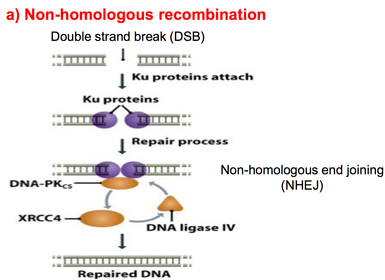
- 20homologous recombinationhomologous recombination is a perfect mechanism.
only works in dividing cells (post S phase) as requires another intact chromosome as a template.
- exonuclease removes a few bases from each 3' end (resection) --> intentional DNA loss always happens before homologous recombination
- free strand invades homologous intact duplex promoted by recA (prokaryotes)/ Rad51 (homologue in humans). --> highly conserved during evolution = important.
- heteroduplex (2 chromosomes) forms; donor strand used as a template for repair.
- resolution (resolving mixed duplex) at junctions (DNA ligase) = 2 identical duplexes with no damage. - 21homologous recombination diagram
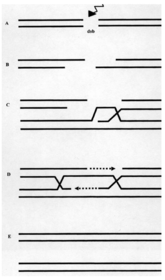
- 225. MeiosisProphase I: homologous chromosomes align as pairs along equatorial plane of cell (synapsis).
DNA exchanged between non-sister chromatids, involving breakage and reunion - duplexes physically held together at discrete sites (chiasmata).
Another breakage and reunion event generates separate chromosomes
Meiosis I: homologs recombine = chiasmata (not just a crossing over but a migration of branch to allow for recombination -they have to get close). - 23Meiosis diagram
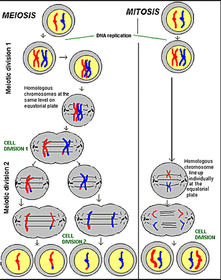
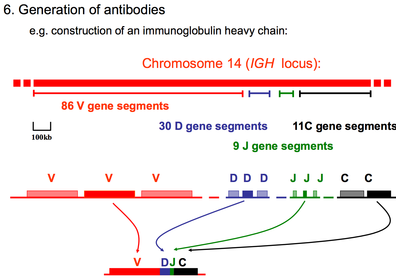
- 246. Generation of antibodiesGenome rearrangements in same individual are responsible for immunoglobulin (antibodies) and T-cell receptor diversities.
Humans can make much more different immunoglobulins than they have genes!
Due many forms of the VARIABLE REGION (antigen binding) of the immunoglobulin.
example of non-homologous end joining as you are joining different segment types.
nxt page - 25Before B cell maturation 1 V gene segment recombines with 1 of D and J and C segments = can have many many different variations. During maturation the extra VDJC segments are then lost and that particular B cell can only synthesise that particular antibody. = many many B cell variations Rag-1 and Rag-2 (expressed in progenitor lymphocytes) induce required double strand breaks. Ends generated are non-homologous and are recombined by the Ku complex. crucial role of these proteins (Rag1/2, ku70/80, XRCC4 or Lig4) confirmed by transgenic mice. NHEJ is responsible for antibody and T-cell receptor diversity.
- 26Homologous recombination is the most important type in nature. why? Explain the formation of the holliday structure.-meitotic crossing over
-integration of transferred DNA into bacterial genomes
Holliday structure:
1. formation of a heteroduplex (RecBCD and RecA --> Rad51 human equivalent)
2. branch migration (DNA swaps via RuvAB)
3. resolution (RuvC nuclease separates duplexes) - 27Holliday structure1. heteroduplex formation:
RecBCD binds to 1 duplex, migrates along unwinding DNA until specific site then nuclease makes a single stranded cut 56 nucleotides to the 3' end of this site. RecA (Rad51 in humans) then binds to and polymerises on single stranded DNA forming a helical nucleoprotein filament that mediates invasion of and pairing with intact DNA = D loop. Cleavage of displaced strand at junction = heteroduplex.
2. branch migration
RuvAB acts as molecular motor – binds and rotates helices = branch points can move exchanging DNA segments. At specific stop site RuvAB detaches.
3. resolution
RuvC (nuclease) carries out cleavage = resolve holliday structure. - 28Recombination and disease1. recombination drives antigenic variation (from gene conversion) in pathogens.
Mutant alleles in genes encoding proteins that drive recombination lead to:
- failure to make antibodies/T cell receptors
2. Faults in class switch recombination (failure to perform immunoglobulin class switch).
3. genomic instability and accumulation of mutations = cancers (BRCA1/2 mutations, double strand breaks are repaired predominantly via error prone mechanisms = increased mutation rate) - 291. Antigenic variation due to gene conversionAfrican Trypanosomes (tseste fly) cause sleeping sickness.
The parasite surface coat is predominantly made of variable surface glycoproteins (VSG) - only antigenic structure exposed on surface.
Trypansosome expresses only 1 VSG at a time, but switches every 2 weeks - immune system lags behind.
Each VSG species is immunologically distinct (10% genomes codes for diff VSG genes) = antigenic variation.
VSG switch involves recombination via gene conversion process: active expression linked copy (ELC) locates at expression site (ES) on telomere is replaced by a pre-existing silent copy. - 30advantages of antigenic variation in trypanosome exampleVSG triggers an immune response which reduces host parasite number, preventing rapid death of host (in its interest, needs host).
trypanosome evades immune surveillance, because immune system always lags behind the change in surface antigen.
each VSG transition is accompanied by a new wave of parasitemia --> cylce = host dies slowly - 312. class switch recombination - changing the class of Ig- Immunoglobulins are divided into 5 classes dependent on constant region type in the heavy chain (IgM, IgD, IgG, IgE, IgA).
- All lymphocytes start by making IgM.
- a single class of ig is made at one time, but can change.
- class switching involves substitution in the type of constant region in heavy chain only (variable region stays the same).
- recombination occurs between specific regions, DNA inbetween is lost = new Ig.
Ku proteins and DNA-PKc are involved (like in NHEJ for double strand breaks). Also cytidine deaminase is activated - converts cytidine to uridine in nucleic acids, uracil DNA glycoslyase removes uracil = apurinic site - now recognised by nuclease. - 32Defects in class switchingclass switch recombination is blocked in B cells in HIV+ individuals (blocks IgG and IgA production).
CD4 T helper cells are infected by HIV, not B cells.
However infected cells release HIV-1 protein Nef
Nef blocks signalling pathways that activate class switch recombination in B cells = prevents antibody class production that are adept at neutralising and clearing virus - 332 ways in which HIV fights immune system- kills CD4+ T helper cells
- inhibits B cell class switch recombination ability by Nef (T cell protein) interrupting the signalling pathway activating class switch recombination in B cells. - 34hyper IgM syndromeIGM2 (form of hyper IgM syndrome) male normal or high amounts of IgM but very little IgG or IgA. (can only make IgM as its the first)
therefore susceptible to bacteria infection (immune system efficiency compromised).
Homozygous for mutations at locus encoding activation induced cytidine deaminase. = class switch recombination blocked - 353. defects in recombination can lead to cancer. Use breast cancer as example5% breast cancers are heritable, rest are sporadic.
most heritable breast/ovarian cancers due to BRCA1 or BRCA2 mutant germ line alleles.
BRCA1 (breast cancer associated 1) - identified 1994 in the US, BRCA2 1995, UK, through positional cloning using data from families with inherited breast cancer.
female carriers have a risk of 50-80% developing breast cancer and 30-50% for ovarian cancer.
Both BRCA 1 and 2 involved in homologous recombination. - 363 observations implicating BRCA2 role in homologous recombination1. BRCA2 physically interacts with Rad51 (essential for strand invasion step)
2. BRCA2 localises at sites of DNA damage (co-localising with Rad51, so does BRCA1)
3. BRCA2 and Rad51 deficient cells share a similar phenotype; extreme sensitivity to ionizing radiation. - 37BRCA 2 structure
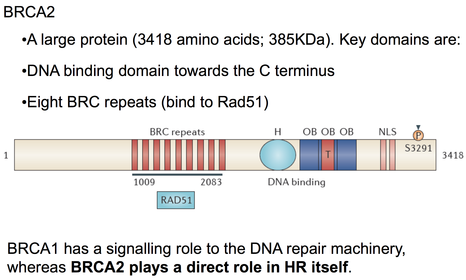
- 38BRCA2 function- Rad51 binds to BRC repeats.
- BRC provides an assembly line of Rad51 monomers.
- BRCA2 binds to single stranded DNA at double strand break.
- enables orderly assembly of Rad51 onto single stranded DNA forming a nucleoprotein filament.
-Rad51 is inefficiently recruited to double strand breaks in cells with mutated BRCA2. - 39Explain how a mutation in BRCA2 results in increased risk of cancerthe physical interaction between BRCA2 and Rad51 is essential for error free homologous recombination.
Defect in BRCA2 means that Rad51 -ssDNA nucleoprotein filament will not form!
therefore strand exchange between paired DNA molecules will not occur.
double strand breaks will not be repaired by homologous recombination, but by non-homologous end joining instead --> errror prone (loss of nucleotides at new junction) - 40What type of mutations are BRCA2 usually?typically deletions that aren't multiples of 3 = frameshift
e.g. all BRCA2 mutations in icelandic citizens are a 5bp deletion at protein 999 --> truncated protein
= example of founder effect
(spanish families and ashkenazi jews) - 41Why do female BRCA1 and BRCA2 mutation carriers develop breast/ovarian cancer specifically? as opposed to other cancers?Reasons are unknown.
One explanation: DNA damage is associated with estrogen metabolism (involves generation of free radicals), so damage will accumulate in estrogen responsive tissue if BRCA1/2 is mutated. - 42How do double strand breaks appear in the first place?- ionising radiation
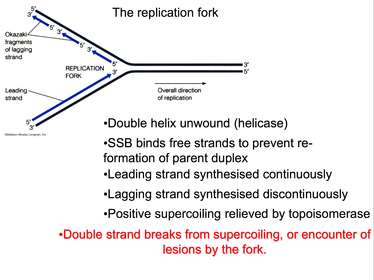
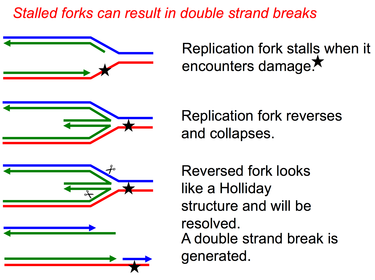
- replication errors
(collapsed replication forks - fork stalls due to damage, then reverses and collapses, reversed forks look like holliday structure and is therefore resolved = double strand break). - 43—
- 44Possible therapy of heritable breast cancer?understanding BRCA1/2 action will lead to therapy of heritable breast cancer
in normal cell; damage is repaired by base excision repair (involving poly ADP ribose polymerase (PARP))
In the presence of PARP inhibitors +BRCA1/2 cells damage is repaired not by base excision repair but by homologous recombination repair.
in -BRCA1/2 cells homologous recombination repair cannot take place (neither can NHEJ due to PARP inhibitor) and thus cells dies due to excessive DNA damage accumulation.
= tumour selective. - 45PARP inhibitors are currently in clinical trialsBase Excision Repair recap:
repairs damage to a single nitrogenous base by deploying enzymes called glycosylases. These enzymes remove a single nitrogenous base to create an apurinic or apyrimidnic site (AP site). Enzymes called AP endonucleases nick the damaged DNA backbone at the AP site. DNA polymerase then removes the damaged region using its 5’ to 3’ exonuclease activity and correctly synthesizes the new strand using the complementary strand as a template.
Information
- Description
- Flashcards on Recombination, created by melanie.selina7 on 24/04/2015.
- Created by
- melanie.selina7
- Views
- 0
- Rating