
Flashcards
Plastics part 1
Cards in this deck (200)
- 1Densitymass per unit volume
- 2What is density normally measured in?pounds per cubic inch (lbs/in3
) or grams per cubic centimeter
(g/cm3) - 3specific gravitythe relative density of a material to the
density of water at 23ºC as a ratio - 4homogeneousuniform
- 5heterogeneousvarying
- 6isotropicat a point are the same, independent of the
direction in which they are measured - 7anisotropicdepend on the
direction in which they are measured - 8Molded (or cast) metals and plastics tend to be reasonably : (anisotropic or isotropic)isotropic
- 9extruded plastic film and rolled and sheet metal products (an or iso)oriented biaxially and are
anisotropic - 10Composite materialsfiber reinforcements are carefully oriented in the directions
of applied load and surrounded by a plastic matrix ( anisotropic) - 11Hydrophillic v. Hygroscopic v. Hydrophobicabsorbs & bonds
just absorbs
repels - 12Ratio of the expected reduction in part dimension as the part solidifies in the mold and cools to room temperature to the original mold dimensionsMold Shrinkage
- 13Mold Shrinkage is expressed in:in/in, cm/cm or % shrinkage
- 14who uses Mold Shrinkage to design the mold to compensate for shrinkage and how?Mold maker and cavity is larger
- 15—transparent
- 16—Translucent
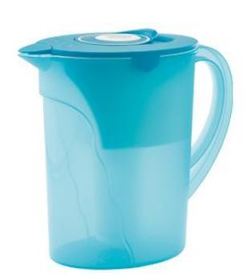
- 17—opaque
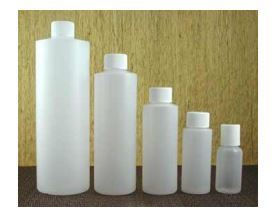
- 18Refers to the load-bearing characteristics of a material under relative motion.Lubricity
- 19Lubricity is also referred to asthe “anti-wear” property
- 20Good Lubricity =o low coefficients of friction with other materials
o do not have the tendency to gall (wear away) - 21Nylon and Acetal have good or bad lubricity?good
- 22how can you improve lubricityMaterials can be compounded or parts impregnated with oils or other
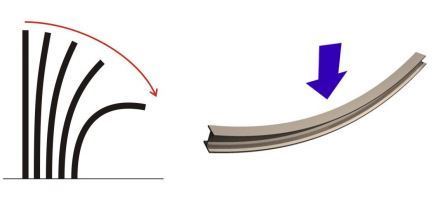
lubricants - 23—flexural load / bending
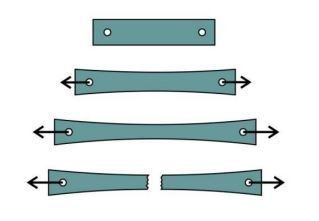
- 24—tensile load / tension
- 25—twisting load / torsion
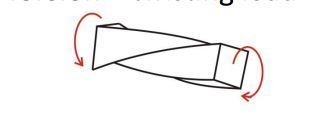
- 26—compressive load / compression
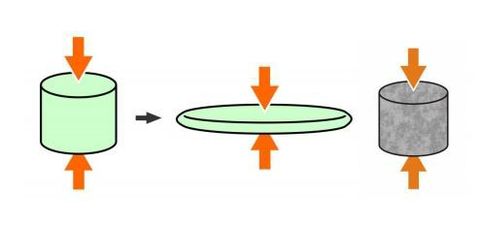
- 27—parallel load / shear
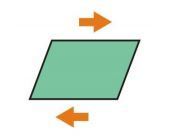
- 28stressinternal forces that develop inside the
material in REACTION to the applied strain. measured in pressure - 29straindeformation as a result of an
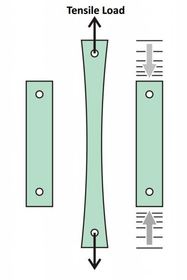
applied force - 30Also called flexibility, is the ability for a material to retain (recover) its original shape after being deformed, bent, compressed, or stretched under load and that load is removedElasticity
- 31The ability for a material to be permanently molded, bent or deformed under loadPlasticity
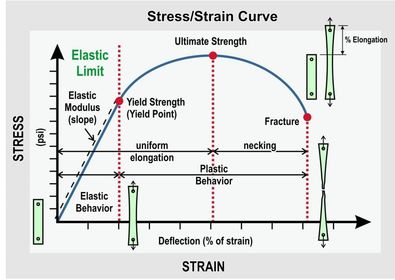
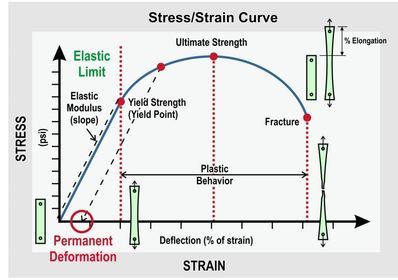
- 32The workable limit of a material, beyond which that material under load transitions from its elastic behavior to its plastic behavior and/or failureYield Strength
- 33The maximum stress a material can withstand before failing or breakingUltimate Strength
- 34Most plastics have ______ elasticity.limited
- 35Rubber and thermoplastic elastomers (TPEs) have _______ elasticityexcellent
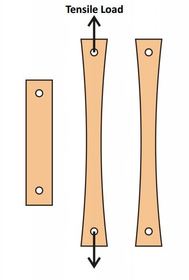
- 36When thermoplastics are heated to their softening point, they have almost perfect plasticity, meaning that...they hold their shape when cooled
- 37Ability of a material to be stretched, pulled, or rolled into shape without destroying the integrity of, or rupturing, the material. • chewing gum or taffyDuctility
- 38Ability of a material to absorb mechanical energy without fracturing. • elastic or plastic deformationToughness
- 39Describes how a material fails by breaking or snapping as opposed to bending or deforming as aductile material would. • lack of toughness • opposite of ductilityBrittleness
- 40—elastic behavior
- 41—plastic behavior
- 42—know these things
- 43—know this
- 44Elastic (Young’s) Modulus
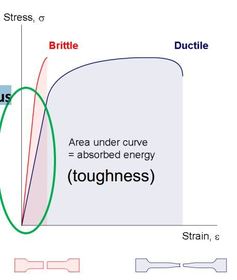
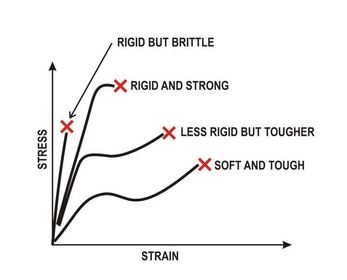
- 45Strength vs. ToughnessStrength indicates how much force the material can support,
while toughness indicates how much energy a material can
absorb before rupturing - 46A measure of the ease with which a crack propagates through a material from a pre-existing notch, crack, or sharp corner.Notch Sensitivity
- 47—yep
- 48The temperature at which a material deforms under a specified loadHeat Deflection Temperature (HDT)
- 49Heat Deflection Temperature (HDT) is used to:determine if a specific material is suitable in an environment
that may experience elevated temperatures - 50—Most plastics typically start to lose their mechanical properties at
around 180°F, but can be as low as around 120°F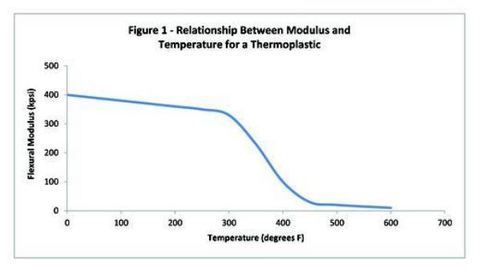
- 51list some key traits of plastics part 1• Built from hydrogen, carbon, nitrogen, oxygen, fluorine, silicon, sulphur, and chlorine atoms. Most are derived
from petroleum, but some are derived from plants like polylactic acid which is derived from corn starch. - 52list some key traits of plastics part 2Primary ingredient: organic polymer with a large molecular weight.
• Can be shaped by “flow” at some stage of their manufacture (e.g., “plastic” state).
• “Solid” in their finished state.
• Includes elastomers.
• Referred to in the industry as
“Plastics”, “Resins” or “Polymers” - 53—
- 54—
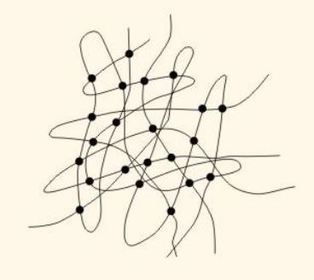
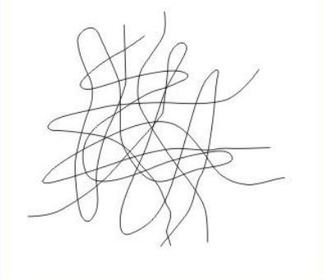
- 55Thermoplastic vs ThermosetThermoplastics can be melted and re-melted: (heat weakens the polymer chains)
Thermosets can NOT be melted or re-melted: (polymer permanently cross links) - 56examples of thermoplasticsBoth crystalline (e.g., HDPE, PP, nylon)
and amorphous (PS, ABS, PC, acrylic, etc.) - 57examples of thermosetsMostly 2-part resin systems like
epoxy, polyester, polyurethane,
silicone, melamine, etc. - 58thermoplasticsmore commonly used
• wide range of physical and mechanical
properties
• molded in softened and liquid states
and higher temperatures (up to 500°F)
• requires heat and tooling that can
withstand that heat
• can be recycled or reground to be molded again (with some restrictions - 59thermosetscan be molded at room temperature
• heat does not soften, so it can be
used in high-heat environments
• heat is a by-product of crosslinking
chemical reaction (curing material
can get hot), up to 250°F
• can be brittle if crosslinking is too
fast or if there is no reinforcement
(e.g., glass reinforcement)
• can not be recycled - 60—Crystalline
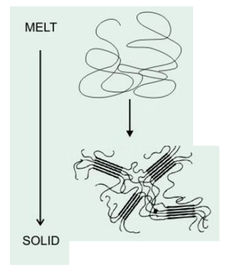
- 61name 3 crystalline plasticsTypical Crystalline
Thermoplastic Resins:
HDPE, LDPE
• Polypropylene
• Acetal
• PBT
• Nylon
• Glass-Filled Nylon
• TPEs - 62—Amorphous
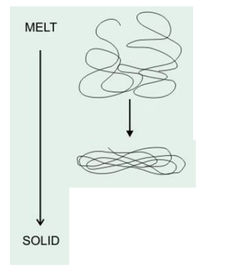
- 63list 3 amorphous plasticsTypical Amorphous
Thermoplastic Resins:
• Polystyrene
• ABS
• Acrylic
• Amorphous
• Polycarbonate
• PC/ABS
• PVC
• Polyester
• Cellulosic - 64what does tg stand for?Glass Transition
Temperature
(material softens) - 65what does Tm stand for?Melt Transition
Temperature
(material melts) - 66—
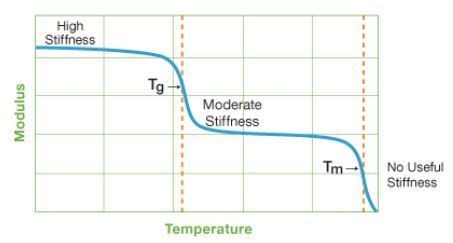

- 67—
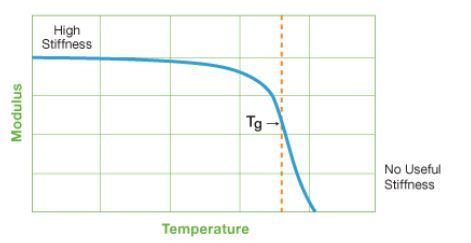

- 68list 3 crystalline polymersPolyethylene (PE), PBT, Polypropylene (PP)
- 69list 3 amorphous polymersPVC, Polystyrene, Acrylic, ABS, PPO,
Polycarbonate (PC), Polyetherimide - 70list qualities of crystalline polymerssharply-defined melting point
• high shrinkage and potential warpage
after molding (particularly relative to
material flow)
• lower impact strength and lower stiffness
than amorphous materials
• high heat resistance but low heat
deflection temperature (HDT)
• usually opaque due to molecular
structure
• good fatigue endurance
• good lubricity; wear resistance
• good chemical resistance
• ability to flow in thin-walled sections - 71list qualities of amorphous polymerswide melting range
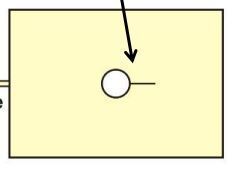
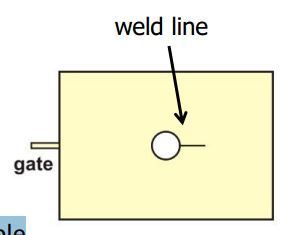
• low shrinkage after molding with
less distortion
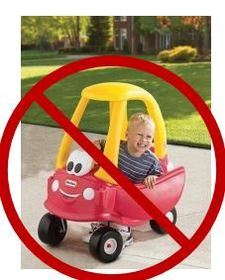
• better impact and lower chemical
resistance than crystalline polymers
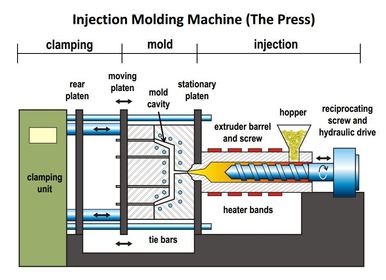
• moderate heat resistance
• dimensional stability
• can be transparent or water-clear
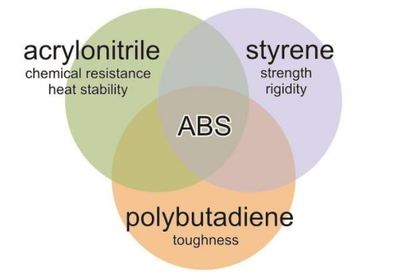
• superior cosmetics of outer surfaces - 72what makes up ABS (and what does ABS stand for?)Acrylonitrile Butadiene Styrene
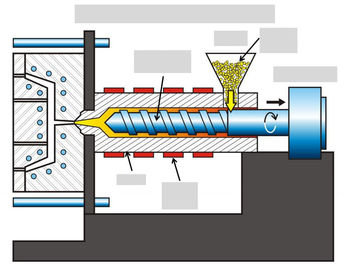
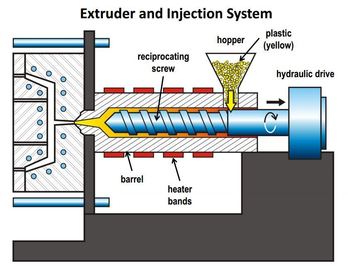
- 73list some Plastic structural Reinforcements(glass fibers, carbon fibers, metal
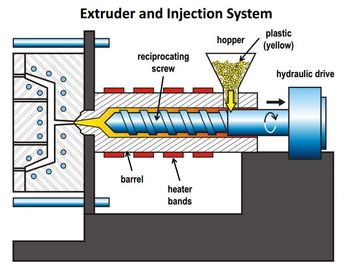
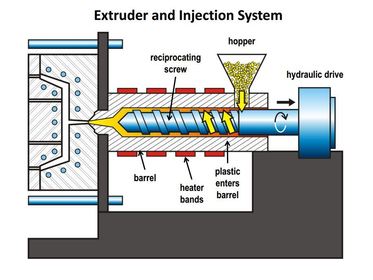
fibers, aramid fibers, jute,
polyester fibers) - 74list some additivesColorants
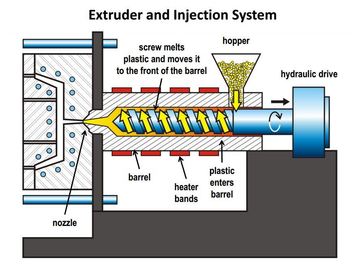
UV Modifiers
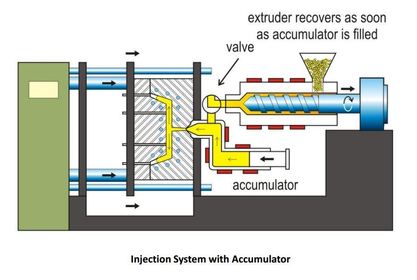
Plasticizers
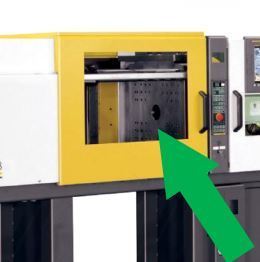
Impact modifiers
Flame Retardants
Anti-Statics
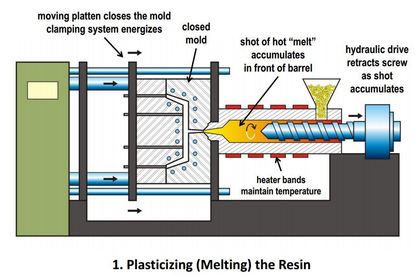
Foaming Agents
Anti-bacterial
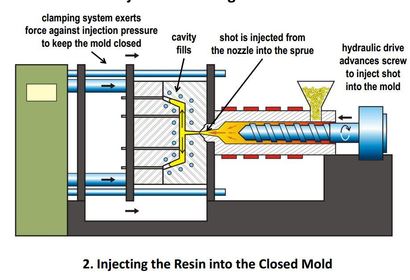
Fungicides
Scent capsules - 75list some fillersglass spheres, talc, mica flakes,
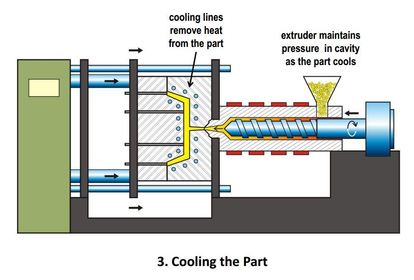
ceramic powders, silica sand,
carbon black, wood flour) - 76—


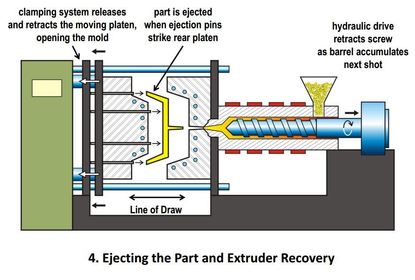
- 77—

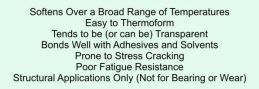
- 78semi-crystalline thermoplastics key characteristics cont'd• High shrinkage and potential warpage after molding (particularly relative to material flow - orientation).
• Ability to flow in thin-walled sections.
• High heat resistance, BUT low heat deflection temperature (HDT).
• Good toughness.
• Good chemical resistance.
• Good lubricity; wear resistance
Lower impact strength than amorphous materials.
• Lower stiffness than amorphous materials. - 79pros to hdpe
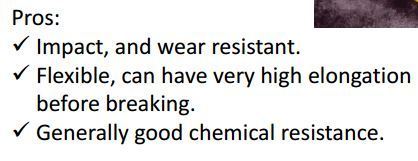
- 80cons to hdpe
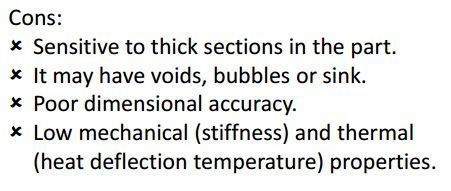
- 81HDPEHigh Density Polyethylene
$
semi-crystalline
too many brand names to list - 82PP— Polypropylene
$
Semi-Crystalline
Common brand names:
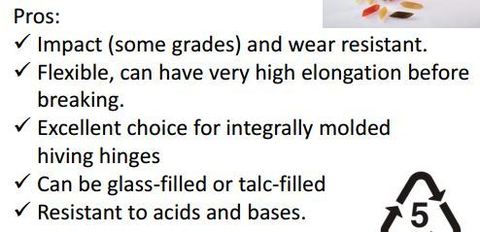
Too many to list… - 83pros to pp
- 84cons to PP
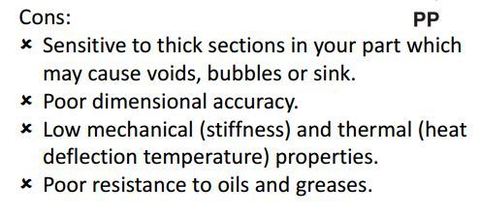
- 85PBTPolybutylene Terephthalate
$$$
Semi-Crystalline
Common brand names:
Ticona Celanex and DuPont Crastin - 86Pros to PBTPros:
Good electrical properties for power
components.
Moderate to high strength depending on glass fill.
Unfilled grades tough and flexible.
Good resistance to organic solvents and fuels. - 87Cons to PBTCons:
Hard to fill thin parts.
Poor chemical resistance to acid, bases and
hydrocarbons. - 88PA 66Polyamide (Nylon 6/6)
$$$
Semi-Crystalline
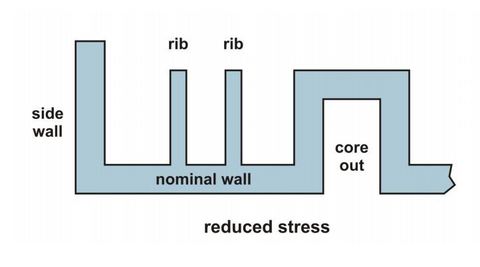
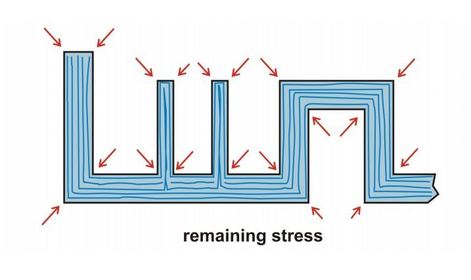
Common brand names:
DuPont Zytel and others… - 89Pros to PA 66Pros:
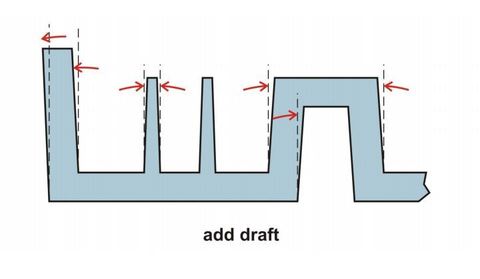
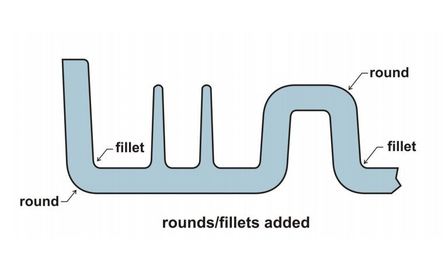
High strength.
Chemical resistant except to strong acids and bases.
Flows well, good for thin part geometry.
Excellent abrasion resistance. - 90Cons to PA 66Cons:
Parts are more subject to warp due to nonlinear shrink.
Molded parts in your application can absorb moisture, changing dimensions and mechanical properties. Nylon 6/12 is better at not absorbing as much moisture. - 91PA 66 GF33— Nylon 6/6 with 33% glass fiber
$$$$
Semi-Crystalline
Common brand names:
DuPont Zytel Plus and others… - 92Pros to PA 66 GF33Pros:
High strength over wide temperature range, up to 450°F (232°c).
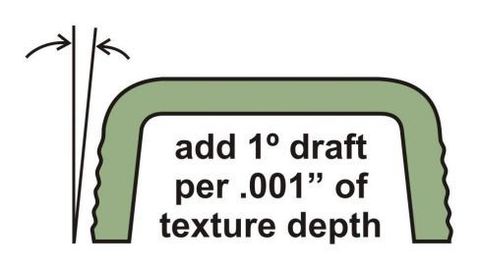
Chemical resistant except to strong acids and bases.
Good wear - 93Cons to PA 66 GF33 Parts are more subject to warp due to nonlinear shrink.
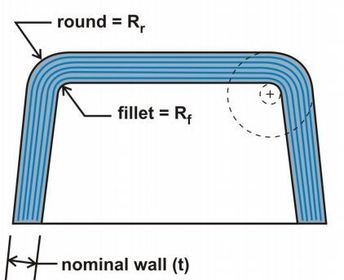
Glass filler can cause wear in the mold.
Glass fibers can be visible on the part's surface (depending on grade and color).
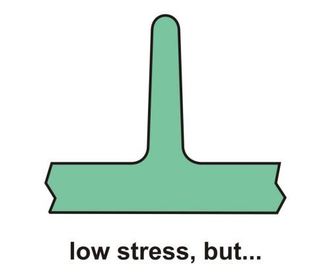
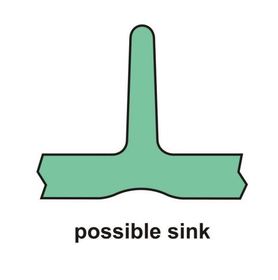
Molded parts can absorb moisture, changing dimensions and mechanical properties. - 94POM— Acetal (Polyoxymethylene)
$$$$
Semi-Crystalline
Common brand names:
Ticona Celcon and DuPont Delrin - 95Pros to POMPros:
High strength.
Good lubricity.
Good wear.
Resistance to hydrocarbons and organic
solvents.
Machines well. - 96Cons to POMCons:
Sensitive to thick sections in part which may cause voids, bubbles or sink.
Poor chemical resistance to acid and bases.
Difficult to bond. - 97amorphous thermoplastics key characteristics cont'd• Low shrinkage after molding with less distortion.
• Good dimensional stability.
• Better impact than crystalline polymers.
• Moderate heat resistance.
• Superior cosmetics of outer surfaces
• Lower chemical resistance - 98PSPolystyrene
$
Amorphous
Common brand names:
Many brands… - 99Pros to PSPros:
Excellent moldability.
Good hardness.
Good dimensional stability.
Good heat resistance.
Good optical clarity.
HIPS (High Impact Polystyrene) available. - 100Cons to PSCons:
Can be brittle.
Attacked by hydrocarbons and organic solvents
(greases, oils, gasoline, etc.). - 101ABSAcrylonitrile Butadiene Styrene
$$
Amorphous
Common brand names:
Many brands including Bayer Bayblend, Sabic Cycolac and others… - 102Pros to ABSPros:
Excellent moldability.
Good impact resistance.
Good appearance for cosmetic parts.
Moderate strength.
Good resistance to acids and bases. - 103Cons to ABSCons:
Sensitive to thick sections in part which may cause voids, bubbles or sink.
Attacked by hydrocarbons and organic solvents (greases, oils, gasoline, etc.).
Can be damaged by sunlight (Requires UV additive)
Low heat resistance. - 104PCPolycarbonate
$$$
Amorphous
Common brand names:
Sabic Lexan and others - 105Pro to PCPros:
Excellent impact resistance and strength at low and high temperatures.
Available in visually clear grades.
Good heat strength.
Can be machined and polished. - 106Cons to PC Sensitive to thick sections in your part which may cause voids, bubbles or sink.
Notch sensitive (must have rounds and fillets).
Fair to poor chemical resistance which can cause stress cracking ("crazing") or opaque dulling of the surface.
Will yellow if used without UV additive. - 107PC/ABSPolycarbonate/ABS Alloy
$$½
Amorphous
Common brand names:
Many brands including Bayer Bayblend, Sabic Cycoloy and others… - 108Pros to PC/ABS Excellent moldability.
Excellent impact resistance.
Excellent dimensional stability.
Excellent heat resistance.
Good appearance for cosmetic parts.
Good strength and toughness.
Good resistance to acids and bases. - 109Cons to PC/ABSCons:
Sensitive to thick sections in part which may cause voids, bubbles or sink.
Attacked by hydrocarbons and organic solvents (greases, oils, gasoline, etc.). - 110PMMAPolymethyl Methacrylate (Acrylic)
$
Amorphous
Common brand names:
Many brands including Lucite, Plexiglas, Perspex and others… - 111Pros to PMMA (Acrylic)Pros:
Good impact resistance.
Good appearance for cosmetic parts.
Moderate strength.
Excellent optical clarity.
Very machinable. - 112Cons to PMMA (Acrylic)Cons:
Sensitive to thick sections in your part which may cause voids, bubbles or sink.
Attacked by hydrocarbons and organic solvents.
Heat resistance is low, but can be easily
thermoformed - 113PVCPolyvinylchloride
$$
Amorphous
Common brand names:
PolyOne Geon and others… - 114Pros to PVCPros:
Sometimes referred to the "poor man's
engineering plastic."
Can be compounded to be rigid or flexible.
Good resistance to chlorine. - 115Cons to PVCCons:
Molding process produces chlorine gas.
Stainless steel tooling required.
Poor chemical resistance to solvents (keytones,
acetone, etc.). - 116PET, PETE, PETGCopolyester
$$$
Amorphous
Common brand names:
Tritan, Eastar, Spectar - 117Pros to PET, PETE, PETG moderate heat resistance
excellent toughness
exceptional clarity
high gloss
excellent surface finish
low residual stress
excellent chemical resistance
resistant to environmental stress
cracking (ESC)
FDA and NSF rated grades
bisphenol-A (BPA)-free, plasticizer-free - 118PET, PETE, PETG poor flame resistance (flammable)
less resistant to heat ("top rack"
dishwasher safe)
shouldn't be exposed to boiling water
– material can break down
less proven in high load applications
PC is typically used in - 119Cellulosics$
Amorphous
Common brand names:
Tenite (Eastman) - 120Pros to CellulosicsPros:
not petroleum-based
tough and durable
warm to the touch ("feels like wood")
dull noise ("sounds like wood")
good clarity
easy to process and machine
can be formulated to break down (compost) - 121Cons to Cellulosicscan get brittle with age (depending on the
plasticizers used)
attacked or swollen by many solvents including chlorinated and aromatic hydrocarbons, alcohols
and ketone - 122TPE— Thermoplastic Elastomer
$$
Amorphous and Crystalline (a combination) - 1236 generic classes commercial TPEs:Styrenic block copolymers
• Polyolefin blends
• Elastomeric alloys (TPE-v or TPV)
• Thermoplastic polyurethanes
• Thermoplastic copolyester
• Thermoplastic polyamides - 124Pros to TPEPros:
Excellent impact and toughness.
Tolerant of thick sections.
Can be overmolded or shot separately to
be used for soft touch as well as gasketing - 125Cons to TPE Poor dimensional stability.
Low modulus (not very stiff).
Tends to flash in the mold (might require some trimming). - 126list 5 advantages of Thermoplastic Injection Molding• virtually unlimited part complexity (if you have the $)
• good for in-line and side core holes
• can produce fine detail
• can produce very small parts
• molded-in threads
• molded-in inserts
• good for open hollow shapes
• best for high volume production
• complete control of wall thickness
• works well with most plastic materials
• good dimensional stability (depending on material)
• excellent surface appearance
• no finishing required - 127List 3 disadvantages of Thermoplastic Injection Molding• expensive equipment costs
• expensive tooling costs
• some undercuts can be difficult to produce
• strength limited in weld line areas
• very large parts (< 6') are not economically feasible
• cannot create closed hollow shapes - 128—
- 129cannot be injection moldedcannot be injection molded

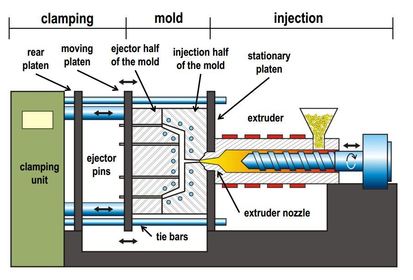
- 130describe the Thermoplastic Injection Molding Process (4 Distinct Operations)4 Distinct Operations:
1. Melting the resin.
2. Injection of the resin into the closed mold.
3. Cooling the resin inside the closed mold.
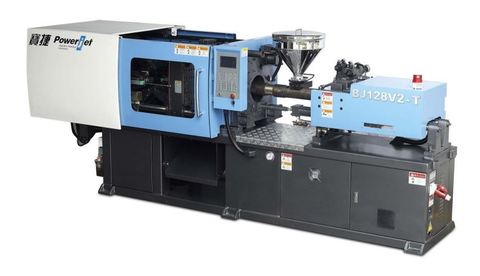
4. Opening the mold and ejecting the molded part. - 131—The Injection Molding Press
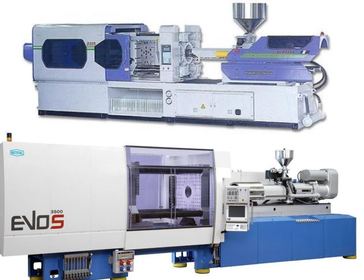
- 132—Horizontal Presses
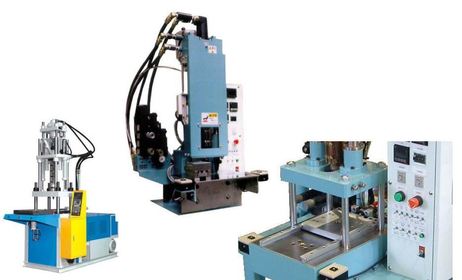
- 133—Vertical Presses
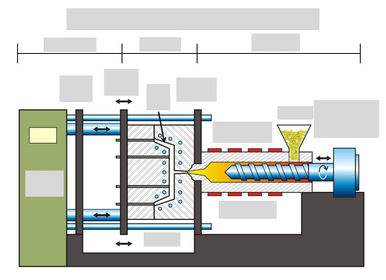
- 134—
- 135—
- 136Extruder and Injection System step 1
- 137Extruder and Injection System step 2
- 138Extruder and Injection System step 3
- 139Injection System with Accumulator
- 140Platen SizeAs small as 3” x 3”.
• Up to 12 feet across.
• Machine size driven by mold size, total shot size and required clamp - 141Clamp Tonnage• Cavity pressure based on material, part
geometry, runner systems, etc.
• Cavity pressures for high pressure injection molding range from 4,000 to 10,000 psi.
• 3 to 5 tons per cubic inch of total projected area (including runners).
• Clamp range 5 to 6,000 ton.
• Typical clamp is 50 to 2,000 ton - 142—Plattens
- 143Injection Molding Process step 1
- 144Injection Molding Process step 1• Recovery from previous shot:
• Plastic (shot) is accumulated in the extruder as screw retracts in the barrel
• Heater bands hold melt at proper temperature
• Mold is closed
• Mold cooling line temperature set
• Clamp pressure set, locked - 145Injection Molding Process step 2
- 146Injection Molding Process step 22. Injecting the Resin into Closed Mold
• Extruder’s nozzle valve opened.
• Melt is shot into the mold via the mold’s sprue and runner system.
• Air is displaced by the melt and vented along the parting line and ejection pin holes.
• Clamping system exerts opposing force to keep mold closed.
• Injection takes only a few seconds. - 147Injection Molding Process step 3
- 148Injection Molding Process step 33. Cooling the Part
• Part is allowed to cool.
• Cooling lines running along the cavity surface remove heat from the part and mold.
• Injection system (either the extruder or accumulator) holds pressure on the cavity as the resin cools and shrinks.
• Clamping system continues to hold the mold closed.
• Cooling is typically the longest part of the cycle.
• Cycle time driven by the part’s nominal wall thickness. - 149Injection Molding Process step 4
- 150Injection Molding Process step 44. Ejecting the Part and Extruder Recovery
• Clamping released, injection valve closed.
• Mold is opened when parts are cooled enough to retain their shape and resist force of ejection.
• Part typically travels backwards (away from the extruder) with the moving part
• Ejection system typically a function of the mold’s movement backward until the ejector pins hit the ejector plate and push the part out of the mold.
• If no accumulator, extruder can now begin recovery.
• if accumulator is used, extruder can now begin recovering (re-filling) the accumulator. - 151—The Press Operator
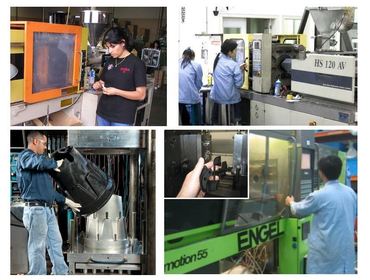
- 152list 3 Typical In-Cycle Operations (performed by press operator)Spot checking molded parts for quality, color, dimensional accuracy, etc. per a set of drawings with production tolerances.
• Performing basic trimming like clipping off runners and gates.
• Drilling, cutting, trimming, routing arts.
• Placing parts in cooling fixtures to hold
squareness, flatness or key tolerances.
• Applying labels or graphics.
• Adding screws or hardware.
• Product assembly.
• Wrapping/packaging for shipping. - 153what type of mold: Heat treated after machining and texturing. • High wear-resistance, long production lifeHardened Steel Molds (ex. P20)
- 154what type of mold: Used specifically for highly corrosive materials like PVC. • Very expensive.Stainless Steel Molds
- 155what type of mold: Much lower cost (less expensive material, faster machining). • Good for prototype molds. • Commonly used for larger parts and lower-pressure and lower-clamp processes (e.g., structural foam, RIM and thermoforming). • Lower cycle times due to better heat transfer • Can be used for high-volume production if well-maintained. • May use beryllium copper inserts for high-wear/heat areas.Aluminum Molds (ex., 7075 and 2024 alloys, QC-10)
- 156what type of mold? Cast alloy of Aluminum and Zinc. • Used for very short prototype runs – typically 500 piecesKirksite Prototype Molds
- 157name the parts
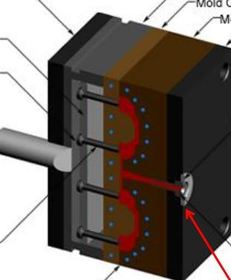
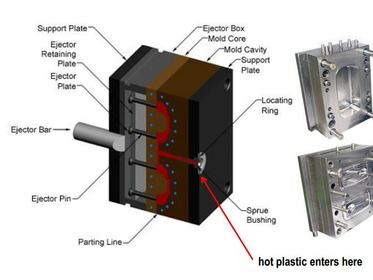
- 158—
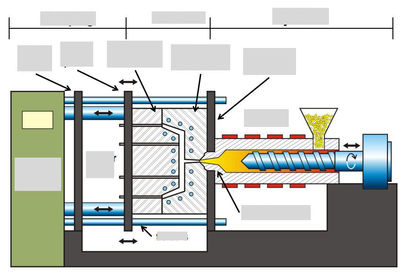
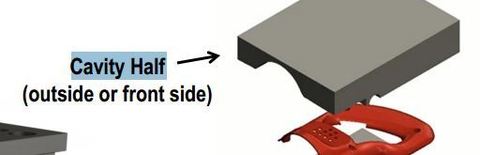
- 159the Cavity Half is what part of the mold and usually what part of the product?
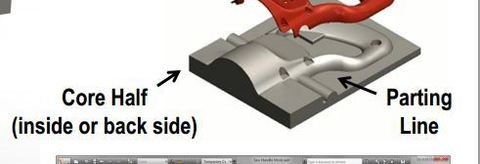
- 160the Core Half is what part of the mold and usually what part of the product?
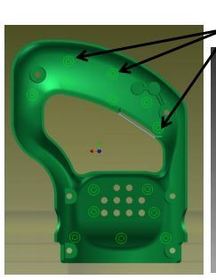
- 161—Ejection Locations
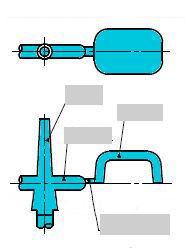
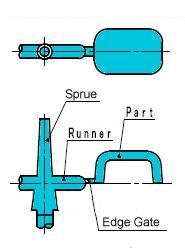
- 162—sprue and gate
- 163—
- 164—
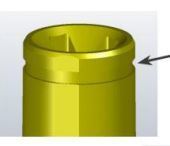
- 165what is this and how was it madeundercut / slides
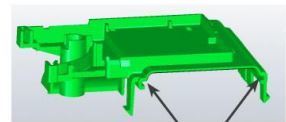
- 166what is this and how is it made?long channel / slides
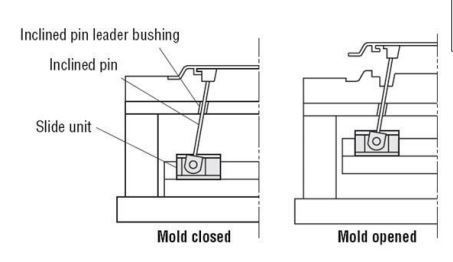
- 167explain how slides work in side action and undercuts
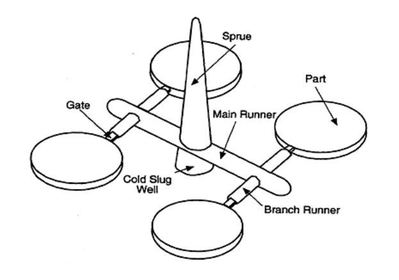
- 168what kind of mold is this fromMulti-Cavity Mold
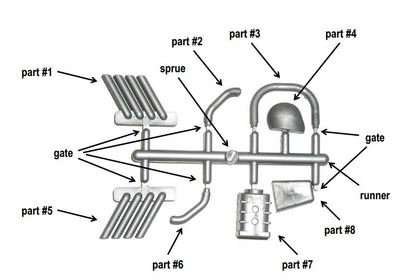
- 169what type of mold did this come fromfamily mold
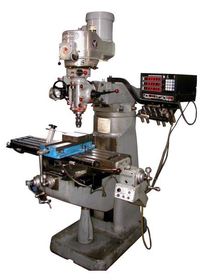
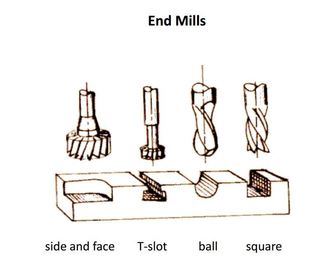
- 170—milling machine
- 171—
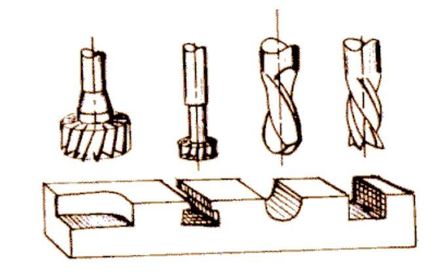
- 172what is the difference between drills and end mills
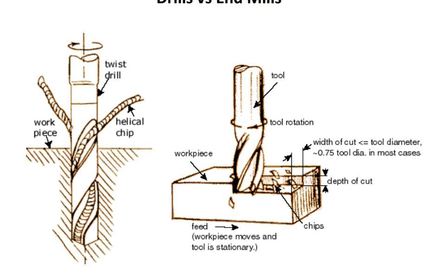
- 173what is the difference between drills and end millsa drill bit drill holes only, while an end mill can machine sideways
- 174what milling technique is thissquaring
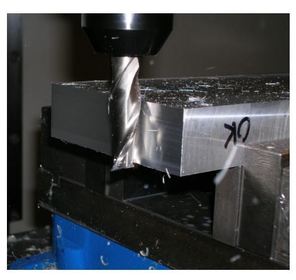
- 175what milling technique is thisfacing
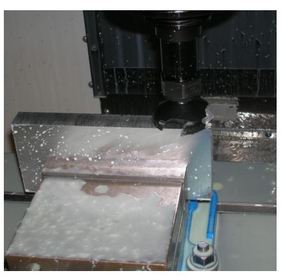
- 176—
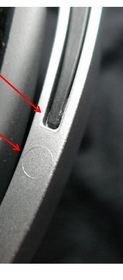
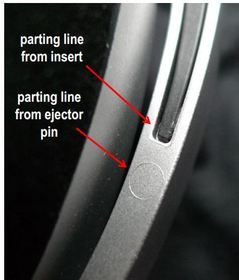
- 177what made thesenon-chip forming:
laser engraving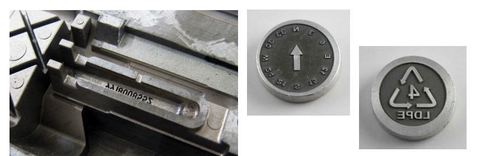
- 178what made theseNon-Chip Forming:
Chemical Milling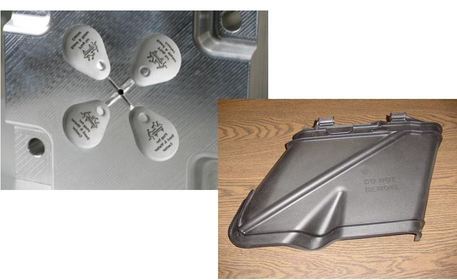
- 179how does Electrical Discharge Machining (EDM) work
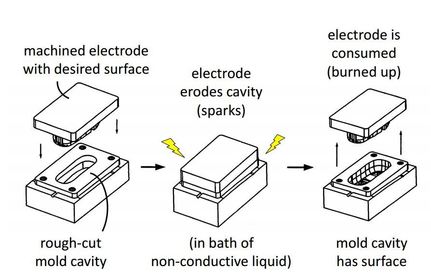
- 180name 2 types of non-chip forming machiningLaser Engraving
Chemical Milling
Electro-chemical Machining (ECM)
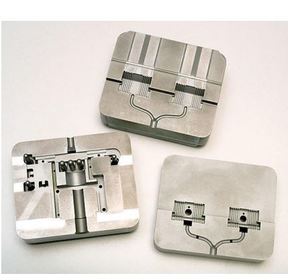
Electrical Discharge Machining (EDM) - 181what type of EDM is thismolds
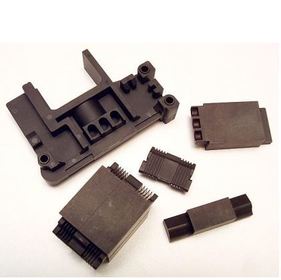
- 182what type of EDM is thiselectrodes
- 183in injection molding, Part Design is Driven By....• Part’s function (What does it do?)
• Physical load(s) the part will experience in service (Where? How Much? How often?)
• Assembly issues (How will it be installed/assembled/attached to other
parts?)
• Material issues (What’s it made of?)
• Processing issues (How will it be molded? What does the plastic do inside the mold?)
• Governing Principle: Low Stress - 184how can you reduce stress in a part? (pertaining to the nominal wall)
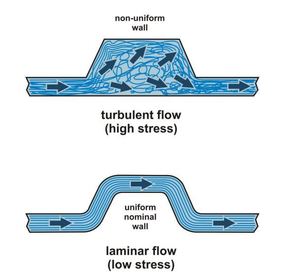
- 185how can you reduce stress in a part?
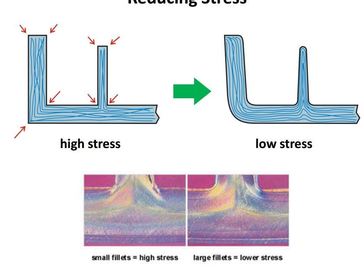
- 186what could high stress result in?
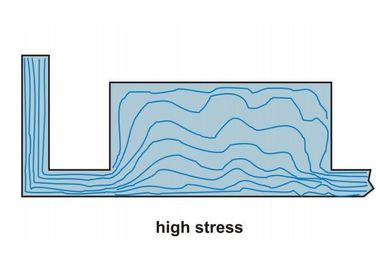
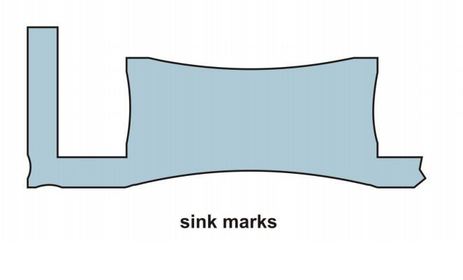
- 187—
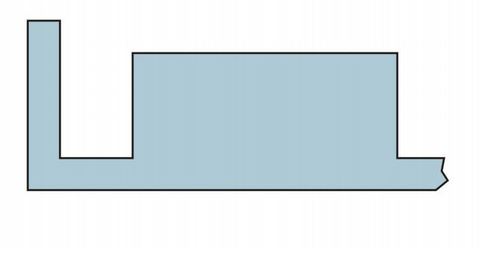
- 188—
- 189—
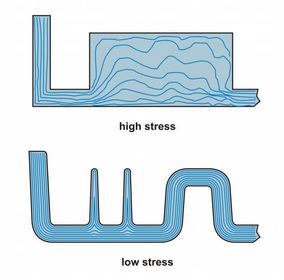
- 190what are the 3 Basic Elements of an Injection Molded Part• nominal wall
• projections
• holes / recesses - 191list 3 characteristics of the nominal wall• Most important decision in plastic part design.
• Many other part details are driven by the nominal wall thickness.
• Determines overall part strength.
• Determines part weight.
• Drives cycle time - 192Whats the difference between a side wall and a nominal wall
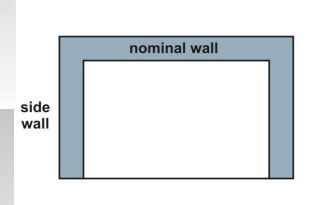
- 193how do you determine the size of the nominal wall?1. Functional Requirements of the Part
2. Nominal Wall = Uniform Wall
3. Molding Considerations (Can I fill the mold with this wall thickness?) If too thin, may not flow all the way before material solidifies (freezes).
4. Cost Considerations (bulk of mass is in the nominal wall). Can the nominal wall be reduced to save cycle time and weight (lower cost) without sacrificing strength/performance? - 194how can you make a nominal wall uniform?coring out+rounds/fillets+maybe ribs
- 195—
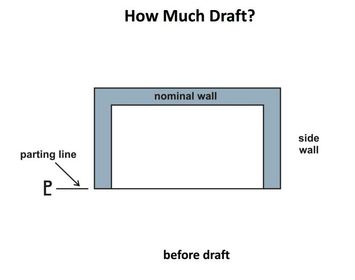
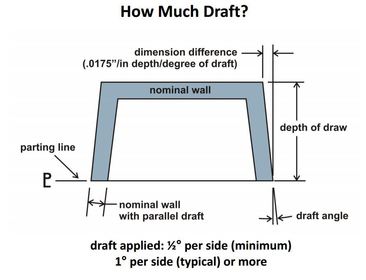
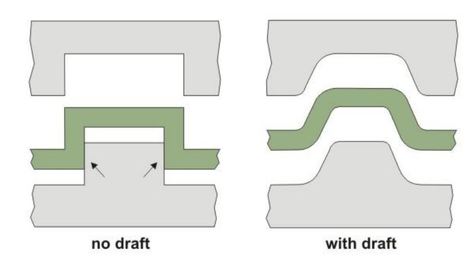
- 196how much draft do you add for texture
- 197why should a designer keep parting lines in mind when designing?it can affect the appearance and is affected by orientation of faces
(hey peeps add onto this one plx if you think of other stuff) - 198whats the difference between a round and a fillet
- 199what is the prefered Rib Thickness Relative to the Nominal Wall?rib should be 60% of nominal wall or less
- 200—
Information
- Description
- Flashcards on Plastics part 1, created by Sierra Crona Thomas on 27/04/2015.
- Created by
- Sierra Crona Thomas · Apr 2015
- Updated
- Aug 17, 2018
- Views
- 33
- Rating