
Flashcards
CSIM1.27
Cards in this deck (45)
- 1What is compliment?A key soluble molecule of the innate immune system
A key system in early protection against infection, before antibody becomes available
A key molecule in immunological reactions
A link between innate and acquired immunity, enhancing B cell responses and contributing to long-lived B cell memory - 2Is the complement system part of the innate or acquired immune system?innate
- 3Describe the Multi-component cascade30 proteins
Without infection – inactive form
Activated by pathogen or antibody bound to pathogen
Result: direct killing or facilitation of phagocytosis - 4Describe the basics of the complement systemCleavage of components yields enzyme active sites and biologically active fragments
C4a, C3a, C5a: anaphylotoxins
Three pathways converge at level of C3
Final common lytic pathway
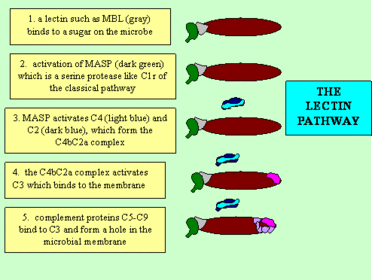
Multiple control points in pathway - 5What is the lectin pathway of the complement system?
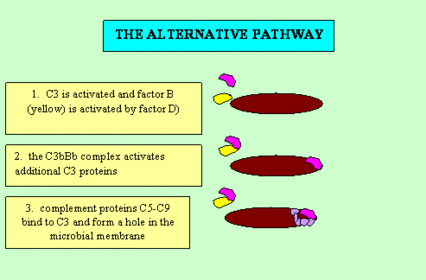
- 6What is the alternative pathway of the complement system?
- 7Describe the classical pathwayThe trigger for the classical pathway is either IgG or IgM antibody bound to antigen. Binding of antibody to antigen exposes a site on the antibody which is a binding site for the first complement component, C1.
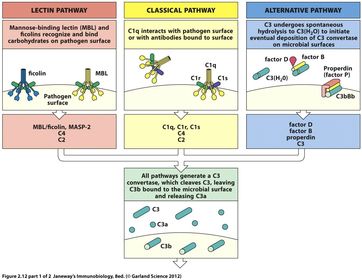
- 8Describe and compare the three pathways of the compliment cascade (image)
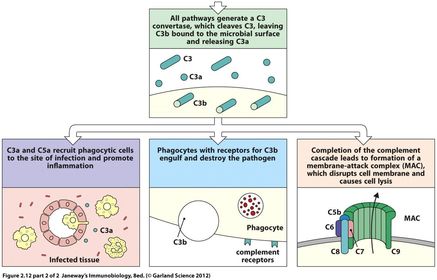
- 9What are the results of the complement cascade?
- 10How does the complement system link innate and acquired immune system?Required for optimal antibody production
Enhances phagocytosis and therefore antigen presentation to acquired immune system
Involved in B cell memory - 11What are the three main functions of the complement system?Opsonisation of bacteria to promote phagocytosis
Clearance of immune complexes
Direct lysis of bacteria/inactivation of viruses - 12How is the complement cascade involved in opsonisation?Via antibody [classic pathway]
Directly via MBL & alternate pathway - 13How is the complement pathway involved in the clearance of immune complexes?Red cell complement receptors act as sump and transport system for immune complexes
Immune complexes stripped off in spleen and phagocytosed - 14What is needed for Activation of the complement system?Cascade of enzymes
Amplification at each step
Release of physiologically active substances
Anaphylotoxins
Effector functions
Terminal lytic sequence
Immune complex formation (clearance, phagocytosis) - 15What is MAC in terms of the complement system?Membrane attack complex- a structure typically formed on the surface of pathogenic bacterial cells as a result of the activation of the host's alternative pathway, classical pathway, or lectin pathway of the complement system, and it is one of the effector proteins of the immune system. The membrane-attack complex (MAC) forms transmembrane channels. These channels disrupt the phospholipid bilayer of target cells, leading to cell lysis and death.
- 16What are Anaphylotoxins?C4a, C3a, C5a
- 17What are the fuctionsIncreased vascular permeability
Local inflammatory response
Chemotactic for phagocytic cells - 18What is the role of C5a in phagocytosis?
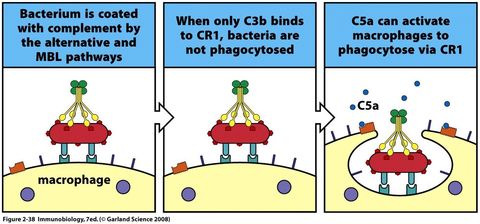
- 19What is the role of anaphylotoxins in Inflammatory responses
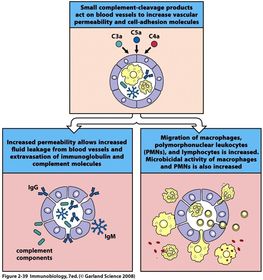
- 20How is the Complement System regulated?Two main types of regulators
Soluble inhibitor molecules [shared with kinin and clotting systems]
C1-esterase inhibitor
Factor D,
Factor I
Factor H [Factor I co-factor, C4BP] - 21What are the three types of compliment receptors?Receptors on phagocytic cells (neutrophils, macrophages)
CR1, CR3, CR4 - Recognise activated C3 bound to bacteria
Receptors on erythrocytes
CR1 -Bind soluble immune complexes for transport to spleen
Receptors on B cells
CR1, CR2- Recognise activated complement in association with antigen
Essential for development of B cell memory - 22What is an immune complex?Antigen, antibody and complelent
- 23What are the roles of immune complexes?Formed all the time in the blood
Inactivate foreign proteins
May be phagocytosed
Need to be solubilised to prevent inappropriate tissue deposition
Removed bound to erythrocytes to spleen - 24What happens to small immune complexes?Cleared by erythocytes
- 25What happens to medium sized immune complexes?They end up in inappropriate tissue deposistion
- 26What happens to large immune complexes?Phagocytosed
- 27What happens in Complement component deficiency?Increases risks of infection
Increases risks of immune complex disease - 28What happens when there is a deficiency of regulatory molecules?Unrestricted activation of complement
- 29What is the role of complement as effector in autoimmune disease?Lysis of red cells
Tissue damage - 30What are the symptoms of complement deficiency?All complement component deficiencies [with exception of C3] increase risk of Neisserial infection
Multiple episodes of meningitis
‘Milder’ disease
Deficiency has a survival advantage in areas where meningococcal disease is endemic [North Africa, South Africa, Middle East]
Sporadic in U.K. [beware of inbred populations in UK) - 31What is Meningoccocal disease?Rapid onset meningitis
Vasculitic rash (non-blanching)
More than one episode or rare strain (Y, W135) = complement deficiency until proven otherwise
Investigate with functional studies of complement cascade - 32What is Systemic lupus erythematosus?May be due to complement deficiency (C2, C4)
Inappropriate immune complex formation
Glomerulonephritis – immune complex deposition in glomeruli
Poor clearance of immune complexes (decreased CR1 receptors) - 33What conditions are associated with deficiency of factor H and factor I?Haemolytic-uraemic syndrome
- 34What is Hereditary angioedema?Deficiency of C1 inhibitor
Autosomal dominant disease
Single functioning gene is inadequate to prevent disease
Swelling due to excess bradykinin
Two types
Type I
85% of cases: mutations leading to non-production of C1-inh from affected gene
Type II
15% of cases:mutations lead to production of inactive enzyme - 35What is the symptoms of Hereditary angioedema?Usually asymptomatic until puberty
Slow onset swellings any part of body including larynx and bowel
NO urticaria
Attacks triggered by trauma, infection, pregnancy, OCP - 36What is Paroxysmal nocturnal haemoglobinuria [PNH]?Acquired clonal disease of bone marrow resulting from somatic mutation
- 37What causes Paroxysmal nocturnal haemoglobinuria [PNH]?Due to defective production of glucosylphosphatidylinositol anchors essential for a expression of a number of surface molecules
metabolic block in transfer of N-acetylglucosamine to phsphatidylinositol
Red cells lack CD55 (DAF), CD59 (ptrotectin) and CD46 (MCP)
Red cells susceptible to complement lysis via alternate pathway - 38What are the clinical features of Paroxysmal nocturnal haemoglobinuria?Haemoglobinuria; iron deficiency anaemia; abdominal pain
- 39What are the three main classes of phagocytes?Macrophages and monocytes = mononuclear phagocytes
Granulocytes – neutrophils, eosinophils, basophils = polymorphonuclear neutrophilic leukocytes (PMNs)
Dendritic cells - 40What are Macrophages and monocytes?Macrophages mature from monocytes that leave circulation to migrate to tissues
Found in connective tissue e.g. GI tract, bronchi, liver, spleen - 41What are Granulocytes?Phagocytic cells which are short lived, in blood tissues, not present in healthy tissue
- 42What are dendritic cells?present in tissues
main role is process micobes and present them as antigens
activates T cells and adaptive IR - 43List some of the antimicrobial mechanisms of phagocytes?Acidification, toxic oxygen derived products, toxic nitrogen oxides, antimicrobial peptides, enzymes, competitors
- 44What is Chronic Granulomatous disease?Deficiency of NADPH oxidase – failure to create super oxide
Most common form is x-linked
Susceptible to bacterial and fungal disease
Liver abscesses
Aspergillus pneumonia
Inflammatory bowel disease - 45What are some of the symptoms of Chronic granulomatous disease?Recurrent abscesses
Deep-seated
Liver, soft-tissues
Fungal
Gingivitis & tooth loss
Information
- Description
- Flashcards on CSIM1.27, created by diseasel.medsoc on 04/05/2015.
- Created by
- diseasel.medsoc
- Views
- 1
- Rating