
Flashcards
Managing Finance Revision SBS
Cards in this deck (6)
- 1BUDGETS “a financial document used to project future income and expenses” “Turnover is vanity, profit is sanity and cash is reality” Purpose of a Budget: • Authority to spend • Comparators for performance • Goal congruence • Plans allocation of resourcesBudget Advantages:
• Motivates divisional managers
• Facilitates assessment
• Promotes goal congruence
• Ensures resources are allocated in an optimal manner
• Gives divisions a target to aim for
Budget Disadvantages:
• Only set for one year = short-term view
• Only considers factors internal to the business
• Only looks at financial performance
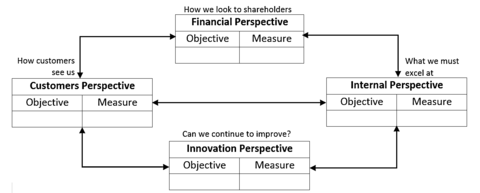
• Historical, out-of-date quickly - 2BALANCED SCORECARD (Kaplan and Norton, 1992) “An approach to the provision of information to management to assist strategic policy formulation and achievement” -> focuses on long-term strategyFinancial Perspective
1. Growth 2. Profitability
1. Has market share increased?
2. Gross profit margins
Customer Perspective
1. Product Satisfaction 2. Reliability
1. How many returned orders?
2. What % of deliveries were on time?
Innovation Perspective
1. New Product Development
2. HR Development
1. % sales of new products
2. No. of employees attending training
Internal Perspective
1. Efficiency 2. Motivated Workforce 1. Reductions in levels of waste
2. Staff absence rates - 3Features of a Good BSC: • Translates strategy into understandable, measured and balanced targets • Articulates a sequence of cause-and-effect relationship • Communicates strategy to all employees • Adopts only critical measures • Highlights sub-optimal trade offsBenefits of the BSC:
• A few key objectives and measures for each perspective
• Brings separate elements of the strategy together
• Guards against sub-optimisation
• Challenges managers to look at the company in a new way
• Likely to contain something to interest all employees
• External focus: can include market, customer and competitor information
• Links to long term goals
• Considers financial and non-financial performance indicators
Limitations of the BSC:
• People still only focus on what is being measured
• Links cannot be proven – may not even exist (Norreklit, 2000)
• Time-lag before results are evident in financial perspective - 4VARIANCES • Sales Price Variance Actual Turnover | Actual Units Sold x Budget Selling Price • Sales Volume Variance Actual Units Sold | Budgeted Units Sold x Budgeted Profit per Unit • Materials Price Variance Actual Material Costs | Actual kg Used x Standard Cost • Materials Usage Variance Actual Materials Used | Should Have Used (Units Sold x Standard Use) x Standard Price per Kg • Labour Rate Variance Actual Labour Costs | Actual Hours Used x Standard Cost • Labour Efficiency Variance Actual Hours Used | Should Have Used (Units Sold x Standard Hrs) x Standard Labour Rate per HourSales Price Variance
(Fav.) Market prices increase, Less competition
(Adv.) Market prices decrease, More competition
Sales Volume Variance
(Fav.) Healthier economy, More advertising
(Adv.) Worse economy, Less advertising
Materials Price Variance
(Fav.) Market prices decrease, Purchase cheaper materials
(Adv.) Market prices increase, Purchase more expensive materials
Materials Usage Variance
(Fav.) Better management of materials, Higher quality materials
(Adv.) Poorer management of materials, Lower quality materials
Labour Rate Variance
(Fav.) Fall in market employment rates, Employment of cheaper staff
(Adv.) Rise in market labour rates, Employment of more expensive staff
Labour Efficiency Variance
(Fav.) Better staff with more training, New quicker technology
(Adv.) Poorer skilled workforce are slow, Old machinery breaks down - 5FLEXED BUDGETS Often companies prepare flexed budgets to compare actual figures with budget figures more accurately. This helps to calculate variances as the purpose of the flexed budget is to remove the effect of volume changes.ACCOUNTING FOR OVERHEADS: Traditional Absorption Costing
Absorption costing allocates costs to product units. It is the traditional cost accounting method that focuses on the product or service when allocating costs. The method divides equally the fixed overhead costs with the number of product units.
ACCOUNTING FOR OVERHEADS: Activity Based Costing (ABC)
Modern technique that links the cost of activities to products according to the actual consumption. COST POOL = Different Costs, COST DRIVER = what the overhead split is based on - 6PRICING FULL COST PLUS: This is where we look at all the costs involved in making a product Materials + Labour + Overheads = Full Cost Full Cost + Profit (Mark Up or Margin) = Selling Price MARGINAL COST PLUS: Not a sustainable business strategy -> only use short term Materials + Labour + Variable Overheads = Marginal Cost (NO FIXED COSTS) Marginal Cost + Profit (Mark Up or Margin) = Selling PriceMARK UP is based on cost e.g. £1 cost, 30% mark up, and £1.30 selling price
MARGIN is based on selling price e.g. £1 selling price, 30% margin and £0.70 cost
CASH FLOW FORECASTS: Profit does not equal cash: sales may not be paid for immediately, companies therefore need to prepare cash flows to identify any cash shortages so overdrafts can be arranged.
Opening Balance +/- Net Cash Flow (Receipts – Payments) = Closing Balance
Only include items in the month you physically pay for them. Do not include depreciation or bad debts.