
27506783
Description

Flashcards by Aidan Leibowitz, updated more than 1 year ago

|
Created by Aidan Leibowitz
almost 6 years ago
|
|
| Question | Answer |
| Waves transfer ____ from one location to another | Energy |
| Mechanical waves transfer energy through matter called a ____(____ would be plural) | Medium, media |
| Once a source of energy causes a disturbance in the medium, what happens? | The particles of the medium vibrate in places, and as they vibrate the energy is passed from one particle to the next. |
| Name the three types of mechanical waves | Transverse, longitudinal, and surface |
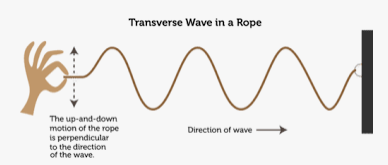
| What are transverse waves? | Waves where the particles of the medium vibrate at right angles (or perpendicular to) the direction that the wave (and it's energy) is traveling. |
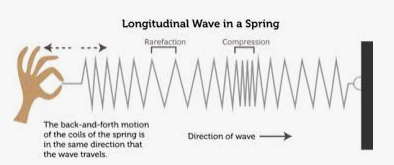
| What are longitudinal waves? | Longitudinal waves (also known as compression waves) have particles that vibrate in the direction that the wave (and its energy) is moving. |
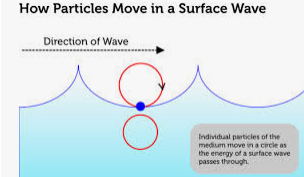
| What are surface waves? | Waves that travel along the surface of a medium (like ocean waves). Surface waves are a combination of both transverse and longitudinal waves (the particles move both up and down and side to side in an overall circular motion. |
| Name the 3 wave parts: | Rest (line in middle of the wave), Crest (highest point in wave), trough (lowest point in wave). |
| What is Amplitude? | Amplitude is measured from the rest to the top of a crest or the bottom of a trough and is measured in meters or centimeters. |
| What is a wavelength? | A wavelength, for a transverse wave, is the distance from one crest to the next. Wavelength is measured in meters or centimeters. |
| What is Frequency? | The number of complete waves in a given point. Measured in meters or centimeters. |
| What makes up one wave? | One crest and one trough. |
| When wavelength increases, what decreases? | Frequency and energy, vice versa. |
| What is the equation for wave speed? | Wavelength times Frequency |
| What is the unit for frequency? | Hz (Hertz) |
| What is the unit for wave speed? | m/s, cm/s, etc. Will always be measured in seconds. |
| What is the symbol for wavelength? | λ (Called lamba.) |
| What kind of waves or sound waves? | Longitudinal mechanical waves |
| Sound waves are mechanical waves, so they can only travel through _____ and not _____ _____. | Matter, empty space |
| The is ____ pressure in rarefactions, and _____ pressure in compressions. | Low, high |
| Sound waves travel through _____ the quickest and _____ the slowest due to the densities of these substances. | Quickest through solids, and slowest through gases |
| When particles are closer together they can quickly pass the _____ of _____ to nearby ______. | energy of vibrations to nearby particles |
| What is the speed of sound in air? (Important!) | Approx. 343 m/s |
| What is the speed of sound in water? (Important!) | Approx. 1500 m/s |
| For sound waves, what is frequency and what is amplitude? | Frequency is pitch, amplitude is volume. |
| For light waves, what is frequency and what is amplitude? | Frequency is color, amplitude is brightness. |
| High frequency equals a short or long wavelength? | Short, and vice versa |
| What is Sonar? | A system for the detection of objects under water and for measuring the water's depth by emitting sound pulses and detecting or measuring their return after being reflected. |
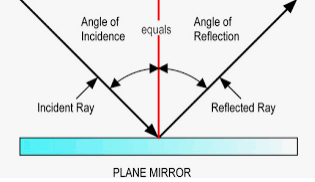
| What is reflection? | When a wave strikes an object and bounces off. |
| What is the law of reflection? | angle of incidence=angle of reflection |
| What is Diffraction? | Bending of waves around a barrier |
| What does the amount of bending depend on? | The relative size of the wavelength of light to the size of the opening. |
| What is refraction? | The bending of waves caused by a change in their speed when the move from one medium to another. |
| ______ wavelengths are refracted more than ______ wavelengths | shorter, longer |
| ____ frequencies are refracted more than _____ frequencies | higher, lower |
| Light bends when it passes from _____ to ______ | water to air, air to water |
| When does refraction occur? | When waves bend as they enter a new medium at an angle and start traveling at a different speed. |
| What is constructive interference? | Waves combine to form a more powerful wave (Increase in amplitude) |
| When does constructive interference occur? | When the crest of two waves line up perfectly, resulting in an increase in amplitude. |
| What is destructive interference? | Waves combine to form a less powerful wave. (Decrease in amplitude) |
| When does destructive interference occur? | When the crest of two waves line up as opposites, cancelling each other out. |
| Interference can cause a increase or decrease of _______ or ________ | Volume or brightness |
| What is the equation for reflection (distance)? | distance=1/2st (Speed*Time) |
Want to create your own Flashcards for free with GoConqr? Learn more.