
Flashcards
Antiparkinson

Cards in this deck (26)
- 1What are the symptoms of Parkinson's disease?T.R.A.P
- 2What is the reason behind the symptoms?- Imbalance between dopamine and acetylcholine in the basal ganglia. This imbalance is due to a decrease in dopamine and not acetylcholine.
- 3Name some drugs that cause parkinson-like effects- Reserpine
- ACHEI
- Neuroleptics
- MPTP - 4—- MPPP (Designer Heroin)
- Meperidine - 5—- MPTP
- Causes Parkinson-like effects
- MPPP --> MPTP --> MPDP --> MPP+ causes irreversible damage
- Can be inhalled or IV
- 6—- Benzotropine mesylate
- Synthetic anticholinergic
- Centrally acting
- Cause 20% improvement (improves T and R but not A)
- Usually given with dopaminergic therapy
- Central and peripheral anti-choli SE
- 7—- Trihexphenidyl Hydrochloride
- Synthetic anticholinergic
- pH dependent
- Centrally acting
- Cause 20% improvement (improves T and R but not A)
- Usually given with dopaminergic therapy
- Central and peripheral anti-choli SE
- 8—- Procyclidine Hydrochloride
- Synthetic anticholinergic
- pH dependent
- Centrally acting
- Cause 20% improvement (improves T and R but not A)
- Usually given with dopaminergic therapy
- Central and peripheral anti-choli SE
- 9—- Biperidine Hydrochloride
- Synthetic anticholinergic
- pH dependent
- Cause 20% improvement (improves T and R but not A)
- Usually given with dopaminergic therapy
- Central and peripheral anti-choli SE
- 10—- Diphenhydramine Hydrochloride
- Antihistamine
- Cause 20% improvement (improves T and R but not A)
- Usually given with dopaminergic therapy
- Central and peripheral anti-choli SE
- 11—- Orphenadrine Hydrochloride
- Antihistamine
- Centrally acting
- Cause 20% improvement (improves T and R but not A)
- Usually given with dopaminergic therapy
- Central and peripheral anti-choli SE
- 12—- Dopamine
- Not effective as a drug because it is highy ionized at physiological pH so it does not cross the blood brain barier and it undergoes rapid metabolism
- 13—

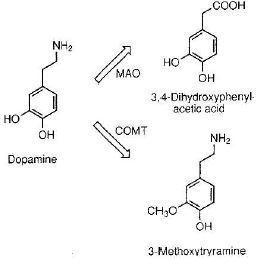
- 14—- L-Dopa
- It is a precurser for dopamine but it is less basic
- It is given orally even though it is a chatachol, what is left from metabolism (in GI) is still enough (1-3%)
- Absorbed in the GI and enters the brain through active transport
- Cause nausea + vomiting due to conversion to dopamine in periphery
- 15—- Carbidopa
- It is used to inhibit the peripheral metabolism of L-Dopa
- It is very basic --> Very ionized --> No BBB penatration
- When using L-Dopa+Carbidopa, there is less amount needed for L-Dopa --> Cheaper
Ex: Sinement 25/100 (25 mg Carbidopa, 100mg L-Dopa) delivers 10% of L-Dopa to brain
- 16—- Selegiline
- 1st gen/Irreversible/MOA-B inhibitor
- Dopamine is the main substrate
- Orally active
- 17—- Rasigiline
- 2nd gen/Irreversible/MOA-B inhibitor
- Dopamine is the main substrate
- Orally active
- 18Metabolism- Desmethylselegiline
- Despropylselegiline (metaamphetamine) --> (-)amp < (+)amp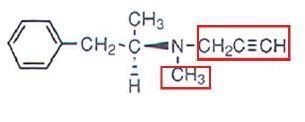
- 19—- Tolcapone
- Non-specific/ reversible/ COMT inhibitor
- Inhibits the metabolism of NE, EPI, L-Dopa
- Works in the brain and periphery
- Longer DOA (8hrs-12hrs)
- SE: Nausea + Hallucination + Psychosis + Hepatic failure (given in extreme conditions)
- 20—- Entacapone
- Non-specific/ reversible/ COMT inhibitor
- Inhibits the metabolism of NE, EPI, L-Dopa
- Works in the brain and PERIPHERY
- Short DOA (2hrs)
- SE: Nausea + Hallucination + Psychosis
- 21—- Amantadine (admantane derv.)
- Dopamine releasing agent
- Inhibit dopamine reuptake
- Antiviral + Anticholinergic
- Very basic --> Highly protonated at body pH, but still enters the brain via active transport
- < L-Dopa
- Short DOA (few weeks)
- Cage like structure protects it from metabolism --> Unchanged renal excretion
- MOA metabolism is inhibited due to the 3-C next to the N
- Reversible SE (insomnia,hallucination)
- 22—- Mimantine (admantane derv.)
- Dopamine releasing agent
- Inhibit dopamine reuptake
- NMDA antagonist
- Very basic --> Highly protonated at body pH, but still enters the brain via active transport
- < L-Dopa
- Short DOA (few weeks)
- Cage like structure protects it from metabolism --> Unchanged renal excretion
- MOA metabolism is inhibited due to the 3-C next to the N
- Reversible SE (insomnia,hallucination)
- 23—- Bromocriptine
- Ergot peptide deriv.
- Partial D-1 agonist/Full D-2 agonist
- First direct dopamine receptor agonist used in anti-parkinson
- Orally active
- Low doses --> prolactine inhibitor / high doses --> anti-parkinson
- Short t1/2 (2hrs) due to extensive first pass metabolism
- 24—- Ropinirol
- Full D-2/D-3 agonist
- Non ergot compound
- Orally active
- Metabolized by CYP 1A2 to give inactive metabolite
- T1/2 6hrs
- 25—- Pramipexole
- Full D-2/D-3 agonist
- Non ergot compound
- Orally active
- Excreted renally unchanged
- T1/2 8-12hrs
- 26—- Apomorphine
- Aporphine alkaloid
- Obtained by boiling morphine in concentrated acid
- Centrally acting, produces effects similiar to dopamine; anti-parkinson + emisis
- Highly ionized at body pH but still lipophilic enough to cross BBB
- Extensive metabolism by 1st pass
- Potent emetic effect
- SQ injection
- Given in late stage Parkinson
Information
- Description
- All Medicinal Chemistry 2 Flashcards on Antiparkinson, created by Majd Fawaz on 13/05/2021.
- Created by
- Majd Fawaz
- Views
- 457
- Rating