
Flashcards
Grad QM 2 Final

Cards in this deck (38)
- 1Golden rule Formula in scattering chapter
- 2Differential cross-section

- 3First order Born approximation

- 4Born approximation assumptionsParticles are non-interacting at long distances (have plane wave solutions). They interact weakly with the potential and emerge as free particles. Born approximation works better at high energies.
- 5Born approximation for spherically symmetric potential

- 6Second order Born approximation

- 7Optical theorem

- 8Discussion about Optical theoremOptical theorem is a consequence of unitarity. It is exact if we compute the scattering amplitude exactly. Otherwise, you are "leaking probability".
- 9Trick to solve matrix element of p with Heisenberg equation

- 10Fermi's Golden rule, constant potential in time

- 11Fermi's Golden rule, Harmonic perturbation ( V = V0*Cos(wt) )

- 12Interaction potential of particles with E&M (first order and second order terms)

- 13Vector potential for a single "photon"

- 14Spontaneous emission rate

- 15Absorption rateAbsorb radiation

- 16Stimulated emission rate

- 17First order time dependent perturbation theory transition amplitude

- 18Variational principle, Etrial calculation

- 19Time independent NON-degenerate pertubation theory, corrections to energy

- 20Time independent NON-degenerate pertubation theory, first order correction to wavefunction

- 21Time independent degenerate pertubation theory, corrections to energyNeed to diagonalize the degenerate subspace.

- 22Time independent degenerate pertubation theory, corrections to wavefunctions

- 23Harmonic oscillator raising and lowering operators

- 24Harmonic oscillator, x and p operators

- 25Harmonic oscillator, ground state wavefunction in position space

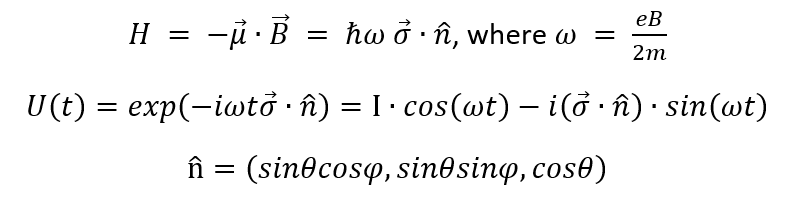
- 26Easy way to solve time evolution of spin 1/2 particle in B-field
- 27Some relevant spherical harmonics

- 28Dipole operator

- 29Stark effect, interaction Hamiltonian

- 30Partial wave total cross section

- 31s-wave phase shift

- 32Scattering lengthScattering length knows about the bound states

- 33S-wave scattering cross-section

- 34Born approximation: scattering amplitude with Form factor

- 35Resonance cross-section

- 36Cross-section in terms of branching ratios

- 37Feshbach resonanceDrive a bound state energy level very close to zero energy such that the scattering length becomes very large (close to diverging). In trapped ions the interactions can be tuned by tuning the parameters in the potential.
- 38"Tell me about Helium" or "Hund's rule"Orthohelium: symmetric spin (triplet), antisymmetric space WF
Parahelium: antisymmetric spin (singlet), symmetric space WF.
Symmetric spatial bring electrons closer together so higher interaction energy in parahelium.
Information
- Description
- Graduate Quantum Mechanics II Flashcards on Grad QM 2 Final, created by Eva G on 29/04/2022.
- Created by
- Eva G
- Views
- 11
- Rating