
Flashcards
Mana3335: ch 3
Cards in this deck (43)
- 1organizational environment-consists of both task and general environments
-includes all elements existing the boundary of the organization that have the potential to affect the organization. - 2organizational ecosystemorganizations in all the sectors of the task and general environments that provide the resource and information transactions, flows, and linkages necessary for an organization to thrive.
- 3general environmentindirectly influences all organizations within an industry
-tech, natural, sociocultural, economic, legal/political, international
-includes 5 dimensions - 4task environment- the sectors that conduct day-to-day transactions with the organization
- directly influences its basic operations and performance
- customers, competitors, suppliers, labor market - 5internal environmentelements within the organization’s boundaries, such as employees, management, and corporate culture.
- 6customers-part of the task environment
-includes people and organizations that acquire goods or services from the organization. - 7competitorsorganizations within the same industry or type of business that vie for the same set of customers.
- 8suppliersprovide the raw materials that organization uses to produce its output
- 9labor marketrepresents the people available to hire by the organization
- 10technological dimension (of the gen environment)-scientific and technological advancements in a specific industry, as well as in society at large
-advances in technology drive competition and help innovative companies gain market share
- industries that fail to adapt decline - 11sociocultural dimension (of the gen environment)- represents the demographic characteristics, norms, customs, and values of the general population
- important characteristics are geographic distribution and population density, age, and education levels
- current trends: growing diversity, widespread social equality, tech savvy customers - 12economic dimension- represents the general economic health of the country or region in which the organization operates
- ex. consumer purchasing power, unemployment rate, interest rates
- organizations operate in a global environment that is complex today - 13legal political dimension- includes government regulations at the local, state, and federal levels, as well as political activities designed to influence company behavior
- 14natural dimension- includes all elements that occur naturally on Earth, including plants, animals, rocks, and resources such as air, water, and climate
- organizations must be sensitive to the environment
ex. reduction and cleanup of pollution - 15strategic issues“events or forces either inside or outside an organization that are likely to alter its ability to achieve its objectives"
- 16boundary spanning- actions that link to and coordinate the organization with key elements in the external environment
- ex. Business intelligence
Big data analytics
Competitive intelligence (CI) - 17social media analytics-refers to gathering data from social media platforms such (Instagram, Facebook, Weibo)
-analyzing those data to help managers address specific problems or to evaluate corporate impact or popularity - 18toxic cultureexists when persistent negative sentiments and infighting cause stress, unhappiness, and lowered productivity among subgroups of employees
- 19corporate culturethe set of key values, beliefs, understandings, and norms shared by members of an organization
- 20symbol-an object, act, or event that conveys meaning to others
-can be considered a rich, nonverbal language that vibrantly conveys the organization’s important values concerning how people relate to one another and interact with the environment - 21story-a narrative based on true events that is repeated frequently and shared among organizational employees
-paint pictures that help symbolize the firm’s vision and values and help employees personalize and absorb them - 22hero- figure who exemplifies the deeds, character, and attributes of a strong culture
- role models for employees to follow
- those with strong legacies may continue to influence a culture even after they are gone - 23slogan- a phrase or sentence that succinctly expresses a key corporate value (LEGO’s “Only the best is good enough”)
- used to convey special meaning to employees - 24ceremony- a planned activity at a special event that is conducted for the benefit of an audience.
- Managers hold them to provide dramatic examples of company values
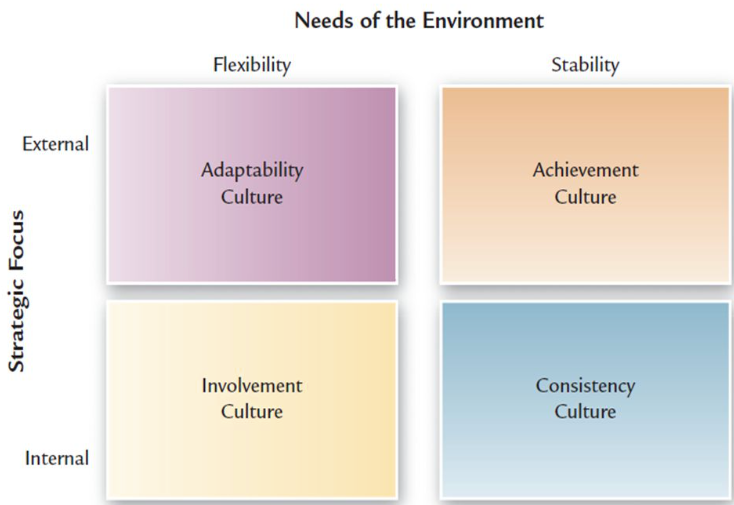
- special occasions that reinforce valued accomplishments, create a bond among people by allowing them to share an important event, and anoint and celebrate heroes - 25adaptability culture- emerges in an environment that requires fast responses and high-risk decision making
- encourage values that support the company’s ability to rapidly detect, interpret, and translate signals from the environment into new behaviors
- employees have the autonomy to make decisions and act freely to meet new needs, and responsiveness to customers is highly valued - 26achievement culture- suited to organizations concerned with serving specific customers in the external environment, but without the intense need for flexibility and rapid change
- values competitiveness, aggressiveness, personal initiative, cost cutting, and willingness to work long and hard to achieve results
- An emphasis on winning and achieving specific ambitious goals is the glue that holds the organization together - 27involvement culture- seeks the participation of employees to adapt rapidly to changing needs from the environment.
- places a high value on meeting the needs of employees, and the organization may be characterized by a caring, family-like atmosphere.
- Managers emphasize values such as cooperation, consideration of both employees and customers, and avoiding status differences - 28consistency culture- uses an internal focus and a consistency orientation to operate in a stable environment
- following the rules and being thrifty are valued, and the culture supports and rewards a methodical, rational, and orderly way of doing things. - 29high performance culture- is based on a solid organizational mission or purpose
- embodies shared adaptive values that guide decisions and business practices
- encourages individual employee ownership of both bottom-line results and the organization’s cultural backbone.* - 30cultural leader- defines and uses signals and symbols to influence corporate culture.
- clarifies what the new culture should be and crafts a story that inspires people to change
- the “chief marketing officer” for the desired cultural values - 31visible corporate culture- culture that can be seen on a surface level
- ex. artifacts (dress office layout, symbols, slogans, ceremonies) - 32invisible corporate culture- deeper values and shared understandings shared by org members
- ex. expressed values ("The HP Way")
-ex. underlying assumptions and deep beliefs ("people here treat each other like family") - 33Four Types of Corporate Culture
- 34supply chainnetwork of multiple businesses and individuals that are connected through the flow of products or services
- 35international dimension- Events originating in foreign countries
- New opportunities for U.S. companies in other countries
- New competitors, suppliers, and customers
- New technological, social, and economic trends - 36Environmental Uncertainty- managers do not have sufficient information about environmental factors to understand and predict environmental needs and changes
- influences: the number of factors that affect the organization and the
extent to which those factors change - 37merger2 or more organizations combine to become one
- 38joint venture- strategic alliance or program by two or more organizations
- occurs when a project is too complex, expensive, or uncertain for one firm to handle alone - 39How do managers work with lawmakers?they educate lawmakers about their products and legislation’s impact on their business strategies
- 40What type of political/economic system does the U.S. encourage?- capitalism
-avoids over-regulation - 41specific tools of the legal-political environment-OSHA
-Fair trade practices
- information and labeling requirements - 42What values drive "good" culture?Agility
- Collaboration
- Customer
- Diversity
- Execution
- Innovation
- Integrity
- Performance
- Respect - 43What makes a great culture?- “A workplace with a clear mission connecting employees' daily work to a broader social purpose and positive change.”
- “High-quality senior leaders who are inspiring, empathetic and competent.”
- “A set of clearly-defined pathways for career advancement, making job roles a journey rather than a dead-end.”
Information
- Description
- college Mana3335 Flashcards on Mana3335: ch 3, created by Lauren Comeaux on 30/08/2022.
- Created by
- Lauren Comeaux
- Views
- 0
- Rating