
Flashcards
Paediatric Dentistry
Cards in this deck (22)
- 1Techniques for behaviour management: 51. Tell, show, do
2. Modelling
3. Behaviour shaping
4. Reinforcement
5. Desensitization - 2Who is desensitization used for?Children with pre-existing fears of phobias.
Involves helping patient to relax in dental environment, then constructing a hierarchy of fearful stimuli for the patient. These are introduced to the child gradually, with progression on to the next stimulus only when the child is able to cope with previous situation. - 3Who is Modelling used for?For children with little previous dental experience who are apprehensive. ENCOURAGE
- 4Who is Behaviour shaping used for?To guide and modify the child´s responses. Encouraging/ignoring bad behaviour
- 5Who is reinforcement used for?Strengthening of patterns of behaviour, usually by rewarding good behaviour with approval and praise.
- 6Should parent accompany child into surgery?Essential on first visit, thereafter depends upon child´s age.
Parents should be motivated positively and instructed to act in the role of "silent helper" - 7Who is sedation indicated for?Genuinely anxious child who wishes to cooperate with RX.
- 8Which oral drugs are used for sedation in children?Midazolam and chloral hydrate
- 9Forms of sedation 51.Oral
2.Intramuscular: rarely used in children
3.Intravenous: rarely used in children > 12 years
4.Per rectum: popular in some Scandinavian countries
5.Inhalation - 10What is used for inhalation sedation in children?nitrous oxide/oxygen mixture to produce relative ANALGESIA
The most popular in children. - 11What does hypnosis do?Produces state of altered consciousness and relaxation
- 12When child comes with toothache what should the examination include?Swelling
Temperature
Lymphadenopathy
Caries
Abscesses
Chronical buccal sinuses
Mobile teeth
Erupting teeth - 13What should we do as emergency treatment for a child who comes to the office with significant pyrexia >38, poorly localized, spreading infection, systemically unwell and swelling involving floor of mouth?Agressive antibiotic amoxicillin and metronidazole. Immediate referral to specialist centre
- 14What would be an emergency management for a child with reversible pulpitis?LA, excavate soft caries, restore temporarily with a zinc oxide/eugenol cement or fi exposed and vital- dress polyantibiotic paste (Ledermix).
Definitive management: pulpotomy or extraction - 15Are natal teeth supernumerary?No, so they should be retained if possible.
Often mobile. If danger of being inhaled, can be removed. - 16What is an eruption cyst?Accumulation of fluid of blood in the follicular space overlying an erupting tooth. Most rupture spontaneously, but some may be need to be marsupialized.
- 17How much time should past if there is a delayed eruption of permanent teeth until needed further investigation?> 6 months
- 18General causes of delayed eruption of permanent teeth? 6Hereditary gingival fibromatosis
Down syndrome
Gardner syndrome
Hypothyroidism
Cleidocranial dysostosis
Rickets - 19Local causes of delayed eruption of permanent teeth? 7Congenital absence
Crowding
Retention of primary tooth
Supernumerary tooth
Dilaceration
Dentigerous cyst
Trauma
Abnormal position of cript - 20Impaction of upper first permanent molar - prevalence -indication of what - when to insert an orthodontic separating spring- 2-5%
- crowding
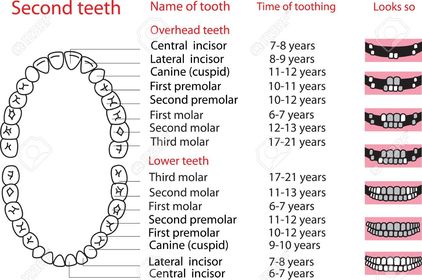
- In younger patients < 8 may self-correct ("jump"), if still present after 4-6 months in older children, ortho - 21Sequence of eruption of permanent dentition
- 22What can cause a premature tooth loss? 3Most commonly caries, sometimes traumatic avulsion and rarely systematic disease such as neutropenia or leukemia (abnormal periodontal attachment)
Information
- Description
- Certificate Pediatric Dentistry Flashcards on Paediatric Dentistry, created by Tsvetlina Brankova on 15/10/2015.
- Created by
- Tsvetlina Brankova
- Views
- 4
- Rating