
Flashcards
BA4 - Pt 2
Cards in this deck (181)
- 1In what situations is redundancy considered unfair?1) No consultation is given
2) Employees in similar poisitons/ roles not all considered equally
3) The employee is chosen for a reason unrelated to their role in the organisation
NB To make a redundancy claim, the employee must prove that
(a) they were an employee
(b) they have served two years' of continuous employment - 2Before considering redundancy, what measures should be considered first?1) Part time work
2) Reduce future recruitment for the role
3) Job sharing
4) Moving employee to a different department - 3What is wrongful dismissal?**When an employee's contract of employment has been terminated by the employer and the termination breaches one or more terms of the contract of employment (A) without giving proper notice, or B) during its fixed term
NB - wrongful dismissal can be claimed regardless of whether a formal contract exists as long as such a contract is implied. It represents a breach of contract rather than employment law. All employees can claim for wrongful dismissal, regardless of length of employment. However, there are usually time limits for making the claim
NB - dismissal without notice = summary dismissal - 4What are remedies for wrongful dismissal?1) Employee - claim for damages based on the loss of earnings
2) Employer - if left as the injured party, may dismiss the employee without wages
*The most common form of breach is where the employee is dismissed without notice or the notice given is too short - 5What is meant by unfair dismissal?*An act of employment termination, where employer terminates contract of employment without justification which is an infringement of employment law. It can lead to a statutory claim made by employees who have been 'unfairly dismissed'
NB - unfair dismissal relates to employment law, rather than contract law!
*claim is likely to be based on minimum length of service - 6What questions need to be considered to establish fair or unfair dismissal?1) REDUNDANCY - does the employer have a fair procedure for selecting who is going to be made redundant?
2) CONDUCT - has the employee conducted themselves inappropriately?
3) ANY OTHER REASON - this could be many situations e.g. an employee is trained to use a computer, but refuses to use it at work - 7What is key to dismissal?*Rules for unfair dismissal vary by jurisdiction depending on each country's own employment laws
*An employer must state a specific reason at the date of dismissal to rely on it as a reason for dismissal. Reasons cannot be applied retrospectively.
*Some people are unable to claim for dismissal (e.g. members of the armed forces in the UK) - 8What are remedies for unfair dismissal?*There are actions an employee can take if they think they've been unfairly dismissed
*In many jurisdictions, a dismissed employee must bring a claim to an Employment Tribunal (ET)
*An appeal may later be heard by an Employment Appeals Tribunal (EAT) - 9What is the two stage dismissal test?1) Was the dismissal for a fair reason
2) Was the dismissal dealt with fairly?
NB - employers may have a written grievance and disciplinary policy to be followed when disciplinary action is taken against an employee. One aspect of 'fair' will then be whether the policy if fully followed - 10What is meant by the three remedies at ET*The Employment Tribunal has the power to offer three remedies for unfair dismissal:
1) REINSTATEMENT - the employee is returned to the same job without any break of continuity
2) RE-ENGAGEMENT - the employee is given a new role that is comparable to the previous one (e.g. similar role with similar pay)
3) COMPENSATORY AWARD - an award given on law principles of damages for breach of contract so that loss may be compensated. The principles will vary by jurisdiciton - 11What is meant by money laundering?**The process of exchanging money or assets that were obtained criminally for money or other assets that are legitimate
(involves making 'dirty' money seem clean - each country is likely to have its own laws regarding money laundering)
Also refers to money, however come by, to fund terroism - 12What is the process of money laundering?1) Placement - disposing of the proceeds of crime into an apparently legitimate business property or activity (e.g. a shop/ bank). This is where the proceeds of crime are most apparant at risk of detection
2) Layering - transferring money from place to place to conceal its criminal origins (e.g. from business to business or various bank accounts/ trusts)
3) Integration - giving the money back to the criminals with the appearance of being from a legitimate source (e.g. from the sale of assets/ property). Once origin of funds is obscured. - 13What is meant by bribery?**The act of giving money, goods or other forms of recompense to a recipient in exchange for an alteration of their behaviour
e.g. paying a sum of money to an official to speed through an application process
*Bribery is big business and the World Bank estimates that more than £1,000bn is paid in bribes each year
NB - each country has its own rules regarding what it considers to be bribery (e.g. Bribery Act 2010 in the UK) - 14What is meant by a whistle blower?**An insider who reveals what they know about any evidence of illegality, gross waste, gross mismangement, abuse of power etc to the authorities
- Many scandals are revealed through a whistle-blower (e.g. the Watergate political scandal bringing down Nixon)
- In some jurasdictions, whistle-blowers are protected by law (their statement is called a 'protected disclosure') with the aim of encouraging people to come forward without fear of punishment - 15What are requirements for protection by law as a whistle blower?1) Have a qualifying disclosure (i.e. reveal the right type of problem)
a) criminal offences (e.g. fraud)
b) violations of health and safety
c) environmental hazards that have the potential to cause or have caused damage
d) a miscarriage of justice (the unjust punishment of someone)
e) the organisation breaking the law (e.g. not paying the right amount of tax)
f) the whistle-blower believes someone is hiding wrongdoing
2) Make a protected disclosure i.e. reveal the information to the right person in the right way (in good faith/ infomration is sustatiably true and disclosure reasonably believed to be made to the right person) - 16What is needed for disciplinary procedures?*There are many ways in which a company can discipline staff (e.g. reprimand/ dismissal), but all disciplinary procedures should:
1) Set out what is deemed an offence
2) Follow a clear set of steps
3) Outline rules for disciplinary meetings
4) Outlines rules for appeals
5) Set out examples of what would be treated as gross misconduct - 17What is meant by gross misconduct?**Where an offence is so serious that it can result in an immediate dismissal (e.g. fighting/ stealing/ bribery/ negligence)
- 18What is key to data protection?*Companies have to follow data protection legislation to balance rights of individuals to privacy and of the organisation to use data for the purposes of their business. These laws ensure information is:
1) Only used fairly and lawfully
2) Used for limited purposes that are specifically stated
3) Used properly and appropriately
4) Accurate
5) Only kept for as long as is needed
6) Handled according to people's data protection rights
7) Kept safe and securely
8) Obtained only for specified and lawful purpose
NB - some laws may provide individuals with rights to know what personal infomration on them is held (for a reasonable fee) - 19What is key to social media policies for companies?*Companies also need to be careful in how they use social media and may have a social media policy to internally regulate its use
*Many companies have a social media policy where they:
1) Outline the extent to which employees represent the company when they use its social media accounts
2) Explain acceptable content to share on the company's behalf
3) Provide rules for people using their own social media accounts
4) Show how personal use of social media will be monitored
5) Explain the consequences of breaching the policy and how it will be dealt with - 20What is meant by an organisation?**A group of people that is organised and managed in a way that aims to follow a corporate goal or need
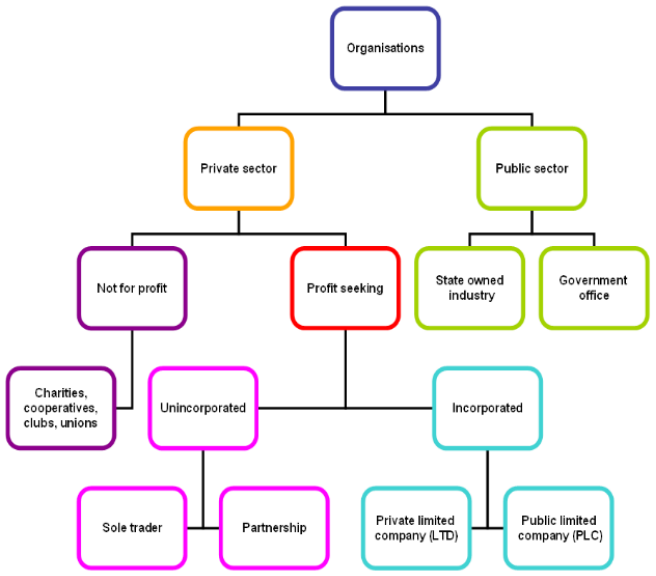
- All types of businesses follow a structure that is controlled by management, who determine how the business performs particular activities and the key roles and responsibilities of its members - 21What are the different types of business organisations?1) SOLE TRADERS - where the trader owns and runs the business (no legal formalities generally required to set up and inappropriate for large businesses/ those involving a degree of risk)
2) GENERAL PARTNERSHIPS - a business agreement where two or more people jointly own the business and share equal authority (can be informal of formalised by written agreement). Not recognised as seperate legal entity
3) LIMITED COMPANIES - a company that is incorporated meaning it has its own legal identity and can sue or own assets in its own right - 22What are the advantages and disadvantages of sole trading?ADVANTAGES
1) no formal procedures required to set up the business
2) Independence and self-accountability
3) All profits go to the sole trader
DISADVANTAGES
1) No limit on their personal responsibility for the debts of the business i.e. business debts must be met from private finance or sale of personal assets, if necessary
2) Expansion may require using business profits as capital, making it slow
3) High dependence on the individual can result in long working hours
NB - sole traders have the authority to:
1) make decisions regarding the running of the business
2) To make legally binding decisions - 23What is key in business partnerships?*General partnerships are a flexible business arrangement where the partners have no protection if the business fails
*the EQUAL AUTHORITY EXCEPTION says each partner in a general partnership will have equal authority, fairly sharing liability for the debts of the business. However, if they have a partnership agreement, one will have more authority than the other and will thus be more liable for the business's debts - 24What are the requirements of a partnership?1) Partners must be associated as joint proprieters
2) Partners are taxed on their share of the profits as they are technically self employed
3) Partnerships do not have to publish or audit their accounts - 25What is key to ownership in a limited company?*The ownership of a limited company is divided into equal parts or shares
*Shareholders own one or more shares in the business and because limited companies have their own identity, their owners are not personally liable for the firm's debts
NB - unlike sole traders and general partnerships, limited companies have a special status in the eyes of the law
*A limited company that can sell its shares on a stock exchange is known as a public limited company (PLC) - 26What are the differences between a company and a general partnership? (COMPANY)COMPANY
1) Must be recognised (incorporated) with the relevant companies register
2) Management decisions are made by a director or board of directors
3) Shareholders are responsible for financing the business, and recieve dividends out of its profits
4) Must file regular financial accounts with the company register
5) Shareholders are not personally responsible for the company's debts
6) Profits are usually distributed to shareholders in the form of dividends
7) Must pay corporation tax and make an annual tax return to the tax authorities - 27What is the difference between a company and a general partnership? (GENERAL)1) Each partner registers with the tax authorities as self-employed
2) The partners usually manage the business, but can delegate responsibilites to employees
3) Money for the business is raised out of partners' own assets and/ or with loans
4) The partnership, and each indiviudal member, must make annual returns to the tax authorities
5) The partners are personally liable for the firm's debts
6) Each partner takes a share of the business's profits
7) Partners are taxed on their share of the profits using personal tax rules - 28What is meant by a mimited liability partnership (LLP)?LLPs offer limited liability whilst maintaining a traditional partnership
However, LLPs must maintain accounting records, prepare and deliver audited annual accounts to the register of companies and submit an annual return in a similar manner to companies
*iN SOME JURASDICTIONS THE LIABILITY OF MEMBERS OF A llp IS LIMITED TO THE AMOUNT OF CAPITAL THEY AHEV AGREED TO CONTRIBUTE - 29What are public sector organisations?Some organisations are owned by the public sector (e.g. a government department or state-owned industry like the BBC in the UK/ Amtrack in the US)
*Part of the economy that is concerned with providing basic government services and is controlled by government organisations - 30What is the structure of different organisations?
- 31What is meant by incorporation and corporate identity?*To form a limited company, one needs to register it and send the relevant documents to the relevant company house
*Most countries have a slightly different, but mostly similar, process - 32What is the UK companies house process to form a company?1) Choose an effective company name - it must be unique
2) Register a company address - there must be a physical address where the business can operate from and have correspondence sent to
3) Appoint a company secretary and register directors - the company secretarial is responsible for being the company's representative to companies house. There must be at least one director. Directors are responsible for the running of the business
4) Register shares and shareholders - it must be established who own the company and what the proportion of ownership is
5) Submit the memorandum and articles of association - a 'memorandum of association' must be acquired and the articles of association must be registered
6) Register the company and for corporation tax - all of the above needs to be submitted to the register (companies house) so that the company is official and can start submitting accounts and paying corporation tax - 33What is meant by memorandum of association and articles of association?**Memorandum of association - a legal statement signed by all initial shareholders agreeing to form the company
**Articles of association - written rules about running the company, agreed by the shareholders, directors and the company secretary - 34What is meant by an off the shelf company?**A 'ready made' company that has a standard set of articles of association
- One can always purchase an off the shelf company if they do not want to go through the process of setting up a limited company from scratch
- Will usually have a non-discript name hat can be changed if wished
*Buying off the shelf has advantages:
1)may be cheaper/ simplier
2) company may be able to trade immediately
3) as the company exists, it can enter into contracts immediately - 35What is meant by corporate identity?**INCORPORATION - where a corporate body has a legal personality that is distinct from its members
NB. many companies are seen as being synonymous with their CEOs/ founders (e.g. Jeff Bezos/ Mark Zuckerberg at Facebook). However, they are usually incorporated so their identities are usually discrete (rules established by case law in the UK) - 36What is meant by legal personality?A legal personality of a company means that:
1) The liability of members is limited (e.g. by shares)
2) The company can be sued or can sue in its own name
3) The company itself can own property (e.g. factories/ equipment)
4) A company has perpetual sucsession which is independent of individual shareholders
5) The company has to be formally wound-up
6) The company is subject to the company law of its country
7) Management of the company is distinct from ownership
8) If a company suffers injury, the company itself must remedy the situation (established by case law in the UK) - 37What is meant by perpetual sucsession?**Where a company carries on existing indefinitely (i.e the company doesn't cease to exist when a shareholder dies)
- 38How can a private company be limited by shares?**A company that limits the liability of their shareholders to the amount unpaid on their share capital
(i.e. they have to pay to purchase value of the shares, but after that they won't have any more liability (even if the company fails with significant debts)
NB these companies:
1) Are usually enterprises in which some, if not all, shareholders are also directors
2) Sometimes have a suffix after their name denoting the company type (e.g. Ltd in the UK)
3) Cannot offer its shares for sale to the general public - 39What is a public limited company (PLC)?*Public limited company usually converted from a private one and is appropriate for larger businesses where shares are intended to be available to the general public
NB - a public limited company:
1) is registered under the Companies Register
2) Can offer its shares on the stock market
3) Must hold a minimum capital e.g. in the UK it's £50,000 - 40What are the difference between private and public limited companies? (PRIVATE)1) In the UK, LTD denotes a private company (this can vary around the world)
2) A private company is a private concern of the persons engaged in it
3) Fewer requirements regarding management staffing
4) Can only sell shares privately - cannot sell shares on the stock exchange
5) No minimal capital requirement
6) Must register with the company register
7) In many jurisdictions there are exemptions from the preparation and filing of some sections of the accounts and time scales for filing are often longer than for public companies (accounts must typically be filed within 9 months)
8) Usually do not have to hold AGMs
9) No mimiumum (or maximum) requirements for raising capital
!0) minimum of one director and no requirement for a secretary
11) Can begin trading at point of incorporation
12) Audit not required if meets exemption criteria - 41What are the difference between private and public limited companies? (PUBLIC)1) In the UK, PLC denotes a public company. This can vary around the world
2) A public company is intended as a vehicle for a business and public investments in that business
3) Greater requirements regarding management staffing
4) Shares can be listed on a recognised stock exchange, enabling companies to raise share capital by offering shares
5) Often a minimum is required (e.g. £50,000 in the UK)
6) Must register with the company register. May need additional documentation prior to trading e.g. trading certificate in the UK
7) Usually more detail is required in the accounts than for a private company and they have to be published within a shorter timeframe
8) Usually have to hold an AGM of shareholders
9) In order to trade, must have allotted shares of at least £50,000
10 Minimum of two directors and must have at least one qualified secretary
11) Must obtain trading certification from registrar before commencing trading
12) Must file accounts within 6 months and must be audited - 42What is key to public companies in terms of disclosure requirements?*Public companies may be subject to special disclosure and publicity requirements, due to the fact that the shares are owned by the general public
- 43What is meant by a parent or holding company?**A parent or holding company is an organisation that own and controls, wholly or partially, separate businesses called subsidiaries
NB - can be private or public and the managers and board of directors of the parent company generally maintain control of the subsidiaries (a wholly owned subsidiary is 100% owned by the parent company) - 44What is the difference between a parent and holding company?In legal terms, a holding company is inactive except for the fact that it owns the subsidiary company
In contrast, a parent company is more active in the running of a subsidiary company - 45What is a multinational company?**A company that produces and markets its products in more that one country
NB - can be private or public#
E.g. Coca-cola - are present in most countries in the world and have to devote huge resources to following the rules of each one - 46What is meant by Articles of Association (AoA)?**Determine the governing rules that companies must follow, protecting those involved. They also regulate the relationship between the company, its shareholders and directors
NB - an incorporated company must have its own articles of association - 47What are the typical contents of the articles of association?1) Procedures for the appointment and dismissal of directors
2) The director's powers and responsibilities
3) Organisation of director's meetings
4) Rules regarding the issuing and transference of shares
5) The different voting rights attached to classes of shares
6) The policy regarding the payment of dividends
7) The conditions and notice needed to be given to members in the event of winding up the company
8) Members rights and meetings and communication with shareholders
9) Payment of dividends
10) Documents and records - 48What is a certificate of incorporation?*In most companies, once the register is satisfied that the documents are all in order, the company is given a register number
*After this, a certificate of incorporation is issued stating the date on which the company was incorporated - 49What is the binding power of Articles of Association?The articles of association has a number of effects:
1) Members (shareholders) of a company are bound by the articles of association (AoA)
2) A company is able to compel its member to obey the AoA
3) The company is bound by them
4) Members can compel the company to obey the AoA (established by case law in the UK) - 50What is meant by lifting the vel?**The act of treating the rights and duties of a corporation as those of their members, rather than treating the company as a legally separate entity
NB - lifting the veil can be done to reveal what companies have done and who has done it, to identify and illegal activity. This allows courts to attribute blame or responsibility to the guilty parties
In certain circumstances, the courts can look through the company to the identity of shareholders (intended to prevent inequitable results and expose commercial reality of the situation - sometimes members/ directors can then become personally liable for debts) - 51What is the effect of lifting the veil?When the veil has been lifted, anyone can be liable if they are guilty of/ responsible for an offence
- 52What are the cases in which the veil might be lifted?1) Failure to disclose the company's full name on company documents, prehaps in a misleading way
2) Wrongful trading (i.e. when a company continues to trade when they know they cannot avoid insolvent liquidation and haven't taken measures to limit the company's debts
3) Liability for trading without a trading certificate
4) Evasion of taxation
5) Fradulent trading - a court may decide that the person who were knowingly party to fraudulant trading shall be personally responsible for debts and other liabilities
6) Accounts are not prepared properly by a group of closely related companies
7) If a disqualified director participates in the management of a company
8) Public interest or times of emergency
9) A company is forbidden from trading with enemy aliens in times of war
10) To reveal the company as a quasi-partnership - 53Why is a conceptual framework necessary?*Accounting standards used to have serious problems:
1) Internal inconsistency
2) External inconsistency - e.g. across different jurisdictions
3) Inconclusive - same issue repeated across many standards so open to interpretation (frameworks being principles based can help make good decisions)
4) Fire-fighting approach - standards brought in to deal with specific dilemmas, but this not very proactive - 54What is the definition of ethics?Oxford English Dictionary:
'moral principles that govern a person's behaviour of the conducting of an activity'
(i.e. how one should act in situations, doing the right thing and morality - knowing right from wrong)
Can question the consequences of actions, the motivation behind action, the guiding principles behind actions and the key values held leading to actions - 55What are the schools of thought for ethics?1) Value ethics - the virtues (justice/ charity/ generosity) are dispositions to act (Aristotle)
2) 'Deontological' - an idea that humans are bound to obey to respect other rational beings (Kant)
3) Utilitarianism - the guiding principle of conduct should be the greatest happiness and benefit the greatest number - 56What is the role of an accountant in promoting ethical behaviour?*Work must be in good faith as used in decision making
*A duty to act in the public interest (referring to the common well-being/ welfare of society) - 57What professional accounting bodies have a role in ethics?1) IFAC (International Federation of Accountants)
2) IFAC's International Ethics Standards Board for Accountants (IESBA)
3) Financial Reporting Council (FRC) - UK
4) The Conduct Committee (part of FRC) - 58What is the role of IFAC in ethics for accountants?protects the public interest by developing high quality international standards, promoting strong ethical values encouraging quality practice
- 59What is the role of IESBA in ethics for accountants?independent standard setting board that develops and issues in the public interest ethical standards for professional accountants worldwide. Develops Code of Ethics for Professional Accountants. The board also provides adoption and implementation support, promotes good ethical practice and fosters international debate on ethical issues face by accountants
- 60What is the role of FRC in ethics for accountants?*UKs independent regulator for promoting high quality corporate governance and reporting to foster investment
*Board of FRC issues the UK versions of International Standards on Auditing and International Financial Reporting Standards (IFRS) (where appropriate, taking advice from the Audit & Assurance Council which is part of the FRC) - 61What is the role of the Conduct Committee in ethics for accountants?*Conduct Committee is part of FRC and provides independent oversight of professional disciplinary issues and oversight of regulation of accountants and actuaries in the UK/ Republic of Ireland
*Responsibilities include:
1) Monitoring of Recognised Supervisory and Recoginised Qualifying bodies
2) Audit quality reviews
3) Corporate reporting reviews
4) Professional discipline
5) Oversiht of the regulation of accountants and acturies - 62What is the IFAC code?*IFAC Code of Ethics for Professional Accountants*
*First published 2005, latest revision 2018 and prepared by Ethical Standards Board
*The Committee issues high-quality ethical standards and other prenouncements for professional accountats around the world
*Developed following a number of financial scandals to prevent the growing confidence crisis in the profession - 63What is the purpose of CIMA Code of Ethics for Professional Accountants?*Developed in 2006, with revised codes in 2010, 2015 and 2020
*Refelcts standards CIMA expects of its members and students and aligns with glabal standards for the profession
*reflects CIMA's status as a Chartered Institute and basis for any complaints/ cases and aims to:
1) Identify nature of personal responsiblity accountant takes on as part of price to pay for getting a reasonable salrary/ status
2) Provides guidance on situations where extra care is needed due to ethical implications
3) provides general guidance on addressing difficult questions - 64How is the CIMA Code of Ethics for Professional Accountants outlined?*Split into three parts with list of definitions at the end
PART 1) - COMPLYING WITH THE CODE - introduction and fundamental principles of professional ethics for professional accountants. Provides conceptual framework that should be used to identify, evaluate and apply safegaurds to eliminate threats to compliance with the fundamental principles
PART 2) - PROFESSIONAL ACCOUNTATNS IN BUSINESS (including GCMA designation holders) - developed in co-operation with American Institute of CPAs (AICPA) - covers issues such as potential conflicts, preparation and reporting of information, acting with sufficent expertise , financial interests and inducements
PART 3) - PROFESSIONAL ACCOUNTATS IN PUBLIC PRACTICE - covers issues identified as relevant for accountats in public t=practice, conflicts of interest, second opinions, fees and other types of remunaeration, marketing professional services, gifts, objectivity etc.
NB - applies to all member firms/ bodies of IFAC and therefore a body may not apply less stringent standards than those stated in this code - 65What is set out in Section 111 - Integrity of the CIMA code of Ethics?*Integrity implies fair dealing and truthfulness
*Members required not to be associated with any form of communication/ report where information considered to be:
1) Materially false/ contain misleading statements
2) Provided recklessly
3) Incomplete (such that the report/ communication becomes misleading) - 66What is set out in Section 112 - Objectivity of the CIMA code of Ethics?*Ensure business/ professional judgement is not compromised because of bias / conflict of interest (where employee has duty to act on behalf f an employer and has an economic or personal interest in a transaction)
*NB there are many situations where objectivity could be compromised so need to ensure objectivity is intact in any business/ professional relationship - 67What is set out in Section 113 - Professional Competence and Due Care of the CIMA code of Ethics?Two main considerations for this:
1) Accountants required to have knowledge/ skill to carry out their work - attained and then maintained via CPD
2) Accountants must follow applicable technical and professional standards when providing professional services
NB - where provision of client service has inherent limitations (e.g. reliance of client information, client must be made aware of this) - 68What is set out in Section 114 - Confidentiality of the CIMA code of Ethics?Two considerations:
1) Information obtained in a business relationship is not disclosed outside the firm unless there is proper/ specific authority/ professional right or duty to disclose
2) Confidential information is not to be used to personal advantage
Reasons for disclosure (although rare):
1_ permitted by law and authorised by the client
2) required by law
3) Professional right or duty to disclose - 69What is set out in Section 115 - Professional behaviour of the CIMA code of Ethics?*Accountatns must comply with relevant laws and regulations
*Actions suggested by a third part which would bring discredit to the profession should be avioded
*An accountant is required to treat all people contacted in a professional capacity with courtesy and consideration. Marketing activities should not bring the profession into disriespute - 70What is the 'seven principles of public life'?*A publically employed acocuntant is subject to these seven principles issued by the Committee of Standards in Public Life (UK Government), but applicable to all accountants. A HOLDER OF PUBLIC OFFICE SHOLD:
1) SELFLESSNESS - act solely in public interest, not for financial/ benefits for themselves, family or friends
2) INTEGRITY - not be influenced in performance of their official duties
3) OBJECTIVITY - make choices on merit
4) ACCOUNTABILITY - accountable for their decision and actions to the public and must be open to scrutiny
5) OPENNESS - open as poissible about decisions taken
6) HONESTY - duty to declare private interests relating to public duties
7) LEADERSHIP - promote and support these principles by leadership and example - 71What personal qualities do members of the profession need/ need to develop? From ' Approaches to the Development and Maintenance of Professional Values, ethics and Attitudes in accounting Education Programs' - International Accounting Education Standards Board1) RELIABILITY - being able to be trusted and dependable
2) RESPONSIBILITY - being accountanble for one's actions and decisions
3) TIMELIENESS - delivering work in a timely manner without delay and meeting expectations of others
4) COURTESY - deomnstrating politeness and good manners toards others. Includes unacceptable forms of address (racism/ sexism etc) being tackled by law, meaning there is a more fundamental set of societal values
5) RESPECT - demonstrating an attitude of esteem, deference regard and admiration of others especially where attitudes might differ - 72What is key to having independence in relation to ethics?*In the public interest (and required by CIMA's code of ethics) that members of assurance engagemtn and teams/ their firms are independent of the assurance ckuents
*Audits should be performed with an attitude of professional scepticism (including a questioning mind and being alert to conditions which may indicate fraud/ error)
Independece of:
1) MIND - come to a conclusion without being influenced in a way that compromises professional judgement. Avoid bias and take second opinions
2) APPEARANCE - question whether a reasonable and informed third party would conclude the same and don't allow independence to be compromised - 73When may disclosures be made when there is a professional duty or right to disclose when not prohibited by law?1) To comply with the quality review of a member body or professional body
2) To respond to an inquiry or investigation by a member or regulatory body
3) To protect the professional interests of an professional accountant in legal proceedings
4) To comply with technical statements and ethics requirements
NB - these all relate to the regulation and disciplinary functions of CIMA
*Disclosures should be made in whole and particular disclosures are tantamount to deception
*With disclosures, need to consider whether any parties would be harmed by a disclosure and whther all relevant information is known and substatiated - 74What is the GCMA Report on Managing Responsible Business?Defines:
1) responsible business - organisation's commitment to operating in a way that is economically, environmentally and socisally responsible. Ensuring commitment prevails while uholding interests of stakeholder groups
2) business ethics - application of values and application to all strategic anad operaitonal aspects of business. conduct.
3) Ethical performance - extent to which organisation's behaviour aligns with stated ethical values and commitments
4) Ethical management information - allows assessment of ethical perfomance and may include specific ethics information. Will often originate from multiple sources within the business and can be qualitative or quantitative.
5) Integrated Reporting
- an approcah to coroprate reporting based on fianncial and non-financial information demonstrating links between strategy, governance and financial performance (as well as environmental, soical and economic context in which it oeperates)
6) Ethical issues witin organisations - 75What is meant by 'Embedding Ethical Values' - a guide for CIMA partners?Jointly produced by CIMA and Institute of Business Ethics - the guide has a twofold purpose:
1) For organisations without an ethical policy - provides right resources to support one being dran up
2) For organisations already withan ethical policy - directs to resources to help address what else can be done to embed ethical values and make the code effective - 76What is poor practice for a company implementing an ethical code??1) Only pinning the code on a noticeboard
2) Failing to obtain commitment to the code
3) Leaving respnsibility for the codes effectiveness to HR
4) Failing to find out concerns of staff at differnet levels
5) Failing to feature the code in induction training/ management development activities
6) Having no procedure for revising the code regularly
7) Make exceptions to the codes applicaiton
8) Failing to follow up on breaches of the code's standards
9) Unhelful example by corporate leaders
!0) Neglectin habing a strategy to itegrate the corporate values/ standards in the running of the business
11) Treating the code as confidential or purely internal document
12) Making it difficult for staff to have direct access to the code/ person responsible for it - 77What iis the relationship between ethics and the law?*Need to consider ethical codes vs legislation - considers who should take responsibility for doing the right things and who should pick up the pieces when it goes wrong
* If there are global or national significance to problems, governments step in (this is why some aspects of professional conduct are regulated by the law, rather than the profesison)
* Laws in themselves do not hlp with ethical problems (e.g. an immoral law) - there is therfore potential for conflict between professional duty (e.g. confidentiality) and statute law - 78What is key to ethical codes vs. contracts?*Contracts can hold a legal obligation, but caution to note that contracts are voluntarily assumed legal obligations (you have the choice to take the contract or not)
*e.g. contractual vs professional duty - if employer asks you to do something professionally unnaceptable, you might break your contractual duty to not do it
NB - from a purely ethical standpoint, you are ultimatly supposed to favour your profession over your employer - 79What is key to identifying ethical dilemas?*Important to understand how ethical dilemas arise:
1) Societal values - laws may be made where there are tensions between corporate values and values of society
2) Professional values - individual might recognise tensions after speakng up about something. This could lead them to want to leave the company
3) Personal values
4) Corporate values - can be related to strategy/ policy (occurs at all levels, including middle management)
*Dilemmas arise where boundaries of right and wrong are unclear (could be due to there being no ethical code). Have to consider what is right for the profession over 'what is right for me' - 80How can ethical dilemmas/ conflicts be resolved?*Dependent on situation - think about CIMA's Code of Ethic's Fundamental Principles and how to best apply these
*Speak up about anything you are uncofrotable with (with a manger/ CIMA etc)
*Follow CIMA's Ethical Checklist
*Act quickly when facing an ethical dilemma - longer it is left the more reprecussions there may be - 81What is CIMA's ethcial checklist?(see book)
1) Check all facts (and document where possible) - do not rely on word of mouth and consider, is it really your problem?
2) Is it ethical? - consider all ethical issues involved - does it feel right? How would you feel if it was in a newspaper? Have you referred to the code of ethics/
3) Is it legal? - national or international - does it comply with rules/ regulations/ standards/ policies and ocntracts for regulators/ bodies of your employer?
4) Identify which fundamental principles are affected
5) Identify parties affected - in waht way are they affected? Understnad affects on inaction
6) Consider a possible source of action - intenral and external escalation - consider internal grivence procedures document every action to resolve the conflict. Escalate to auditors/ legal advisors/ professional bodies
7) Seek professional/ legal advice - whistleblowing or helpine/ CIMA ethics helpline (free to members and students)
8) Refuse to remain associated with the conflict - disocciate yourself (in writing if necessary) - 82What are some key tips for helping if you ever find yourself being pressured into unethical conduct?1) Know your company's business culture - it is easier to consider how best to respond after an event has occured. Therefore, prepare yourself before such an event. Before taking a job consider the business culture - ask questions in interview!
2) Understand professional obligations - when pushing back, make sure you understand professional bodies codes to be able to maintian the se standards in times of stress. Can also draw on the sanctions/ implactions that could be imposed
3) Put facts into context - understand the facts before diagnosing the problem - consider the motivation for the pressure put on you
4) Raise the issue with your manager - talk to the right people
5) Point out potential reputational damage - useful tactic for pushing back when pressurd to act unethically (consider it on social media...!)
6) Consider further action - if the threat cannot be reduced it is better to dissociate yourself (remove your name from a misleading report). May need to become a whistle-blower
7) Keep records - resources tp anyone providing you with support - 83What is the key to the report 'Business Ethics for SME's: A Guide for CIMA Partners'?The second of two guides (alongside 'Embedding ethical values')
*Wht business ethics means to SMEs
*How SMEs can introduce and support high standards of business practice
*Considers some examples of where owners/ managers could encounter ethical challenges
*Considers some of the benefits to making ethical values explict (e.g. attracting high quality staff/ reputational benefits/ more open and innovative culture)
*Considers business values (e.g. customer service/ innovation/ efficiency/ relaibility)
*Considers ethical values (e.g. integrity/ honesty/ fairness)
*Considers examples of business ethics issues (e.g. bullying and harrassmnet/ tax aviodance, use of social media, paying suppliers on time, health and safety) - 84What is the definition of 'an organisation'?Buchanan and Huczynski
**Organisations are social arrangements for the controlled purpose of collective goals**
1) Collective goals - organisation as defined by its goals (e.g. a school is education for children)
2) Social Arrangements - somone working alone cannot be classed an organisation. Organisations are structured to allow people to work togther for a common goal
3) Controlled performance - systems and procedures in place to ensure group goals re achieved (e.g. sales targets) - 85How can different organisations be classified?1) Profit Orientated - primary objective is to maximise shareholder wealth, with secondary objective to give detailed objectives of how to mximise wealth of the owner
2) Not for Profit orientated - primary objective to maximise benefit to beneficiaries with secondary objective to give economy (controlling costs), efficiency (achieving objectives at mimum cost and effectiveness (measure of achievement by reference to objectives)s - 86What is a co-operative?Co-operatives (or mutuals) are organisations owned and democraticaly controlled by their members (people who buy their goods/ services
*Organised solely to meet the needs of member-owners who ususally share any profits - 87What is the definition of corporate governance?From the Financial Reporting Council:
**The purpose of corporate governance is to facilitate effective, entrepreneurial and prudent management that can deliver the long term sucsess of a company**
*It is the system by which companies are directed and controlled
*Boards of directors are responsible for the governance of their companies (inc. setting strategic aims, providing leadership, supervising management and reporting to shareholders on their stewardship)
*Shareholders responsible for appointing directors
*Auditors responsible for satisfying themselves that an appropriate governance structure is in place
*Boards actions are subject to laws, regulations and the shareholders - 88Why is corporate governance needed?*To ensure companies are run well in the interests of their shareholders and wider communities
*Developed off the back of some major accounting scandals (e.g. Enron)
*There are different codes of practices around the world, but they generally all cover:
1) role of the board of directors
2) reliability of financial reports and the relationship between a company and its auditors
3) interest of the company's shareholders in the company - 89Why is corporate governance so important?*In most developed countries, listed companies are required to operate systems of corporate governance laid down by either statute or professional organisations (e.g. Securities and Exchange Comission (SEC) in the US or Financial Conduct Authority (FCA) in the UK
*Requirements often given support by the stock exchange (often written in to listing rules)
*Development of corporate goevernance largely stems from the UK (80s and 90s following series of corporate failures)
*UK Corporate Governance Code follows a principles-based approach and is endorsed by the London Stock Exchange (US is more legislative with the SARBOX Act, 2002) - 90Why did Corporate Governance come about in the 80s/90s?*Number of high profile company collapses
*Findings were that often companies that failed were:
1) poorly run - board of directors dominated by one chairman/ CEO and greed 'fat cat' directors. May also have directors lacking in sufficient breadth of knowledge/ experience to appreciate problems companies faced and relative risks.
2) poor financial reporting - questions raised about audit and internal control systems
3) apparant lack of interest in performance of the compnay from the major investment institutions invested in them
4) companies run in interest of executive directors (on high renumeration) rather than shareholders
5) inadequate risk management - internal control systems ineffective - 91What is the relationship between Governance, ethics and company law?*In many jurasdictions, company law is made up of ethical principles and standards of behaviour which legislators and courts have though of appropriate to codeify as law
LAW
Compliance requirements - always to be obeyed
Penalties - civil (may allow the company to recover funds from directors who breach legal obligations) or criminal (fine and/or imprisonment may result from certain criminal infringements)
CORPORATE GOVERNANCE
Compliance requirements - In the UK, stock exchange rules require listed companies to comply with UK Corporate Governance Code. Unlisted companies are under no obligation to comply, but it is considered best practice to do so.
Penalties - no formal penalties for non-compliance, but companies must give reasons for non-compliance and may suffer loss of reputation/ bad publicity
ETHICS
Compliance requirements - individual ethical action, but CIMA students and members expected to follow CIMA's code of ethics
Penalties - an individual behaving unethically may suffer loss of reputation/ their job/ sanctions imposed by professional body - 92What is meant by stewardship?*Responsibility to take good care of resources
*A 'steward' is entrusted with the management of another's persons proprty
*Stewards are accountable for the way they carry out their role
*The relationship (where one person has a duty of care towards someone else is known as 'FIDUCIARY RELATIONSTIP) - a relationship of good faith - 93What is meant by resource-dependancy theory?Pfeffer and Salancik, 1978
*How the external resources of organisations affect the behaviour of the organisation:
1) Organisations depend on resources
2) Resources ultimatley originate from an outside organisation's environment
3) Resources one organisation needs is often in the hands of another organisation
4) Resources are a basis of power
5) Legally independent organisations can depend on eachother
NB - directors therefore responsible for developing their own strategies to exploit resources in order to ensure the survival of their own organisation - 94What is the OCED Principles of Corporate Governance?ORGANISATION FOR ECONOMIC CO-OPERATION AND DEVELOPMENT
*Consists 38 countries who want a free market economy with one set of rules for corporate governance
*The principles (1999, revised 2004/2015) are intended to:
1) assist member and non-member governments to evaluate and imporve legal and institutional regulatory framework for corporate governance in their country
2) Provide guidance and suggestions for stock exchanges, investors, corporations and other parties who have a role in developing good corporate governance - 95What are the 6 principles in the OCED Principles of Corporate Governance (1-3)?1) Ensuring the basis for an effective corporate governance framework - should promote transparent and fair markets and efficient allocation of resources. Should be consistent with the law and support effective supervision and enforcement
2) Fair treatment of shareholders - protect and facilitate excercise of shareholders' rights, ensuring equitable treatment of all. Shareholders should have a right to redress if there is violation of their rights
3) Institutional investors, stock markets and other intermediaries - should provide sound incentives throughout the investment chain and provide for stock markets to function in a way that leads to good CG - 96What are the 6 principles in the OCED Principles of Corporate Governance (4-6)?4) Role of stakeholders in corporate governance - framework should recognise the rights of stakeholders established by law or through mutual agreements and encourage active co-operation and stakeholders in creating wealth, jobs and sustainability of financially sound enterprises
5) Discloure and transparency - should ensure timely and accurate disclosure on all material matters regarding the corporation
6) Responsibilities of the board - should ensure the strategic guidance of the entity, the effective monitoring of management by the bard's accountability to the company and the shareholders - 97What is the status of OECD principles?1) The principles reprenset a common basis that OECD Member countries consider essential for the development of good governance practice
2) They are intended to be concise , understandable and accessible to the international community
3) They are not intended to be a substitute for government or private sector incentives to develop more detailed 'best practice' in governance - 98What is the need for IFAC's main drivers of corporate success?*From PAIB (Professional Accountants in Business) Comittee paper - it lists 8 drivers of sustainable organisational success showing how the global accountancy profession needs to support development of professional accountants so that they can help organisations achieve value creation
- 99What are IFAC's main drivers of corporate success?1) Customer and Stakeholder Focus - understanding customer/ service user needs and alligning organisation to these
2) Effective Leadership and Strategy - ethical and strategic leadership for sustainable value creating and facilitating key performance drivers
3) Integrated Governance, Risk and Control - balancing performance and conformance in goverenance
4) Innovation and Adaptability - to improve reputation and performance
5) Financial Management - ensurse leadership and strategy supports value creation. Implement good practices in tax/ treasury/ cost/ working capital managemen
6) People and Talent Management - as a strategic function
7) Operational Excellence - allign resource allocation with strategic objs and support decision making with timely and insightful perfomance management
8) Effective and Transparent Communication - engage stakeholders effectively so recieve relevant communication and prepare high quality business reporting for decision making - 100What is CIMA's proposals for better corporate governance?*CIMA contributed to 'report leadership' - a multistakeholder group aimed to challenge current thinking on corporate reporting
PROPOSALS FOR BETTER REPORTING ON CORPORATE GOVERNANCE:
1) Tone from the top - communicating chairman's vies of good governance and the culture of the board
2) Show how board works as a team - complementary sets of skills/ experience
3) Key actions of the board and its committees - to be linked to the key corporate events for the year
4) Board effectiveness - use board evaluations to communicate board performanace and priorities
5) Communication and engagement with shareholders - how needs of shareholders have/ have not been met (and why) - 101Why are two-tiered boards commonly seen in France/ Germany?*In Germany, there is a Codetermination Act (1976) that gives workers the right to be informed and involved in the decisions that affect them. There are also must stronger relationships between companies and banks than in the UK. Banks frequently shareholders and other shareholders often use the banks for their shares
- 102What are the roles of the supervisory board in a two-tier board structure?1) Appoint, supervise and advise members of management board
2) Strategic oversight of organisaiton
3) recieve information/ reports from management board
4) elected by shareholders at AGM
5) chairman co-ordinates the work
6) includes stakeholder representitives (e.g. employee reps/ environmental group reps) - not considered independent NEDs - 103What are the advantages and disadvantages of a two tier board?ADVANTAGES
1) Clear seperation betwen management and owners/ those that control business for benefit of stakeholders
2) Implict stakeholder involvement (where used in countries with prevelant insider control)
3) Worker representation gives wider stakeholder involvement
4) Independence in thought/ discussion and decision since board meetings/ operation is separate
5) Direct power over management - right to appoint members to management board
DISADVANTAGES
1) Dilution of power - confusion over authority/ perceived lake of accountability
2) Isolation of supervisory board (non-participation in manager meetings)
3) Agency problems
4) Increased bureaucracy (slower decision)
5) Lack of transparancy over appointment of supervisory board members - inefficient monitoring/ governance - 104What are advantages of a unitary board?*Issues specific to unitary board tend to relate to role of NEDs
1) NED expertise - there is implied involvement of NEDs in running the company rather than just supervising
2) NED empowerment - as responsible as executives (better demonstrated by active involvement at early stage)
3) Compromise - less extreme decisions developed prior to the need for supervisory control
4) Responsibility - cabinet decision making with wide viewpoints suggests better decisions
5) Reduction of fraud/ malpractice due to wider involvement in actual management of company
6) Improved investor confidence due to above - 105How did corporate governance codes develop (UK)?NB - development of corporate governance codes is closely related to the UK, so used to illustrate best practice
1992 - Cadbury report
1995 - Greenbury report
1998 - Hampel report
1999 - Turnbull report
2003 - Higgs report
2003 - Tyson report
2003 - Smith report
2010 - Sir David Walker and the FRC report - 106What was the focus and outcomes of the Cadbury report (1992)?FOCUS:
1) Board of directors, OUTCOME - Chairman/ CEO role should be split and Chairman independence is necessary
2) Institutional investors, OUTCOME - need for greater dialogue
3) Audit and accountability - OUTCOME - good communication/ disclosure
4) Use to form part of stock exchange listing rules - OUTCOME - used in listing rules, comply or explain..! - 107What was the focus and outcomes of the Greenbury (1995), Hampel (1998) and Turnbull (1999) reports?GREENBURY (1995)
Focus - director's renumeration, Outcome - reporting balance between salary/ perfomance
HAMPEL (1998)
Focus - dealing with criticisms of previous reports, Outcome - consolidation in a combined code!
TURNBULL (1999)
Focus - need for directors to review internal control systems/ report on them, Outcome - framework for establishing internal control systems - 108What was the focus and outcomes of the Higgs (2003), Tyson (2003), Smith (2003) and Sir David Walker & the FRC (2010) reports?HIGGS (2003)
Focus - role of NEDs, Outcome - specific guidelines regarding NEDs and their role
TYSON (2003)
Focus - recruitment and development of NEDs. Outcome - additional guidance
SMITH (2003)
Focus - auditors and audit committee, Outcome - relationship between auditors and the company/ role of the audit committee
SIR DAVID WALKER & THE FRC (2010)
Focus - complete review of Corporate Governance following the financial crisis (08-09), Outcome - The Code was found to be 'fit for purpose' and the name was changed to 'UK Corporate Governance Code' (last updated 2018) - 109What are the roles of the board (UK Corporate Governance Code)?1) THE CHAIR - leads board of directors, enables flow of info/ discussion at board meetings. Ensures satisfacotry channels of communication with external auditors and effective operation of sub-committees. Should be independent to enhace effectiveness
2) CHIEF EXEC - ensure effective operation of company. Head of exec. directors. Clear division of responsbility between them and chair
3) EXEC. DIRECTORS - responsibility for running of company on day to day basis
4) NEDs - monitor exec. directors (should hold managment to acocunt). contribute to overall strategy/ direction of organisation. Usually employed on part time basis and do not take part in routine management of company. Participate inboard meetings, bring experience, insight and contacts to assist the board and sit on sub-committees as independent, knowledgeable parties. They should ensure they have policies, processes, information, time and resources they need to function effectively/ efficiently - 110What is key to Audit, risk and internal control (including audit committees) in the UK Corporate Governance Code?1) Board should establish formal/ transparent procedures/ policies to ensure independence and effectiveness of internal/ external audit functions and satisfy itself on the integrity of financial and narrative statements
2) Board should present a fair, balanced and understandable assessment of the company's position/ prospects
3) Board should establish procedures to manage risk/ oversee internal control framework and determine the nature/ extent of the principal risks the company is willing to take in order to achieve long term objectives - 111What are the key points to Sarbanes-Oxley (SOX)?1) Auditor independence - auditors restricted in the additional services they can provide to their audit clients
2) Audit committee - company disallowed from trading without one
3) Audit partner - senior partner to be changed every 5 years
4) Restrictions on dealing - directors prohibited from dealing in shares at 'sensitive times'
5) Internal control report - annual report must contain statements concerning internal control systems in the company
6) Accuracy of financial statements - must be signed off by CEO and CFO
7) Increased financial disclosures - financial reports to detail off balance sheet financing - 112What key measures were introduced by SOX?1) All companies with a listing for their shares in the US must provide a signed certificate to the SEC vouching for accuracy of their financial statements (by CEO and CFO)
2) If company's financial statements are restated due to material noncompliance with accounting rules/ standards, the CEO and CFO must forfeit bonuses awarded in previous 12 months
3) Restrictions on type of non-audit work for audit firm working with company
4) 'Public Company Oversight Board' (independent 5 man board) established with responsibilities for enforcing professional standards in accounting/ auditing - 113What is key to the 'King Report IV' in Southern Africa? (NB Institute of Directors in Southern Africa (IoFSA) introduced King Code of Governance Principles and the King Report on Governance, first edition 1994 (King IV published 2016))*Applies to all entities regardless of manner/ form of incorporation
*Principles drafter based on basis if they are adhered to the company would have good governance
*Operates as a 'apply and explain' governance framework - application of the principles is assumed and companies need to explai how they have implemented them
*Defines good corporate governance as the achievement of (Ethical culture, Good performance, Effective control and Legitimacy)
*The Code should be used in conjunction with the reportand provides recommendations of best practice covering:
1) Leadership, ethics and corporate citizenship
2) Strategy, performance and reporting
3) Governing structures and delegation
4) Governance functional areas
5) Stakeholder relations - 114What factors influence whether a country operates a rule-based or princples-based governance regime?1) dominant ownership structure (bank/ family/ multiple shareholder)
2) legal system and its power/ ability
3) government structure and policies
4) State of the economy
5) culture/ history
7) levels of capital inflow or investment coming into the country
8) global economic and political climate - 115What areguments favour a rules-based approach?FROM ORGANISATION's PERSPECTIVE:
1) Clarity for what organisation must do (no interpretation), rules set by law
2) Standardisation for all companies
3) Binding requirements - legal nature
FROM WIDER STAKEHOLDER PERSPECTIVE:
1) Standardisation gives level playing field
2) Sanction - sanction is criminal and therefore a greater deterrent
3) Greater confidence in regulatory compliance - 116What areguements against rules-based approach?FROM ORGANISATION PERSPECTIVE:
1) Exploitation of loopholes
2) Underlying belief - that you have to play by the rules, no suggestion you'd like to play them - no buy-in
3) Flexibility lost - considering size of organisation/ development age of org.
4) Checklist approach = can arise where companies are only seeking to comply to tick boxes
WIDER STAKEHOLDER PERSPECTIVE:
1) 'Regulation overload' - volume of rules and amount of legislation gives rise to increasing costs for businesses/ regulators
2) Legal costs - to enact new legislation to close cloppholes
3) Limits - no room to improve/ go beyond minimum set level
4) Box ticking - rather than compliance - 117How can the nature of the company impact the need for corporate governance?*Need to consider whether the company is a large listed company, a private company or not for profit organisation
*The primary accountability, principal stakeholders, main method for monitoring performance, governance/ board structure and openness/ transparency will differ for these types of company (see book)
*Corporate governance is of greater importance for large public companies where seperation of ownership from management is much wider than for smaller private firms - raising capital for investors on the stock markets
*Small private and NFPs don't need to comply with corporate governance codes
*Public/ nfp sectors have voluntary best practice guidelines that cover many elements of the Code anyway - 118What is the Charity Governance Code?7 PRINCIPLES:
1) Orgnaisational purpose - board to be clear about charity's aims and ensures they're being delivered effectively/ sustainably
2) Leadership - every charity to be headed by effective board that provides strategic leadership in line with aims/ values
3) Integrity - board acts with integrity and adopts values. Board to be aware of importance of the public's trust in charities and trustees undertake duties accordinly
4) Decision making, risk and control - informed, rigorous and timely. Effective delegation, control, risk -managment systems set up and monitored
5) Board effectiveness - works as an effective team using balance of skills, experience and knowledge
6) Equality, diversity and inclusion - for effective decision making and leadership
7) Openness and accountability - board leads charity in being transparent and accountable - 119What is the Good Governance Standard for Public Services?1) Focus on organisations' purpose and outcomes for citizens/ service users
2) Perform effectively in clearly defined functions/ roles
3) Promote values for the whole organisation and demonstrate values of good governance through behaviour
4) Take informed, transparent decsions and manage risk
5) Develop capacity/ capability of the governing body to be effective
6) Engage stakeholders and make accountability real - 120What are reasons for developing a governance code?1) Should reduce fraud/ corruption - improves shareholder perception and market confidence
2) Statistical evidence that poor governance = poor performance
3) Study found global investors prepared to pay a premium in companies with good governance
4) Even if it does not add value, it reduces risk and potenial losses to shareholders - 121What are practical problems with corporate governance codes?1) Process is reactionary and responds to major failures in cgovernance rather than being proactive in setting an agenda
2) Impact varies on the nature of the company and the global viewpoint
3) Directors complain it can restrcit/ dilute individual decision-making power
3) Adds red tape/ bureaucracy in the use of committees and disclousre requirments
4) Cannot stop fraud
5) Adherance to governance requirements harms competitiveness and does not add value - 122What is the importance of baord sub-committees?1) Reduces board workload and enables them to focus on other isues
2) Creates structures that can use inherent expertise to improve decisions in key areas
3) Communicated to shareholders that directors take issues seriously - imrpoves shsreholder confidence
4) Satisfies requirements of UK Corporate Governance Code - 123What is assurance/ an assurance engagement?**One in which a practictioner expresses a conclusion designed to enhance the degree of confidence the intended users (other than the responsible party) have about the outcome of the evalation of mesurement of a subject matter against critera
3- Party Relationship:
1) Practictioner (e.g. auditor)
2) Intended user (depends on assignment, but e.g. shareholders)
3) Responsible party - e.g. directors
(Assurance engagements are e.g. external audit/ fraud investigations/ due dilligance/ environmental audits/ business paln analysis) - 124What are the 5 elements of an external audit engagement?1) Three parties are involved (preparers (directors), users (shareholders), practictioner (auitor)
2) The subject matter - financial statements
3) Sufficient evidence (obtained by performing audit procedures and reviewing financial statements). Sufficient in quantity and appropriate in quality
4) Evalute whether FS's prepared in accordance with relevant financial reporting frameworks
5) Audit report produced - presented to shareholders and summarises position - 125What is meant by an expectations gap?In audit - some users incorrectly believe audit provides absolute assuranve and that the audit opinion is a gauruntee FS's are correct
*this nd other misconceptions of the role of audit is known as the ' expectations gap'
e.g.
1) belief audit test all transactions/ balances (in reality test a sample and multiply up)
2) Belief auditors detect ALL fraud - only need to provide reasonable assurance financial statements free from MATERIAL misstatement
3) belief that auditors responsible for producing FS's (this is role of management) - 126What are the limitations of audit (FIRED)?F - financial statements include subjective estimates and other judgmental matters
I - internal controls may be relied on which have their own inherent limitations
R - Representations from mangement have to be relied on as only source of evidence in osome areas
E - Evidence is often persuasive not conclusive
D - do not test all transactions/ balances (use a sample) - 127What are the rights of auditors?*In order to carry out their duties, auditors are given certain rights:
1) Access to accounting records
2) Access to information and explaniations as necessary
3) To recieve notice of, attend and speak at general meetings of shareholders
4) Rights relating to their removal, resignation and retirement - 128What are the testin types that auditors use (where they cannot test 100% of transactions/ balances?!)?1) CONTROLS TESTING - assess the reliability of accounting systems, procedures and controls. If these appear to be working satisfacorily the auditors can place a degree of reliance on them and thet means they do not need to test those areas in details
2) SUBSTANTIVE TESTING - used in any areas of doubt/ high risk or items of a material nature the auditors can carry out more detailed testing designed to detect material misstatement - 129What is key to inherent risk (in terms of audits)?**Inherent risk is a risk that the financial statement contains a material misstatements where the misstatement occurs in the first place**
*It is the suspectibility of a transaction, account balance or disclosure to material misstatement irrespective of the internal controls in place
*Can be considered at the:
1) Industry level - affects whole industry (e.g. banking)
2) Entity level - e.g. company may not be a going conern/ management gets profit related bonuses
3) Balance level - inherent risk is isolated to one balance (e.g. items that are complex or subjective) - 130What is meant by an audit engagement letter?*Specifies the nature of the contract between the audit firm and the netity
*Purpose to:
1) minimise risk of any misunderstnading between auditor and client
2) confirm acceptance of engagement
3) set out T&Cs of engement
*Letter is sent before the audit commences and reviewed every year to ensure it is up to date (does not necessarily need to be reissued each year), but needs new one if scope or contrect changes
*Should include:
1) objective/ scope of the audit
2) responsibilities of the auditor
3) responsibilities of management
4) identification of an applicable financial reporting framework
5) reference to the expected form and content of any reports to be issued
6) Limitations for the audit/ limitations to auditor's liability - 131How is an audit planned?*Audits are complex, risky and expensive so vital there is plan so that the auditor can devote attention to imporant areas of audit, resolve problems in a timely basis, slect team members with appropriate capabilities -t he operational detial/s competencies, etc.
*Planning stage consists:
1) Preliminary engagement activities - i.e. evaluate compliance with ethical requirements and establish terms of engagement
2) Planning activities - develop an audit strategy (setting scope, timeliness and direction of the audit) and audit (to address how matters identified in the strategy will be applied)plan - 132What is meant by audit reporting to those charged with governance?* Those charged with governance includes directors, and the memebers of its audit committee (where exists)
*They should know about:
1) Responsbilites of the auditor
2) Overview of planned scope/ timing of the audit
3) Significant findings of the audit
4)For listed clients, matters that have bearing on auditor Independence and the safegaurds that have been put in place to eliminate them
5) All communications to be in writing - 133What is meant by the 'management letter'?*Where audit reports dificiencies in internal control to those charged with governance
Report includes:
1) Covering letter
2) Appendices showing control deficiencies (in table form), columns for a) the deficiency, b) the consequence (cost to the business/ possibility for misstatement in FS's)and c) the recommendations
3) Disclaimers - auditor to make clear that:
a) report is not comprehensive and only shows deficiencies come to light as result of audit
b) report is for sole use of the company
c) no disclosure made to 3rd party without written agreement
d) no responsibility assumed to other parties - 134What is a 'written representation letter'?**Written statement by mangement provided to the auditor to confirm certain matters or support other audit evidence
*This obtains evidence from management that they have fulfilled their responsibility for the preparation of FS's and to support other audit evidence determined necessary by the auditor
*A representation to support other audit evidence may be appropriate where other evidence is not aviallbe. E.g. plans or intentions that may affect carrying value of assets/ formal confirmation on the director's judgements for contentious issues/ aspects of law/ regulation
*Letter is made out to the auditor and must be signed by the client with responsibilty for FS's/ knowledge of matters concerned (e.g. CEO and CFO)
*Letter is same date as FS's and must be obtained before audit report is finalised - 135What is the audit firm governance code?*Published 2010 buy FRC and ICAEWin response to recommendation in FRC's Market Participants Group that there should be a code for audit
*Code applies to firms that audit 20+ listed companies (there are 8 firms that together audit 95% listed companies) so for them
*Provides formal benchmark of good governance practice and split into 5 sections/ 20 principles
1) LEADERSHIP
2) VALUES
3) INDEPENDENT NON-EXECUTIVE
4) OPERATIONS
5) REPORTING
6) DIALOGUE - 136What is key to the Leadership, Values and Independent Non-Executive principles in the audit firm governance code?LEADERSHIP - the audit firm management should be accountable to the audit firms owners and no individual should have unfettered powers of decision. Management of the firm should have responsibility and clear authority in running the firm
VALUES - firm should perfom quality work by excercising judgement and upholding values of integrity,etc. an should publicly commit itself to the Code. Should ma
intain a culture of openess.
INDEPENDENT NON-EXECUTIVES - firm should appoint independent non-execs to the governance structure to help enhance firm's performance in meeting the putpose of the Code. Their duty of are is to the firm so should respect firms owners and have mix of experience knowledge and skill (one to have competence in accounting and audit) - 137What is key to the Operations, Reporting and Dialogue principles in the audit firm governance code?OPERATIONS - firm should comply with professional standards and applicable legal/ regulatory requirements. Maintain sound internal control and risk managment. Firm to apply policies and procedures for management people across the whole firm and should support whistleblowing policies.
REPORTING - management of firm should ensure member of governance structure provided with information in timely manner. Publicly report how Code is applied (and reasons for non-compliance). Publish annual transparency reports/ audited financial statements
DIALOGUE - should have dialogue with the listed company shareholders as well as the companies and their audit committeees about matters covered in the Code to enhance mutual communication/ understanding. - 138What are the roles of internal audit?1) Reviewing accounting and internal control systems
2) Examining finanical and operating information
3) Assisting with the identification of significant risks
4) Reviewing the economy, efficiency and effectiveness of operations - (operational audit) - considers value for money
5) Special investigations e.g. into suspected fraud
6) Reviewing compliance with laws and other external regulations
NB internal audit is key to monitor and feedback/ evalute all internal controls and processes
Considered 'best practice' but not required by law) - 139What does the need for internal audit depend on?*Scale/ diversity of activity (larger, diversified organisations have a higher risk that controls don't work as effectively due to delegation of responsbility
*Complexity of opertations - larger organisaitons likely to have greater consequence of poor controls/ corporate governance practices etc.
*Number of employeees - more = greater risk of fraud
*Cost/benefit considerations - only worth establishing internal audit function if the benefits outweigh the costs
*Desire of senior management to have assurance/ advice on risk and control - 140What type of work could internal audit cover?1) Financial audit - traditioanl work of internal audit. Examin records and evidence to support financial/ management reporting. Analyse information/ identify trends etc
2) Operational audit - examine/ review business operation/ effectiveness of control and identify areas for improvement in efficiency/ performance (often in procurement, marketing, treasury + HR)
3) Project audit - asking whether objectives achieved, implemented efficiently/ any learnings from mistakes?
4) Value for Money audit - considers 3es!
5) Social and Environmental audit - looks at company's contribution to society/ the community
6) Management audit - objective and independent apprisal of the effectiveness of managers/ the corporate structure and can identify limitations/ weaknesse - 141What is meant by the three Es for value for money auditing?1) Efficiency - does operation use minimum inputs for a given output? How well operation converts inputs to outputs
2) Effectiveness - does operation meet its stated objectives? Need to have clear objectives that can be examined in the first place..!
3) Economy - is operation cost effective? Looks at inputs and decides whether they are the most economical available at accepted quality level - 142What are the limitations of internal audit?*May be employees of the company so harder to be truly objective (might not want to loose their job/ fall out with people so may not raise concerns of deficiencies
To mitigate:
1) Reporting channels to be separate from the management of the main financial reporting function
2) Reviews of internal audit work by managers to be independent of the function under scrutiny
3) Outsource internal audit function to professional third party - 143What are the qualities of an effective internal audit function?Needs to be:
1) properly staffed/ resourced (financially and timely etc)
2) well organised, to have developed work practices
3) Chief internal auditor to be appointed by audit committee to reduce management bias
4) No operational responsiblities
5) Work plan agreed by audit committee
6) No limitation on scope of their work (e.g. full access to every part of the organisation) - 144What are come advantages/ disadvatanges with outsourcing the interal audit function?ADVANTAGES
*greater focus on cost/ efficiency of internal audit function
*staff from broader range of expertise and risk of staff turnover outsourced
*avoids cost of permenant staff
*could access new market techologies wihtout having to pbut these in at cost
*Reduceed management time in adminstering an in house team
DISADVANTAGES
*possible conflict of interest if provided by external auditors (NB in the UK, ehtics rules prohibit external auditors providing internal audit servics where signifcant reliance to be placed on work of internal auditor)
*Risk of lack of knoweldge/ understanding of business's objectives, culture etc
*Decision may be ,amde on cost basis rather than effectiveness of the work
*Lack of control - flexibility and avialbility may also be reduced compared to an in house team
*Risk of blurring roles of internal and external audit meaning credibility of both is reduced - 145What is key to internal audit reports?*Has no formal reporting structure (unlike external audit)
*Can use internal use only reports as agreed with the audit comitte/ board of directors prior to commencing the assignment
*External auditors may have sight of the reports if they are intending on placing relicance on the work of internal suit (e.g. about the intenal systems controls internal audit may have tested)
*Typical report would include:
1) Terms of reference (requirement of the ssignment)
2) Executive summary - e.g. the key risks/ recomendations
3) Body of the report - including detailed description of rework and the results of the work
4) An appendix - containing additional infomraiotn not beloning in body but which is useful for the assignment - 146What are the distinctions between internal and external audit?1) OBJECTIVE - external - express opinion on the truth/ fairness of the FS's in a written report. internal - improve company operations by reviewing efficiency and effectiveness of internal controls
2) REPORTING - external - reports to shareholders. internal - reports to mangement/ those charged with governance.
3) AVAILBILITY OF REPORT - external - public cally availble. Internal - not public, us
4) SCOPE OF WORK - external - veryfying truth and fairness of FS's. Internal - wide scope dependent on mangement requirements
4) APPOINTMENT OAND REMOVAL - external - by shareholders. Internal - bu audit committee/ board of directors
6)RELATIONSIP WITH COMPNAY - external, must be completely indpendent. Internal - may be employees/ or outsourced function - 147How can errors be prevented?1) Authorisation procedures - at appropriate level for POs, inovoices and credit notes as well as payroll. Requirment of two signatures for large amounts. New accounts to be approved by senior officer
2) Documentation - to give evidence of transactions. Needs to be properly filed and referenced (POs/ quotes/ GRN/ recipt of invoice/ payment of invoice)
3) Organsiation of staff - to be properly recruited, trained and supervised. No one perion to have complete control over one section of bookeeping section - segregation of bank blances, ledger accounts and inventoriesof duties
4) Safeguard asets - properly maintained, insured, utilised, valued and recorded
6) Detecting errors - including spot checks - 148How can fraud impact many groups?1) E-crime - spamming/ hacking etc
2) Crimes by professional criminals - money laundering/ advance fee fraud
3) Crimes against government - tax evasion/ benefit cheats
4) Crimes against financial institutions - using lost/ stolen credit cards and false insurance claims
5) Crimes against investors - financial statement fraud
6) Employee fraud - payroll/ falsifying expenses/ cheft of cash
7) Crimes agains tconsumers/ clients - misrepresenting quality of goods/ pyramid trading/ counterfeit goods
8) False accounting - concealing/ falsifying accounts with view of personal gain. Providing infomraiton that is false/ deceptive - 149How can fraud be prevented?*Best to use preventitive controls to reduce opportunity and remove temptation
1) Anti-fraud cluture - have high ethical standards for even small things (like expenses/ time recording)
2) Risk awareness - never discount fraud and promote awareness through training especially for those involved in receiving cash, purchasing any paying suppliers
3) Whistleblowing - must be encouraged
4) Sound internal controls - to monitor fraud and identify where the may be risk - 150What are the responsibilites relating to fraud?1) Managers - responsible for detecting fraud in their area
2) Finance director 0 overall responsiblity for the organisational response to fraud, including the investigation
3) HR - responsible for disciplinary processes, employment law and practice
4) Audit comitteee - review all details of fraus and recieve reports on significant events
5) Internal audit - investigate the fraud
6) External audit = obtain expertise (no expectation to find fraud)
7) Legal advisors - in relation to internal disciplinary policy/ civil/ criminal response
8) Public relations - if fraud significant
9) Police - where there is a policy to prosecute
10) Insurers - if there is likely to be a claim - 151What is key to corporations?1) Artificial person in law - has same rights/ responsibilities as humans
2) Notionally owned by shareholders but exists independently of them
3) Managers have fiduciary right to protect shareholder investment - it is managers duty to act solely in the interest of the shareholders (this is a point of law)
4) Social issues are the province of the state (not the coroporation)
5) Milton Friedman argued that corporations have no responsibility outside of profit making for shareholders - only human beings have moral responsbility for their actions - 152What is meant by 'social responsiveness' and what strategies does Carroll propose for this?**The capacity of the corporation to respond to social pressure and the manner in which it does so**
1) REACTION - corporation denies any responsibility for social issues
2) DEFENCE - corporation admits responsbility but fights it (doing the least required)
3) ACCOMODATION - corporation accepts responsibility and does what is deemed of it by relevant groups
4) PROACTION - corpoation seeks to go beyond industry norms - 153How can a CSR strategy be developed?1) Identify stakeholders
2) Classify stakeholders
3) Establish stakeholders' claims - what are their threats/ opportunities
4) Assess importance of stakeholders
5) Decide upon response to social pressure (Carroll's strategies)
NB - by taking a strategic approach to CSR, companies can determine what activities they have the resources to devote to being socially responsible (what will give them most competitive advantage) - 154What is key to the approach for developing CSR strategies for them to be effective?1) Senior execs. to commit to and engage with CSR. CSR should report to a top level exec. in the company
2) Clear vision of CSR embedded within and reflected in the mission, vision and values of the organisation. Should be managed as a core business strategy
3) Determine the critical business objectives/ priorities and develop CSR strategy that contributes to these
4) Develop KPIs to measure impact of CSR strategies (internal e.g. reputation/ market share and external e.g. environment) - 155What are areguments for and against CSR?AGAINST:
*Milton Friedman - 'the business of a business is business' - the manager responsibility is to maximise shareholder wealth. Anything more that this means they are failing in their responsibility
*Argues that purely maximising wealth of company is form of social responsibility (increased tax/ pension funds can be used)
*Take up management time
*Having to turn away business from unethical suppliers/ customers
* Increased costs (e.g. fairtrade products)
FOR:
*Running a sucsessful business means giving customer what they want - this is ethical socially responsible prducts
*Attracting higher calibre of staff and being open to diversity means access to wider employee base
* Sponsorship/ charitable donations tax deductible and could act as advertising
*Ahead of curve for new legislation (e.g. pollution) - 156What is sustainability leadership and what factors ensure the corporation uses this?From US Sustainability Leadership Institute: 'individuals who are compelled to make a difference by deepening their awareness of themselves in relation to the world a round them. In doing so, they adopt new ways of seeing, think and interacting that results in innovative, sustainable solutions'
i.e. employees who go above & beyond
KEY STRATEGIES FOR THIS:
1) RECRUITMENT - look for sustainbility mindset, systems thinking - seeing the bigger picture, ability for relationship building
2) TRAINING - Cross-skilling, upskilling and re-skilling of all employees to work towards sustainability goals
3) INTEGRATION - sustainability into daily business practice (derived from business strategy with long-term goals, targets)
4) APPRASIAL - ensure sustainbility built into performance measurement. Clearly communicate the behaviours expected
5) INCENTIVES - reward those that promote sustainability agenda of the organisation - 157how does sustainability affect operations management?1) Process design - to minimise waste & reduce energy use/ carbon emissions
2) Product design - use of recycled/ sustainable inputs, ability to recycle/ safely dispose of
3) Quality management - good management will encourage efficiency and reduce waste to achieve organisation sustainability targets - 158What is key for supply chain management and CSR?*Common for companies to have anti-slavery policies in the supply chain
*Aim to lower carbon footprint
*Aim to promote sustainable sourcing
*Companies to track their carbon footprint for their own manufacturing as well as transportation, distribution and procurement activities
*Location between supplier and company should be minimised
*It can be reputationally damaging to use poor supply chain management - companies doing business in China have quality difficulties a lot of the time (e.g. 2008 melamine-tainted baby milk scandal where 6 babies died due to issues with quality assurance and this damaged China's dairy industry) - 159What is the Global Reporting Initiative (GRI)?PURPOSE - GRI is an international independent organisation that helps businesses, governments and organisations to understand, communicate the impact of business on critical sustainability issues (e.g. climate change, human rights & corruption)
*Framework for reporting sustainbility is the Global Reporting Initiative's Sustainability Reporting Standards (GRI Standards) - latest version 2018
*The standards promote reporting on sustainability performance and are applicaple for all entities including SMEs and NFPs - 160What are the reporting principles for the GRI Standards?GRI101
Split into the Reporting Principles of Report Content and Report Quality - helps organisations decide which topics are material and should be included in their sustainability reports
1) REPORT CONTENT - when deciding on topics, should consider:
A) Stakeholder inclusiveness (how has business responded to their expectations/ interests)
B) Sustainability context - the entity's performance in the wider context of sustainability - environmental issues/ social/ economic topics (e.g wage levels)
C) Materiality - relevant topics should be those reasonably considered important for reflecting the entity's economic/ environmental and social impacts
D) Completeness - coverage of all material topics and their indicators should be enough to allow stakeholders to asess the reporting entity's performance
REPORT QUALITY:
A) Accuracy
B) Balance - report to reflect both positive and negative aspects to entity's performance
C) Clarity - information to be understandable and accessible to stakeholders
D) Comparibility - to others in sector/ time
E) Reliability
F) Timeliness - 161What disclosures are required by the GRI standards?1) UNIVERSAL STANDARDS - provide contextual details of business/ management approach
A) GRI102: General Disclosures - provide context to other disclosures (e.g. business location, size, structure, supply chain, risks/ opportunities, ethical policies, stakeholder engagement/ reporting policies
B) GRI103: Management Approach - organisation to explain which topics it believes to be material/ where most imapct occurs/ extent of involvement with the impact and management approach to the issue
2) TOPIC SPECIFIC STANDARDS - disclosing specific performance of the entity on specific material areas within economic, social and environmental categories - 162What are examples of Topic Specific Standards disclosures required by the GRI standards?1) ECONOMIC (200 Series Standards) - entity's impacts on the economic conditions of its stakeholders and on economic systems at local, national and global levels (e.g. revenues/ costs/ levels of pension contributions/ subsidies received/ comparison of wages compared to other firms/ senior managers hired locally/ procurement practices inc. % of spending with local suppliers)
2) ENVIRONMENTAL (300 Series Standards) - the impact on living and non-living natural systems (land/ water/ ecosystems) - e.g. materials used (weight or volume)/ proportion of materials recycled/ total energy consumption/ biodiversity impacts (e.g. specieies affected/ duration of impact)/ total emissions/ Supplier Environmental Assessments (how many new suppliers screened?)
3) SOCIAL (400 Series Standards) - impacts the entity has on social systems it operates. e.g. labour practices (turnover/ pay/ benefits/ training/ education/ diversity)/ human rights/ product responsbility/ wider social impacts (anti-competitive behaviour/ customer privicy) - 163What are the types of stakeholder?INTERNAL - strong influence on how entity is run (managers/ directors - needs and expectations could be pay/ bonus/ job security/ working conditions)
CONNECTED - invest in or have dealings with the firm (shareholders/ customers/ suppliers/ finance providers - needs and expectations e.g. dividends/ capital growth/ value-for money/ prompt payment etc)
EXTERNAL - no direct link, but can be influential (e.g. wider community/ environmental pressure groups/ government/ trade unions (needs/ expections include not wanting lives negatively effected by business decision no harm to local environent/ provision of taxes/ compliance with legislation/ active part in decision making processes) - 164What are key topics covered in the OECD guidlines for Multionatioanl Enterpricses, 1976?1) Informaiton disclosure
2) Respect for labour standards
3) Contribution to sustainable developent
4) Respect for human rights
5) Supply chain responsibilty
6) Consumer interests
7) Science and technology
8) Competition
9) Taxation
10) Environment
11) Bribery and corruption
12) Whistleblower protection
NB - non-binding and came when there was a growing concern for negative impacts of corporate practices, particularly on developing countries - 10 chapters in the guidelines for all sectors of business operating in/ from OECD member states (full supply chain responsibilities) - 165What is the definition of Law?Oxford dictionary - The system of rules which a particular country or community recognises as regulating the actions of its members and which it may enforce by the imposition of penalties
- 166What are the essential terms for a valid contract?1) An offer - definite and unequivocal statement of willingness to be bound on specific terms without further negotiation
2) An acceptance - the unqualified and unconditional assent to all the terms of the offer
3) Consideration - each party must provide something of value
4) Intention to be legally bound - both parties must intend to enter into a legal relationship - 167What is key to an offer?*An offer is a definite promise to be bound on specific terms may by the offerer to the offeree
*Offer can be in any form, but must be communicated to the offeree (who could be a particular person, a class of persons or the whole world population..!)
*A legally binding offer states:
1) Clearly stated terms
2) an interntion to enter into a contract
3) Communication of that intention
There needs to be an offer made, acceptance and consideration - 168When is an offer not an offer?1) invitation to treat
2) Supply of information or a statement of intention (early in negotiations and unlikely to be held as a valid offer)
3) Vague statements - cannot constitute an offer if it is not sufficiently specific (e.g. one of my cars for around £50000) - 169When may there be deemed invalid consideration?1) Past consideration - consideration is past if it involved something which had already been done at the time the promise is made (i.e. if a person requests a service and no price is mentioned, there is an implied promise to pay a reasonable sum)
2) Existing statutory duty - e.g. a legal duty although if it can be shown that some extra service over and above statutory duty is required it will constitute good consideration
3) Existing contractual duty - if there is only performance of an already agreed contractual duty this does not constitute good consideration. However, if the original contractor asks for more than the original work required by the contract, then carrying out that additional work amounts to consideration
4) Illegal acts - cannot amount to consideration - 170What is meant by a voidable contract?*Considered in terms of misrepresentation of contracts
*The contract is valid and will continue until the innocent party takes steps to cancel the contract
*The contract a be ended by the innocent party and parties restored to their pre-contract positions (e.g. any money/ goods handed back) - 171What is key to the ability of a company to contract?*A company can enter into contracts in its own company name when it comes into existence
*If a company wishes to restrict its ability to enter into particular contracts, it can restrict directors from doing so with internal arrangements
*If directors ignore restrictions, consequences can be:
1) if the directors are about to take the company into a contract in excess of their authority, the hareholders may be able to apply to court for an injunction to stop them
2) if the directors enter into a contract in excess of their authority then it is usually still enforceable by both parties, but directors may be sued for breach of duty - 172What implied terms could there be for a contract of employment?Sources of the terms could be from:
1) The courts - e.g. duty of good faith from the employee
2) Legislation - e.g. right to equal pay/ not to be discriminated and t be paid a minimum wage
3) Custom and practice - relevant practices locally/ nationally, but must be reasonable, certain and lawful. This form of terms is less liekly now there are more formal employment contracts
4) Collective agreements between employer/ trae unions/ staff associations (NB. an employee handbook cannot be deemed implied terms but failure to obey could be deemed failure to bey reasonable orders. They can then be varied and changed as employer sees fit rather than be legally binding at point of contract - could be years ago!) - 173What is summary dismissal?DISMISSAL WITHOUT NOTICE
*usually wrongful unless the employee:
1) waives rights or accepts payment in leiu of notice
2) repudiates the contract themselves or is in a fundamental breach (eg. negligence) - 174When analysing whether dismissal is fair or a breach of contract, what issues are relevant?1) CONDUCT - well documented/ fair disciplinary procedure should be in place and followed
2) CAPABILITY - employer must demonstrate hte employee failed to meet the required standard and shoul detail formla/ written warnings given and remedial actions attempted
3) BREACH OF STATUTORY DUTY - if continuing employment would breach statutory dutires (e.g. health & safety)
4) SOME OTHER SUITABLE REASON - dishonesty/ refusal to transfer within the organisation etc
5) REDUNDANCY - 175What is meant by facilitation payments?Additional payments made to induce officials to perform routine function that they are not otherwise obliged to perform (e.g. additional payments to customs officials to prioritise import of particular goods)
Some countries may perceive these as bribes if the sums involved are excessive - 176What is likely to be key to a health and safety policy?NB - the law often places responsibility for H&S on both the employer and employee
*Employer has duty to provide a safe working environment, adequate information, instruction and training, prevent risks to health, ensure plant/ machinery are safe, infomr staff of hazards, provide first aid facilitities, ensure maintenance and set up emergency plans
*Employee has duty to take reasonable care of their own H&S, reasonable care not to put others at risk, cooperate with employer and ensure they have adequate training and follow policies, report any injuries/ near misses and report if there is anything of concern of affects their ability to work safely - 177What types of internal policies could a compnay have (NB list not exhaustive!)1) Diversity and discrimination
2)Disciplinary procedures
3) Corruption and bribery policies
4) Anti-money laundering policy
5) Whisleblowing policy
6) Data protection policy
7) Social media policies
8) Health and safety policies
*Policies should declare the purpose they have and could have a FAQ type basis to them to help with queries - 178What is meant by the veil of incorporation?The fact that a company has a separate legal entity (separate from its members, the owners and its directors (the managers))
This separates the legal identity of the company from that of its ,embers and also the liability from that of the members - 179What are consequences of a company limited by shares (being a separate legal entity)?1) Management separate from ownership
2) Company has perpetual sucsession (irrespective of shareholders)
3) Comapany owns its own property
4) Company enters into contracts in its own name (cane be sued or sue in its own name)
5) Company liable for its own debts - liability of shareholders is limited to the amount unplid on their share capital - 180What are advantages and disadvantages of companies limited by shares?ADVANTAGES
1) Legal entity - separate from its members
2) Liability - the company is liable itself on its contracts
3) Limit on liability - the members liability is limited to the amount he/ she agreed to pay for the shares
4) Ownership - company owns its assets and ownership not affected by chnge in members
5) Transferability of shares - members shares freely transferrable (subject to provision in the articles)
DISADVANTAGES
1) Formation - detailed documents and administration procedures required on registration
2) Disclosure and loss of privacy - much infomraiton about the company, its officers and financial affairs must be kept and could be open for public inspection
3) Cost - complying with all administrative procedures and need ofr audit
4) Managemenr - a member cannot be directly involved in the management of the company unless he/she is also a director
5) Dissolution - formal procedure is required - 181—
Information
- Description
- Flashcards on BA4 - Pt 2, created by P H on 16/01/2023.
- Created by
- P H
- Views
- 10
- Rating