
Flashcards
02Handout1

Cards in this deck (47)
- 1logic gaterefers to an arrangement of electronically-controlled switches that can make “logical” decisions based upon a set of rules. If the appropriate conditions are met, then the gate is opened, and a Boolean function is produced.
- 2integrated circuit (IC)it is the set of electronic circuits on one (1) small plate (“chip”) of semiconductor material
- 3Integrated circuits 2 groupsanalog (linear) and digital.
- 4Linear ICIts output voltage is continuous and follows changes in the input. Examples of this include the audio amplifiers, operational amplifiers, voltage regulators, and radio- frequency circuits, oscillators, and rectifiers.
- 5Digital ICIts output voltage is not continuous. It is either LOW or HIGH, and it changes from one state to the other very quickly. This includes those that are used in computers, digital clocks, calculators, and other digital devices.
- 6Notational Methods for Describing the Behavior of Gates and CircuitsBoolean expressions
Logic diagrams
Truth Tables - 7Boolean expressionsIt is an expression that demonstrates the activity of electrical circuits.
- 8Logic diagramsIt is a visual/graphical representation of circuit operators as well as some of their combinations.
- 9Truth TablesIt is a table that defines the function of a gate by listing all possible input combinations that the gate could encounter and the corresponding output.
- 10NOT, AND, OR, Buffer, NAND, NOR, XOR, and XNOR.seven basic logic gates
- 11It performs “inversion” or “complementation” function. This gate accepts one input signal (0 or 1) and produces the opposite signal as an output. To represent the it, an “overbar”, a “prime” mark, an “elbow” or a “tilde” is used.NOT Gate (Inverter) – IC 7404
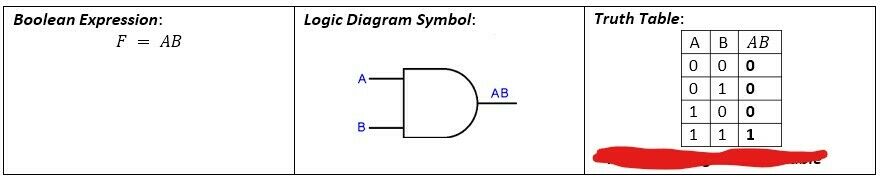
- 12It performs logical multiplication function. This gate accepts two (2) input signals and produces a HIGH output (indicated by “1”) if all of the inputs are also HIGH; otherwise, the output is LOW (indicated by “0”). To represent the operator (A⋅B), a dot (⋅) is used. However, there are some cases that the dot is omitted from the expression (AB).AND Gate – IC 7408
- 13It performs logical addition function. This gate accepts two input signals and produces a HIGH output (indicated by “1”) if one or more of its inputs are HIGH; otherwise, the output is LOW (indicated by “0”) if all inputs are LOW. A plus (+) is used to represent the OR operator (A + B). Below are the various representations of an OR gate.OR Gate – IC 7432

- 14– It performs no inversion or decision making capabilities (like logic gates with two or more inputs). Instead, it produces an output that exactly matches that of its input. In other words, this gate simply passes its input, unchanged, to its output.Buffer gate – IC 74134

- 15Sometimes, isolating logic gates from each other or have them drive or switch higher than normal loads, such as relays, solenoids, and lamps without the need for inversion is necessary for digital electronic circuits. A buffer gate allows us to do that. It can be used to isolate other gates or circuit stages from each other preventing the impedance of one circuit from affecting the impedance of another. It can also be used to drive high current loads such as transistor switches because their output drive capability is generally much higher than their input signal requirements. In other words, buffers can be used for power amplification of a digital signal as they have what is called a high “fan-out” capability.If a buffer gate does not invert or alter its input signal in any way or make any logical decisions or operations like the AND or OR gates do, then why not just use a piece of wire instead?
- 16Fan-outIt specifies the number of standard loads that the output gate can drive without impairing its normal operation. A standard load is usually defined as the amount of current needed by an input of another gate in the same logic family.
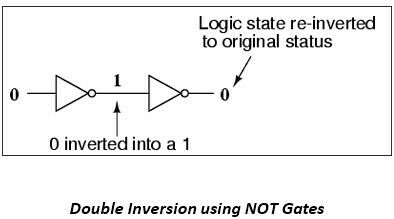
- 17A buffer can also be made by connecting together two (2) NOT gates The output of the first gate is connected to the input of the second gate. The first will “invert” the input signal “0”, and the second will “re-invert” it back to its original level performing a double inversion of the input. This may seem pointless, but remember that their function is an amplifier, regardless of what logic input it takes.A buffer can also be made by___
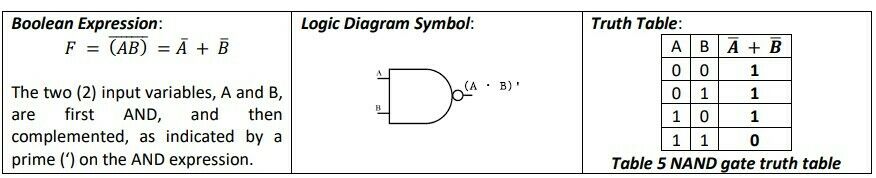
- 18It performs an AND function with a complemented (inverted) output. This gate is essentially opposite of an AND gate as far as the output is concerned. It produces a LOW output (indicated by “0”) when all of the inputs are HIGH; otherwise, when any of the inputs are LOW, the output is HIGH (indicated by “1”).NAND Gate – IC 7408 + 7404 or IC 7400
- 19It performs an OR function with an inverted output. This gate is essentially opposite of an OR gate as far as the output is concerned. It produces a LOW output (indicated by “0”) when any of the inputs are HIGH; otherwise, when all of its inputs are LOW, the output is HIGH (indicated by “1”). Below are the various representations of a NAND gate.NOR Gate – IC 7432 + 7404 or IC 7402

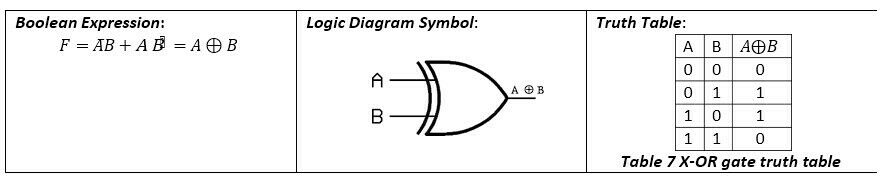
- 20This gate produces a LOW output (indicated by “0”) if its two inputs are the same; otherwise, if both its operands have different values, the output is HIGH (indicated by “1”). Below are the various representations of an X-OR gate.X-OR (Exclusive OR) – IC 7486
- 21It performs an X-OR function with an inverted output. This gate produces a HIGH output when all of its inputs are HIGH or when all of its inputs are LOW. If some of its inputs are HIGH and others are LOW, then the output of the XNOR gate is LOW. Below are the various representations of an X-NOR gate.Exclusive-NOR (X-NOR) – IC 7486 + 7404 or IC 74266

- 22Boolean Algebrait was named after George Boole (November 2, 1815 – December 8, 1864), who was an English mathematician, philosopher, and logician. His intention of developing such a new form of mathematics was to use mathematical techniques to represent and rigorously test logical and philosophical arguments. In 1938, it was adapted by Claude Shannon, who introduced switching algebra (two-valued Boolean Algebra) to represent a bi- stable switching circuit that is used in efficient logic design.
- 23Set of elements Set of operators variableA Boolean Algebra is a form of algebra that consists of the following:
- 24Set of elementsE = {true, false} – in formal logic or E =
{on, off}, {1, 0}, {high, low} – in digital systems - 25variableis a symbol that represents an arbitrary element of a Boolean Algebra.
- 26A Boolean Algebravariables are allowed to have only two possible values, 0 or 1. The Boolean 0 and 1 do not represent an actual number, but instead, represent the predefined voltage ranges present on a wire or at the input/output terminals of a circuit.
Because only two values are possible, Boolean Algebra is relatively easy to work with as compared with ordinary algebra. In Boolean Algebra, there are no fractions, decimals, negative numbers, square roots, cube roots, logarithms, imaginary numbers, etc. - 27logic levelit is the state of a voltage variable
- 28Set of operatorsO = {NOT {‘}, AND {⋅}, OR {+}}
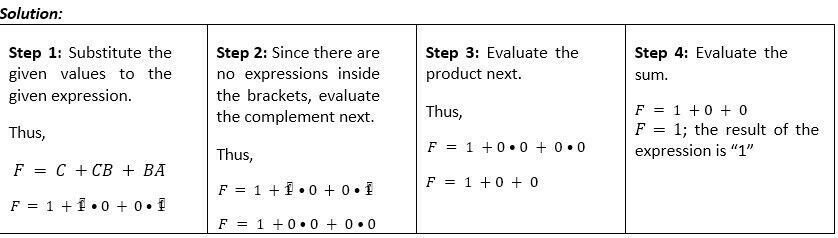
- 29—Sample Problem: Evaluate 𝐹 = 𝐶 + 𝐶̅𝐵 + 𝐵𝐴̅ when 𝐴 = 1, 𝐵 = 0, 𝐶 = 1
- 30Postulates (or axioms)are given facts that are accepted as true without proof. These are very much like the “rules” of a game.
- 31Huntington’s Postulateit refers to a set of rules defined on how a set of numbers can be manipulated and is used to derive certain theorems applicable assuming certain conditions.
- 32Theoremsit is the “practical applications” of postulates. Hence, the basis of winning or losing the game is through following the given rules.
- 336 fundamental postulatesPostulate 1: Set and Operators
Postulate 2: Identity Elements
Postulate 3: Commutative
Postulate 4: Associative
Postulate 5: Distributive
Postulate 6: Complement - 34Postulate 1: Set and OperatorsThis implies that variables (a set of F objects or elements) are subject to equivalence relation (denoted “=”). The symbol “=” assigns the resulting expression from the combination of variables (at one side of the “=”) to the variable at the other side of the “=”. This satisfies the principle of substitution because a variable can be used as a replacement for the expression.
Thus, if A = F, A may be substituted for F in any expression involving F without affecting the validity of the expression. Like in ordinary algebra, the letters of the alphabet are used to represent variables.
This also implies that a pair of variables are closed under binary operators {addition “+”, multiplication “·”}; the binary operator produces a Boolean result according to the specified rules for each. Thus, for any pair of elements, A and B in F, A + B, and A · B belong to F. - 35Postulate 2: Identity ElementsThis is considered as the additive identity of the set, which implies that a variable with respect to “+” operation and is designated by “0” produces the original variable. Therefore, whenever “0” is added to a number, the value of the number to which “0” was added will not change.
Thus, every element A in K is always equal to the variable.
a) 𝐴 + 𝟎𝟎 = 𝟎𝟎 + 𝐴 = 𝐴
This is also considered as the multiplicative identity of the set, which implies that a variable with respect to “·” operation and is designated by “1” produces the original variable. Thus, whenever “1” is multiplied to a number, the value of the number to which “1” was multiplied will retain its value.
b) 𝐴 • 1 = 1 • 𝐴 = 𝐴 - 36Postulate 3: CommutativeThis implies that a resulting sum or product is not affected even if the order of the two (2) variables that are being added or multiplied is reversed.
Thus, for any elements, A and B in F makes no difference in the output.
a) 𝐴 + 𝐵 = 𝐵 + 𝐴
b) 𝐴 • 𝐵 = 𝐵 • 𝐴 - 37Postulate 4: AssociativeThis implies that a resulting sum or product is not affected even if the order/grouping of several variables that are being added or multiplied is changed.
Thus, for any elements A, B, and C in F, the result is the same.
a) 𝐴 + (𝐵 + 𝐶) = (𝐴 + 𝐵) + 𝐶
b) 𝐴 • (𝐵 • 𝐶) = (𝐴 • 𝐵) • 𝐶 - 38Postulate 5: DistributiveThis implies that multiplying a variable by several variables that are being added or multiplied gives the same result as adding/multiplying each addend by the variable and then adding/multiplying the sums/ products.
Thus, for any elements A, B and C in F:
a) 𝐴 • (𝐵 + 𝐶) = (𝐴 • 𝐵) + (𝐴 • 𝐶)
b) 𝐴 + (𝐵 • 𝐶) = (𝐴 + 𝐵) • (𝐴 + 𝐶)
Note 𝐴 + (𝐵 • 𝐶) ≠ (𝐴 + 𝐵) • 𝐶; dot (•) operation is performed before plus (+) operation - 39Postulate 6: ComplementThis implies that every variable has an opposite of its value. For example, if variable A is equal to “0,” then A’ is equal to “1”; and if A is equal to “1”, A’ is equal to 0. The product of a variable and its complement is “0” while the sum of a variable and its complement is “1”.
Thus, every element A in F, there exists the complement (A’) such that:
a) 𝐴 • 𝐴� = 𝟎𝟎
b) 𝐴 + 𝐴� = 1 - 40Boolean Algebra TheoremsTheorem 1: Idempotency theorem
Theorem 2: Zero (0) and one (1) theorems
Theorem 3: Involution theorem
Theorem 4: DeMorgan’s Theorem
Theorem 5: Absorption or Redundancy Theorem - 41Theorem 1: Idempotency theoremIt implies that a variable that is added to or multiplied with itself produces the original variable such that for every element A in F:
a) 𝐴 + 𝐴 = 𝐴
b) 𝐴 • 𝐴 = 𝐴 - 42Theorem 2: Zero (0) and one (1) theoremsIt implies that a variable that is multiplied with 0 produces “0”, and a variable that is added with 1 produces “1” such that:
a) 𝐴 • 𝟎𝟎 = 𝟎𝟎
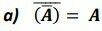
b) 𝐴 + 1 = 1 - 43Theorem 3: Involution theoremIt implies that the complement of a complement leaves the original variable (or expression) unchanged such that:
- 44Theorem 4: DeMorgan’s TheoremIt implies that the complement of the sum/product of two or more variables is equal to the product/sum of the complements of the variables.
Thus,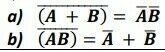
- 45Theorem 5: Absorption or Redundancy TheoremIt implies that if there is a product that contains all the factors of another product in a Boolean function that is expressed as the sum of products (SOP), then it is redundant and can be eliminated.
Thus,
a) 𝐴 + 𝐴𝐵 = 𝐴
b) 𝐴 • (𝐴 + 𝐵) = 𝐴 - 46Duality Principleit states that every valid Boolean expression (equality) remains valid if the operators and identity elements are interchanged, as follows:
Changing each OR sign to an AND sign
Changing each AND sign to an OR sign
Complementing any “0” or “1” appearing in the expression - 47—

Information
- Description
- hard Logic Circuits and Design Flashcards on 02Handout1, created by Eljin Aguilar on 14/08/2024.
- Created by
- Eljin Aguilar · Aug 2024
- Updated
- Aug 14, 2024
- Views
- 1
- Rating