
Flashcards
vertebrate biology - history of fish to land!
Cards in this deck (116)
- 1what are darwins 4 postulates?1. There is individual variation within a species
2. More offspring produced than will survive to breed
3. Survival & reproduction of individuals is not random- survival of the fittest
4. Some phenotypic traits are heritable - 2what evidence is there for evolution?The Fossil Record
Biogeography
Comparative Anatomy
Comparative Embryology
Molecular Genetics - 3radiation of mammals occurred when?65 mya after dinosaur extinciton
- 4biogeographical evidence for evolution is?how species are related - through a geographical view:
Island species - the island furthest away is least related to the mainland.
papua new guinea and australia
wallace's line
-position of continents millions of ya. - 5what is comparative anatomy and how does it link evolution?comparing how similar morphological structures are in different species
i.e. hand of human and wing of bird are same bones, but adapted and modified -
descent with modification from common ancestor.
- vestigal organs - 6what is convergence?It is not homologous - but convergent evolution where both species have separately evolved this characteristic because it benefits them in their environment.
- 7comparative embryologyusing examination of homologous features found in embryos that are not apparent in adults.
humans, dogs and chickens, etc., all have gill pouches - these just turn into lower jaw, thyroid, etc. - 8molecular evidencePhenotype and genotype - however this is impacted by the environment
- 9what is heritability and its range?the passage of genetic information from the adult to its offspring
- Heritability = 0
all variation is due to environment
- Heritability = 1
all variation is determined by genotype - 10what is macro evolution?above the species level
- 11what is micro evolutionwithin a species or population
- 12what is gene flowMovement of genes between populations
- 13what is genetic drift?variation in frequency of different traits occurring in a population when some are randomly killed (stepping on beetles example)
- 14in what age were the origins of multicellular animals?Pre cambrian 600mya
- 15what time did prokaryotes appear?3500mya
(stromatolites) - 16what time did eukaryotes appear?2100-1004 mya
- 17how old are the burgess shale?520mya (middle cambrian)
- 18what is the first chordate ancestor?Pikaia gracilens, found in the burgess shale
- 19Urochordatatunicata
- 20cephalochordataamphioxus
- 21myxiniformeshagfish
- 22petromyzontiformeslamprey
(brook/river lamprey) - 23gnathostomesJawed fish
- 24ray finned fishactinopterygians
- 25lobe finned fishessarcopterygians
8 spp. coelacanth, lungfish - 26cartilaginous fishchondricthyans
- 27name 3 functions jaws benefit1. active predation (capture and bite)
2. manipulate food (improve digestion)
3. herbivory (grazing possible)
4. mating (nest building, grasp mate, mouth brooding)
5. improved forced gill ventilation - 28placoderms (such as?) have what adaptations?=dunkleosteus, could move due to joint.
armoured fish
-pectoral and pelvic fins
-jaws
-no teeth
-head trunk joint
-benthic species - 29how do shark teeth develop, compared to ours?from the skin rather than the bone like ours
- 30jaws developed during which orders?chondricthyans and sarcopterygians
- 31what order are chimeras and ratfish? what class are they?Holocephalii
chondrichthyans - 32what order are sharks, skates and rays under? in what class/super order?elasmobranchii
chondrichthyans - 33what do shark jaws do to benefit catch success?they are hyostylic jaws; they open, then push up and outwards extending their reach.
- 34latin for Ray finned fish?Actinopterygii/gians
teleosts most diverse group under this
26 000 spp. - 35Teleosts started what?to radiate in the cretaceous period and are now 96% of all fish.
changed the body plan - 36what are the two main groups in teleosts?Ostariophysi
acanthopterygii - 37what teleost developed ram feeding and how does it work?herring, mackerel
the premaxilla and maxilla open with a fold of skin stretched between whilst the fish constantly swims forward, forcing water in. - 38what other teleost developed suction feeding?(evolved independently in several lineages)
jaw bones and premaxilla stretch out and up flap forwards to suck in a rush of water. - 39moray eel has what adaptation?teeth in throat! come forward as the eel opens its mouth.
- 40—a) Squalus
b) Latimeria
c) Neoceratodus
d) Teleost - 41What problems are created by an aquatic existence?-Movement
–Bouyancy
–Osmoregulation
–Gas exchange
–Senses
–Temperature
–Pressure - 42what direction do these factors move the fish? -bouyancy -weight -thrust -drag= upwards
= downwards
= forwards
=into fish (backwards against fish) - 43oscillation =?side to side motion
- 44what is a myotome? What are these separated by? functions?a segment of muscle (orange parts of salmon) and they are separated by myosepta (white lines).
Myosepta stop muscles pulling against each other. - 45what shape muscle creates what kind of movement?
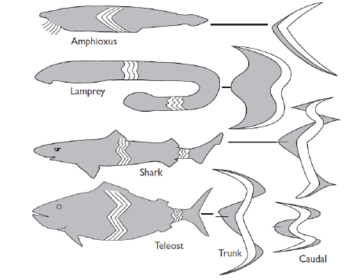
- 46what function do myotomes have?To lie next flexible vertebral column
focus contractile force onto column away from other muscle blocks, this allows the skin to flick back the energy when pulled. - 47fast twitch muscle provides....? slow twitch muscle provides....?...a fast, short burst of movement. Meaning large amount can be set aside for use less often.
(white coloured)
...a constant swimming speed, cruising, migration, long distance, that does not become fatigued quickly.
(red coloured) - 48Water causes what effect on thermoregulation?It has a high heat capacity, so draws out warmth from fish faster.
- 49—Retia mirabilia
arteries and veins. These exchange the heat from muscles mix with the cold blood coming from the gills to reduce heat loss, through counter current system.
- this allows further range and faster speed when bursts of speed required.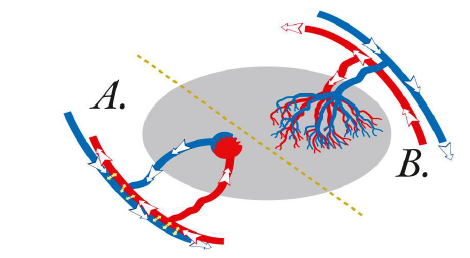
- 50what type of movement do these fish use? Eels? Tuna? Box fish? Rays? Bowfin? Cod? Triggerfish? Wrasse?Anguilliforme
Carangiforme
Ostraciiform
Rajiform
Amiiform
Subcarangiform
Balistiform
Labriform - 51where is drag most potent?Pressure - pressure at the nose, higher than at tail to vorticity
skin friction - viscosity of water makes it stick to surfaces - 52what reduces drag?- streamlining.
- reducing surface area of fins - i.e., using finlets, cutaway tail, foldaway and collapsible fins, turbulence at water boundary (shark scales disrupt water produce turbulence), mucus.
- behaviour (flying fish, environment lifestyle). - 53Lift prevents the fish from sinking, what are the two main types + how do they work?Dynamic: Airplane wing shape, to exert downwards force on air which pushes up on "wings" (shark)
-must keep swimming, not hover, or swim backwards.
Static:
seawater = 1027g fish almost x3.
gas/swim bladder = 5-7% of body.
oil. - 54What is the gas bladder structure and and how does it work?v
- 55what are the 2 swim bladder types?Phyostome
outpocket of digestive tract. adult retains pneumatic duct.
Phyosoclist
- young may have open duct, adults closed, with secreting gas gland and re-sorption gland. Needs mechanism to fill air from its own body (gas gland) - 56how does a physostomatous fish fill and empty its air bladder? how does physoclistus?=by gulping air at the surface
=by burping to release air
(generally more primitive sp)
some use gas from oxygen in water passed via blood
(more advanced sp) - 57this image shows....? which is what iknd of lift?The production of gas through:
gas gland produces lactic ACID and CO2
lowered pH causes hemoglobin to lose oxygen
countercurrent system raises partial pressure of gases =static lift.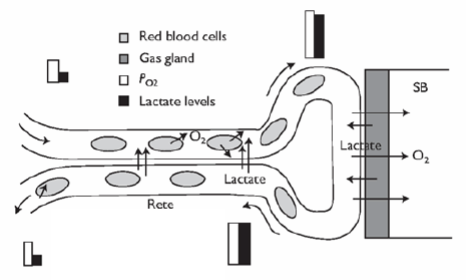
- 58what other function does the swim bladder have?can produce sound - many fish do!
also use guanine crystals to stop gas getting out - 59what is squalene?oil (lipids) found in shark liver - remember catshark practical. Less dense than water, so helps float.
some fish put this in muscles. - 60what are the 4 key forces fish must content with?bouyancy
weight
thrust
drag - 61name mechanisms to generate lift?-gas bladder
2 different types?
-constant swimming
-oil - 62what function does the gill arch have?the gill arch can be used to crush prey, using bony plates.
- 63what is a special feature of lungfish? and what type of swim bladder does it use?they use their swim bladder as a lung, so can be out of water, propping themselves up on fins.
Physostome - 64There is a lower concentration of oxygen in water compared to air. What happens to oxygen as the temperature of water: increases? decreases?it lowers
it increases - 65what is the latin for an Antarctic icefish? In waters of -2 to 4 degree's C, how does it survive?Notothenioidei
Uses Unidirectional flow (mouth->gills->exit) to reduce energy cost. (buccal pumping)
reduces bone density and has lipid storage for buoyancy
no haemoglobin - 66how does buccal pumping work?Inspiration:
1.Buccalcavity expands, pressure drops
2.Water enters mouth down pressure gradient
3.Opercularcavity expands, pressure drops
4.Mouth closes, pressure in buccalcavity higher than opercularcavity
5.Water enters opercularcavity
Expiration:
1.Operculum contracts, pressure in cavity higher than outside
2.Buccalcavity contracts, pressure rises
3.Water forced out - 67what is another method of ventilation (sometimes obligate)?ram ventilation - the fish must constantly swim to receive oxygen.
-mackerel, tuna, sharks.
more efficient energy use than buccal pumping.
also reduces drag. - 68what system is altered in order to cope with ram ventilation and how?circulatory, as the blood must flow in the opposite direction to the incoming water. (oxygen would level out if same direction, so reversed allows maintained pressure diffusion).
- 69How does the circulatory and respiratory system of fish larvae function?So small and in high level environment, gas exchange can occur across body surface, and so little need for gills present and no haemoglobin is required.
- 70gill arches - average number? which arch supports the mandibles formed by the "?" arch?5 in most fish
6-7 in gilled sharks
(basking shark)
the hyoid (2nd) arch supports the mandible and maxilla formed from the palatoquadrate (upper) and mandible (lower) from the 1st gill arch. - 71how did this change the development in humans?Gill arches derive from pharyngeal arches and in human embryo's form the the jaw, parathyroid....
- 72—showing the gill arch and how it has evolved to be used in human system.
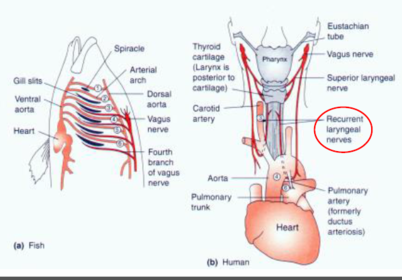
- 73why does the laryngeal nerve have to travel to the heart and back to the face?during evolution it got trapped on the wrong side and so must loop under the heart to travel back up
- 74how do the gill rakers work? Explain in 3 steps1. vortex at the top of the mouth is created by the rakers.
2. Food particles accumulate, get stuck to mucus lining the mouth
3. mucus forms into bolus and is swallowed. - 75what are the two different methods?Hydrosol (dead end) - the food gets stuck between gill rakers.
crossflow - the food is passed along as the water is drawn through the gaps between the gill rakers. - 76how do marine fish cope with osmoregulation?the ionic concentration in the blood is lower than the surrounding water and so they must constantly drink to replace lost water.
- 77how do they cope with the high salt levels?chloride cells in the gills, rich in mitochondria, help the process of ATP -> ADP by using the sodium to produce potassium and change the pH. Uses the transporter proteins.
- 78where else does osmoregulation occur?in the kidney
- 79how do freshwater fish osmoregulate?by using the sodium/potassium pumps, just the other way round.
I.e., in Teleosts, Large ionic concentration in blood (> surrounding water). produce large amount of dilute urine (salts in kidney) gills take up salts.
Chondrichthyes: blood has high Urea, Urea + ions = osmolarity similar to seawater. kidney + rectal gland and gills conserve urea. - 80so if for example a flounder (paralichthys lethostigma) loses: 8% of body weight from osmosis of fluids -0.4% of body weight through urine 2.7% through feces how does it regain lost osmotic components?by drinking 11% of body weight each day
-Absorbs around 76% of the water…
…but 99% of the Na+and 96% of the Cl-
•Between 8-17% of resting metabolic rate is dedicated to pumping ions - 81in what order does evolution workfor physiological processes?Evolution
locomotion
respiration
feeding
Environment - 82why is the operculum important? list 3 reasons.1. protects the delicate gills.
2. used in buccal pumping to create pressure.
3. important for later modifications in tetrapods. - 83what roles do gills have? what does gas exchange depend on?gas exchange, feeding, osmoregulation
unidirectional flow of water and countercurrent exchange mechanism - 84what lineage do vertebrates come from?sarcopterygians
- 85what new technologies allowed further investigation and new discoveries in fossils?CT scans of bones in rock
3D reconstructions
--> functional analysis - 86what species did fish tetrapod transition start with?Eusthenopteron
(had pectoral fins plus post anal fins) - 87the second transition species was...?at around 385mya
Panderichthys
(lengthened muscle to fins) - 88the third?Tiktaalik
bones beginning to look hand limb like on pectoral fins. skull shape crocodile like. - 89fourth?Acanthostega (365mya)
very long tail full fore and hind limbs. - 90and finally the 5th?Ichthyostega (362mya)
- 91why would fish benefit from evolving limbs for use underwater?land plants increased the nutrient flow into the sea.
increased microbial activity - decreases oxygen.
- so benefit by popping head above surface. - 92what other factor occurred at the same time as limb development?a drop in oxygen levels, calling for a need to move out water to get oxygen in higher quantities.
- 93what advantages did the early lolobe-finned fish Eusthenopteron have that helped the evolution to limbs?pectoral girdle stronger
solid skeleton to support
- however, it couldn't crawl on land. - 94around what time was Acanthostega present, with what adaptations?365 mya - the what period...?
bones supporting the gills
limb skeleton - 95what did ichthyostega have to benefit the transition onto land.had four limbs, however hind only moved up and down (dorso-ventral) used as paddles, fore limbs similar to mudskipper.
Fully aquatic. - retained gills.
breathe air in shallow water using lungs.
vertebral column not lateral, orientated dorso-ventrally. - 96when were the first tetrapod tracks on land found to be dating to?395 mya.
- 97what could have happened to the ichthyosteglians?a lineage of tetrapods moving in a modern directions/fashion may have predated them by 20 my
- 98what is the name of the gap showing a gap of tetrapods being present for ...how many years? what happened in the end?Romer's gap (began ca., 335 mya in devonian period
~20 million years
succeeded by more modern groups in Carboniferous - 99how many species went extinct in the late devonian extinction? what did mass extinctions allow?70-80% of species
they opened up new niches and allowed new radiations of previously unknown groups to evolve in new niches. - 100what did the late devonian extinct allow?paved way for diversification of other basal groups, including amniotes
- 101when did pentadactyly evolve?after the late devonian extinction.
(reduced to 5 digits ;) - 102what happened after the devonian extinction that benefited being on land?insects diversified (Carboniferous), providing ample high protein food source for terrestrial predators
- 103define an amniote (developed in the carboniferous period)an animal whose embryo develops in an amnion and chorion and has an allantois; a mammal, bird, or reptile (the three layers of the "embryonic egg"
- 104which species was it that evolved pentadactyl foot?Perderpes
also lateral foot extension able to loco-mote terrestrially. - 105there was also a return to what kind of lifestyle? (in start of carboniferous)return to aquatic lifestyle
sp such as:
Crassigyrinus
Eogyrinus - 106what time did all the amniote (and most tetrapod)lineages become extinct? what was this extinction called?240 mya - end of the permian period
The Great Dying. (Permian-triassic)
most severe event in earth - 107how many marine (?) and how many terrestrial vertebrates went extinct? what was the supposed cause96% marine
70%
volcanism trapping - 108what were the Aistopoda, and what did they help evolve?They are limbless, snake-like kinetic skull, aquatic and also possibly terrestrial - they still need water to reproduce.
- 109what did temnospondyli look like?Newt-like (but large, <4-5m) to alligator, one in brazil reaching 9m.
- 110which tetrapod is not an amniote?amphibians
- 111when did first amniotes appear? what did this allow?early carboniferous, 20-30 million years after first tetrapods!
Removes the need to reproduce in water!
first were small lizard like creatures - 112amniote evolution led to...?viviparity!
- 113what were the permian-only aquatic amniotes? the earliest amniotes weren't viviparous, what did they have?mesosauria
probably a leathery shell (poor fossilisation) - 114what is an innovation of being an amniote?Costal ventilation (where muscles inflate lungs!)
-Reduced need for cutaneous gas exchange – more waterproof skin
-More varied head shape
Buccal pump requires broad, flat head
Constrains jaw muscle evolution
Constrains foraging mode?
-Allows longer neck
Different foraging modes
More complex brachial plexus more complex forelimb innervation - 115this new head and jaw adaptation allowed what to evolve?herbivory! Woo Veggie! in the permian.
-wide diversity:
synapsids - most improtant in permian, as led to mammal-like reptiles and mammals after diverging in carboniferous.
sauropsids - led to diapsids (led to birds?) - 116—
Information
- Description
- Flashcards on vertebrate biology - history of fish to land!, created by ameliabmargrave on 12/11/2015.
- Created by
- ameliabmargrave
- Views
- 48
- Rating