
Flashcards
Test 1 (Systematic Theology)
Cards in this deck (147)
- 1DeismThe concept that God created the Universe, placed it under the authority of Natural Law,
then left it to run its own course. - 2Eschatology eschatos meaning "last"(1) The doctrine of the end times and the eternal states.
(2) The doctrine of the last things and includes all concepts associated with life beyond death: heaven/hell, paradise/immortality, resurrection/transmigration of souls, rebirth/reincarnation, and last judgement/doomsday.
(3) The section of Christian theology dealing with the ‘‘last things,’’ especially the ideas of resurrection, hell, the Last Judgment, and eternal life. - 3ProvidenceThe doctrine of The universal sovereign reign of God. God preserve and governs all His creatures and all their actions.
- 4Transcendence of GodGod is above, beyond, outside, all that he has made. The belief in the transcendence of God produces reverence, and humility.
- 5Theodicy Theo = God Dike = JusticeGod and justice. Justifying the goodness of God and understanding his sovereignty with the existence of evil in the world.
- 6AnthropologyThe section of Christian theology dealing with the doctrine of humanity. Also denotes fields of study outside of Christian theology.
- 7ChristologyThe section of Christian theology dealing with the identity of Jesus Christ, particularly the question of the relation of his human and divine natures.
- 8PneumatologyThe section of Christian theology dealing with the doctrine of the Holy Spirit (Greek: pneuma).
- 9RevelationAn unveiling or making known of what is otherwise unknown. In Jesus Christ and the Scriptures, God graciously makes himself known to humanity. The sources of revelation are typically divided into two: general and special revelation.
- 10General Revelation(1) Is that knowledge which is available to all people at all times from creation, history, and the makeup of human nature.
(2) Those ways in which God makes himself known to all people at all times, as in nature, and in the features of human experience.
(3) Bible and Jesus Christ - 11Special or Specific Revelation(1) Is God’s particular revelation of Himself through specific events, especially His revelation in Jesus Christ and the Scriptures.
(2) The disclosure of God's word to specific people in specific acts of redemption or judgement, or through the words of prophets and apostles.
(3) Individually Revelation - 12SoteriologyThe section of Christian theology dealing with the doctrine of salvation (Greek: sotēria).
- 13TheologyThe study of the knowledge of God. Sources for theology include the Bible, Christian tradition, reason, and experience, with Scripture being the supreme authority.
- 14What is the "A Priori Argument" for God Existence?(1) Is the justification of "Independent Experience."
(example “all bachelors are unmarried”) something that is plain to see you don’t have to get up off your couch to do the science (common sense)
(2) An argument that proceeds from the "Logical Necessity" of the idea itself - 15what is the "A Posteriori Argument" for God's Existence?(1) Knowledge or justification is dependent on
"EXPERIENCE OR EMPIRICAL EVIDENCE"
“some bachelors are very happy” justification makes reference to experience based on one’s belief in it.
(2) One begins with the consequence of a certain reality and argues back to its logical necessity. - 16Ontological argumentIs a priori argument that begins with the premise that:
"God is being than which none is greater."
Anselm Arch-Bishop of Canterbury,
1st and famous (a priori argument)
titled "Prologion"
"Hierarchy of Being" - 17Teleological argument(1) Refers to the fact that things in the universe all seemingly work towards an end; that is, they are goal-oriented, and in
(2) Aquinas argument of that name he attributes this innate quality as manifested in non-intelligent beings to the providence of God. - 18Theology ProperThe doctrine of the works and nature of God
- 19AngelologyThe doctrine of angels, unfallen and fallen
- 20AnthropologyThe doctrine of man, sin and death
- 21ChristologyThe doctrine of the person and work of Christ
- 22PneumatologyThe doctrine of the person and work of the Holy Spirit
- 23SoteriologyThe doctrine of personal salvation
- 24EcclesiologyThe doctrine of the church
- 25Ontological ArgumentA Priori type of proof.
The very concept of God necessarily entails his existence. - 26Cosmological ArgumentA Posteriori type of proof.
Causality begins with the mere fact of something's existence. - 27Teleological ArgumentA Posteriori type of proof.
Causality, begins with a certain quality in existing thing (apparent design) - 28TheophanyGod manifests himself directly through the visible phenomena, clothing himself with the form of a creature.
- 29What is Systematic Theology?“Systematic Theology may be defined as the collecting, scientifically arranging, comparing, exhibiting, and defending of all facts from any and every source concerning God and His works.”
- 30What does “Dispensation” mean?“A stage in a progressive revelation, expressly adapted to the needs of a particular nation or period of time….Also, the age or period during which a system has prevailed.”
- 31TheismBelief in the existence of a god or gods, especially belief in one god as creator of the universe, intervening in it and sustaining a personal relation to his creatures.
God is greater than the World, he is greater than his creation. - 32Pantheismis the belief that the Universe (or nature as the totality of everything) is identical with divinity, or that everything composes an all-encompassing, immanent god. Pantheists thus do not believe in a distinct personal or anthropomorphic god.
- 33MonotheismThe doctrine or belief that there is only one God.
- 34ApatheismA portmanteau of apathy and theism/atheism), also known as pragmatic atheism or practical atheism, is acting with apathy, disregard, or lack of interest towards belief or disbelief in a deity or deities.
- 35AtheismIs not a disbelief in gods or a denial of gods; it is a lack of belief in gods. Older dictionaries define atheism as "a belief that there is no God."
- 36PanentheismPanentheism (meaning "all-in-God", from the Ancient Greek πᾶν pân, "all", ἐν en, "in" and Θεός Theós, "God"), also known as Monistic Monotheism,[1] is a belief system which posits that the divine – whether as a single God, number of gods, or other form of "cosmic animating force"[2] – interpenetrates every part of the universe and extends, timelessly (and, presumably, spacelessly) beyond it. Unlike pantheism, which holds that the divine and the universe are identical,[3] panentheism maintains a distinction between the divine and non-divine and the significance of both.[4]
- 37Pantheism vs PanentheismIn pantheism, the universe and everything included in it is equal to the Divine, but in panentheism, the universe and the divine are not ontologically equivalent.
- 38Transcendent(1) (of God) existing apart from and not subject to the limitations of the material universe.
(2) He is essentially Unknown and Incomprehensible.a
(3) God is beyond human experience.
(4) God greater than his creation. - 39MonotheismThe doctrine or belief that there is only one God.
Monotheism has been defined as the belief in the existence of one god or in the oneness of God. - 40Anselm of Canterbury in his 1078 work ProslogionThe first ontological argument in the Western Christian tradition[citation needed] was proposed by Anselm of Canterbury in his 1078 work Proslogion. Anselm defined God as "that than which nothing greater can be conceived", and argued that this being must exist in the mind; even in the mind of the person who denies the existence of God. He suggested that, if the greatest possible being exists in the mind, it must also exist in reality. If it only exists in the mind, then an even greater being must be possible — one which exists both in the mind and in reality. Therefore, this greatest possible being must exist in reality.
- 41Systematic TheologySystematic theology is a discipline of Christian theology that formulates an orderly, rational, and coherent account of the Christian faith and beliefs. Subdisciplines are dogmatics, ethics and philosophy of religion.[1]
- 42What is AJ Heschel understanding on Revelation?Revelation is not an act of seeking, but of his being sought after; Hence, an act of God's search for man.
- 43ProvidenceProvidence is the way that God is directing the universe. He is moving it into tomorrow — He is moving it into the future by His providence. Providence means "to provide." God will provide. On Golgotha the Lord Jesus Christ was crucified. He was the Lamb that God provided. He was "the lamb of God, which taketh away the sin of the world" (John 1:29).
- 44"What is divine providence?"Divine providence is the governance of God by which He, with wisdom and love, cares for and directs all things in the universe. The doctrine of divine providence asserts that God is in complete control of all things. He is sovereign over the universe as a whole (Psalm 103:19), the physical world (Matthew 5:45), the affairs of nations (Psalm 66:7), human destiny (Galatians 1:15), human successes and failures (Luke 1:52), and the protection of His people (Psalm 4:8). This doctrine stands in direct opposition to the idea that the universe is governed by chance or fate.
- 45Divine PreservationGod maintaining the existence of his creation
- 46Creation ex Nihilo"Creation out of Nothing"
- 47Creation ex Nihilo Creatio ex Materia Creatio ex DeoCreatio ex Nihilo ("creation out of nothing"), contrasts with
Creatio ex Materia (creation out of some pre-existent, eternal matter)
and with
Creatio ex Deo (creation out of the being of God). - 48MonismThe school of Monism teaches that there is only one reality or thing or substance; everything else is ‘maya’ or illusion. If we call this ‘one thing’ God, then man becomes God since there cannot be God and man (two things or dualism). So in the school of monism, we become God! The cycle of birth or reincarnation is the process/vehicle through which man unites into God.
- 49MonotheismThe school of Monotheism teaches that there is One God, the creator of all things including man. However, man having sinned is separated from God, and, God provides a unique Way of Salvation to man to restore his/her relationship back to God.
- 50EschatonThe final event in the divine plan; the end of the world.
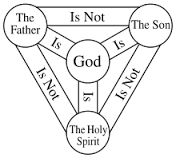
- 51Ontologic TrinityThe Ontological Trinity is the teaching concerning the Trinity that all three persons within the Godhead are equal in nature, essence, and attributes. Each member of the Trinity is equal in omniscience, omnipresence, omnipotence, holiness, etc. It differs from the Economic Trinity, which deals with the relationship of the Father, Son, and Holy Spirit within the Godhead and to us.
- 52Trinitarian DoctrineThe Christian doctrine of the Trinity (from Latin trinitas "triad", from trinus "threefold") defines God as three consubstantial persons, expressions, or hypostases: the Father, the Son (Jesus Christ), and the Holy Spirit; "one God in three persons".
- 53Thomas Aquinas 5 Cosmological Afguments(1) the unmoved mover;
(2) the first cause;
(3) the argument from contingency;
(4) the argument from degree;
(5) the teleological argument ("argument from intelligent design"). - 54What is John Calvin's view on the transcendence of God?(a knowledge of God) except under the guidance of the gospel.
- 55What is Martin Luther's understanding of the Transcendence of God?Martin Luther's emphasis on this distance between God and man, a distance that could only be bridged by God himself, is well known
- 56OrigenUnlike many church fathers, he was never canonized as a saint because some of his teachings directly contradicted the teachings attributed to the apostles, notably the Apostles Paul and John. His teachings on the pre-existence of souls, the final reconciliation of all creatures, including perhaps even the devil (the apokatastasis),[2] and the subordination of God the Son to God the Father, were extremely controversial.
- 57Jurgen MoltmannMoltmann is known as "one of the leading proponents of the theology of hope. He believes that God's promise to act in the future is more important than the fact that he has acted in the past. What is implied by this focus on the future, however, is not withdrawal from the world in the hope that a better world will somehow evolve, but active participation in the world in order to aid in the coming of that better world."
- 58What is Karl Barth understanding on Revelation?Christianity means Jesus Christ.
Revelation the concept: God wants our interest, He wants us to listen, He wishes to call us to decision, He wants us to obey His word. - 59What is the difference in Theists & Deists?Both [theists and deists] asserted belief in "One Supreme God, the Creator...."
But the THEISTS taught that God remained actively interested in and operative in the world which he had made, whereas the DEISTS maintained that God endowed the world at creation with self-sustaining and self-acting powers and then surrendered it wholly to the operation of these powers acting as second causes.[18] - 60TheologyThe articulation of comprehensive and general truths about God, his creation, and his redemptive actions,based upon:
(1) The variety of Revelation.
(2) The presupposition of the unity of truth of all truth.
"Hear, O Israel: The Lord our God is One." (Deut. 6:4)
The Oneness of God!!! - 61What is the basic difference in Theology and Philosophy?Theology is based upon God's disclosure of himself in human history; it is based on revelation.
- 62Theologians differ on the question of the scope and nature of Revelation.a
- 63What is Revelation?The word "revelation", especially in its Greek from "Apocalypse", suggest an unveiling. Something is disclosed that is otherwise hidden.
God seeking man.
It is not gained by human powers of perception but is a Divine Gift. - 64Immanuel Kant understanding of Revelation?Revelation is only a concession to weaker minds, and that reason will sooner or later discern what is given earlier (as they readily concede) by being revealed.
- 65What is Karl Marx understanding of religion?The "opium of the people" that had been useful to the ruling classes since it gave the working classes false hope for millennia.
At the same time, Marx saw religion as a form of protest by the working classes against their weak economic conditions and their alienation.[2] - 66What is the special significance of Psalm 19?Psalm 19, is an example of the biblical appreciation of nature.
How the Psalmist didn't equate Nature with God. Unlike the Babylonians and Egyptians, they suffused and intermingled nature with the divine. Nature was to worship and feared. - 67Why is Revelation essential in Christian Theology?(1) NATURE, by itself, is an incomplete and inadequate source of KNOWLEDGE.
(2) SIN distorts and falsifies human reason.
(3) In the OT and NT - God Reveals and humanity responds to that Revelation. - 68What is Conyer's understanding of General Revelation?Available to all people.
Available to all times.
Available in nature, history, and human consciousness.
Discoverable in the philosophies and religious traditions of all individuals, even if subject to distortion.
Centered in general truths.
Repeatable or constant in human experience.
Suggests original wholeness of creation, but cannot restore wholeness. - 69What is Conyer's understanding of Special Revelation?Disclosed to particular people.
Disclosed at particular times.
Often contradicts the normal experience.
Revealed through the communication of a message, a gospel, or a prophetic oracle.
Related to specific events.
Unrepeatable and unique.
Soteric: It is restorative, revealing not only God's goodness but also his power to save - 70What is the difference between General and Special Revelation?Hence, We find that General Revelation according to the Psalm 91 and in Romans 1, makes explicit references to nature, history and human consciousness serving as the media of God's self-disclosure.
- 71What is Thomas Aquinas understanding of General Revelation and Natural Theology?Thomas Aquinas argued that a "Natural Theology" serves as a rudimentary basis for understanding the truth of Christianity, a truth more fully disclosed in Scripture.
- 72What was Karl Barth argument against Thomas Aquinas understanding of General Revelation and Natural Theology?Karl Barth argued against the validity of General Revelation, claiming that Jesus Christ is the exclusive Revelation of God and that to add to that disclosure (NATURE) is to fall back into idolatry.
- 73What is the Condescension of God?(1) God uses means appropriate to the limitations and conditions of humanity in order to disclose what is true of himself.
(2) Hence, God discloses himself in human experience (History) and in a manner that is transmitted into the experience of a people (namely through language.) - 74The only way to know God?For God to reveal himself to Us.
- 75The identity of who God is expressed in the Old Testament into two terms, Explain?(1) What he has done: I am the Lord your God, who brought you out of the land of Egypt, out of the house of slavery.
(Deut. 5:6)
(2) Who has known him as God: "the God of your ancestors, the God Abraham, the God of Isaac, and the God of Jacob"
(Exod. 3:15) - 76Teleological ArgumentThe order of the universe is said to imply a "designer" who has shaped the universe to fulfill divine purpose as a final goal.
- 77TheodicyThe justification of a deity's justice and goodness in light of suffering and evil.
- 78Cosmological ArgumentSince all things in the universe must have a cause, God must exist as the ultimate cause of all things.
- 79Why are modern people more likely to believe the Cosmology Argument (Thomas Aquinas) than the Ontological Argument (Anselm of Canterbury)?Because I don't know.
- 80A PrioriStarting with the concept of the existence of God "Without" having had an "Experience" with God.
- 81A PosterioriStarting with an "Experience" with God and arguing the concept of His existence.
- 82Areas of Systematic TheologyBibliology (Bible)
Theology Proper (God)
Anthropology (Man)
Christology (Christ)
Soteriology (Salvation)
Pneumatology (Holy Spirit)
Ecclesiology (Church, Christian life)
Eschatology (Prophecy, End times) - 83Transcendence/Immanence:God is entirely above
and outside of creation (transcendent) as well as entirely
within creation (immanent). He is incomprehensible in
his majesty, but in his condescending goodness and love,
he freely relates us to himself - 84General/Special RevelationGeneral/Special Revelation: Creation (general revelation)
displays the existence, wisdom, power, goodness,
and righteousness of God “so that everyone is without
excuse” (Rom 1:20). However, in special revelation God
more clearly discloses these attributes, correcting our
sinful distortions, and also reveals the gospel of his Son,
which is not known apart from this source - 85Systematic theology:any study that answers the question, “What does the whole Bible
teach us today?” This definition indicates that systematic theology involves collecting and understanding all the relevant passages in the Bible on various topics and then summarizing
their teachings clearly so that we know what to believe about each topic. (Bible Doctrine,
Wayne Grudem) - 86ApologeticsApologetics: a defense of the Christian faith for the purpose of instructing believers or
convincing unbelievers. - 87Ontological ArgumentOntological Argument— the idea that God must exist; his nonexistence is inconceivable.
Man cannot consider the finite without at the same time thinking of the infinite, which
bounds and determines the finite. Devised by Anselm. 2
God must "Exist" because, without His existence, nothing else would exist. - 88Cosmological and Teleological ArgumentCosmological and Teleological Argument— God must exist as the cause of the world or
as the cause of what we observe in the natural world. Thomas Aquinas used this argument in
Summa Theologica. - 89Moral ArgumentMoral Argument— the practices of all social communities reveal a universal code of
morality. Immanuel Kant was the first major philosopher to use the moral argument. The
moral argument has been popularized in modern times by C. S. Lewis. - 90There are at least three Trinitarian heresies:* Tritheism—there is not one God. God is three persons and each person is fully God.
* Modalism—God is one person who appears to us in three different forms or “modes.”
* Arianism— Jesus and the Holy Spirit are not eternally and fully God. - 91Clock Maker TheoryGod made the world and after making the world left it to work under its own design.
- 92What are the 5 Bibical visions of God as related to his role in the. Universe?Patheism, God is identified with the world.
Panentheism, God is identified with the world, but is greater than the world.
Theism, God created the world, distinct from himself, and continues in dynamic relationships to the world.
Deism, God created the world and no longer operates upon that creation - he is radically distinct from the world.
Materialism
, God is a construction of the human mind, projecting an answer to unfilled material needs. - 93CosmologyThe Doctrine of the world.
- 94Creation ex NihiloThe Doctrine of creation out of nothing.
- 95The first creation passage in the Old Testament appears where?The book of Genesis (1:1 - 2:4a)
"The Earth was a formless void" - 96Why is the lord our God referred to as Father and not Mother?Father is the Marker
Mother gives birth - 97What is the relationship of sin and evil as it relates to nature?Sin and Evil are fundamentally against nature, not a result of nature.
- 98What is Preservation?God also preserves his created order despite the fact that through humanity, it has been given an independence that is contrary to God; the disaster of the fall, in other words, has been allowed to undo utterly the good of creation.
- 99What is Creatio Continua?God's creation takes place not simple at the beginning but along with each moment of existence.
The danger with this concept is that creation becomes a co-deity with God.
1. We lose independence of creation.
2. We lose the idea of the otherness of God. - 100What is the Independence of Creation??
- 101What is the concept of Dependence of Creation??
- 102What is the 19 Psalm telling us about God and the Universe?Nature is not divine, but it is the "handiwork: of the divinity, and it thus reflects his glory.
Nature is dependent and real but is not God. - 103Creation presents 2 important conditions without which relationships cannot take place. (God and Man)(1) Creation is an object apart from God. thus, His love for this world is not a circular love for himself.
(2) The dependence of creation means that the 2 sides of this relationship, creator and creation could not be more Unlike on another
Pantheism or Monism undermines the relationship between God and Man. - 104To understand the Dependent Reality of God and Man, give us insight on what?The truth of the world's distinction from God and accents and reveals the truth of God's love for his creation.
- 105What is Theodicy? God + Justice (Theos + Dikes) "Justifying God"It signifies a problem that occurs in an ethical monotheism, but not in other theological concepts.
(1) God is Good...
(2) So why is there evil on the Earth? - 106How did Augustine of Hippo deal with Theodicy?Augustine (354 - 430)
(1) Evil serves the interests of GOOD. (AESTHETIC ANSWER)
(2) UTILITARIAN Argument, What is evil might be used by God for a greater purpose. All things lead to Good, even though they are not in themselves good.
(Rom. 8:28) "all things work together for good.)
(3) Ontological Answer, Evil is the privation of good (privatio boni). - 107What is Augustine concept of Privatio Boni?Evil is rather the absence or lack ("privation") of good. Even in evil, there is good.
- 108What is the difference between Preservation and Providence?Unlike Preservation, which implies the maintenance of something given in creation, Providence is oriented toward the future.
- 109What is Providence?Latin providere which means "to foresee"
Providence is the assurance that when all is said and done, in spite of the intervention of evil, God's will is going to be accomplished. - 110What can humanity understand about God through general revelation?God's existence
God's power
God's order/rightness
God's wisdom/knowledge
God's greatness/supremacy
God's goodness (see Acts 14:16-17) - 111Special RevelationDefinition
The acts of God whereby He makes Himself and His truth known at specific times and to specific people - 112Forms of Special RevelationPersonal Experience (cf. Galatians 2:2)
Hearing an audible voice (like Samuel in 1 Samuel 3)
Having a dream (like Joseph in Genesis 37)
Seeing a vision (like Paul in Acts 16)
Being spoken to by an angel (like Mary in Luke 1) - 113What is the difference in the Ontological and Economic TrinityTo be overly simplistic, we could say that the Ontological Trinity deals with what God is, and the Economic Trinity deals with what God does.
Ontological Trinity (ontology, the study of being and essence). Each of the three persons in the Godhead are divine, have equal attributes (omniscience, omnipresence, holiness, etc.).
Economic Trinity (economic, from the Greek oikonomikos, which means relating to the arrangement of activities). - 114As a Christan, Why is it important that God created everything Ex Nihilo??
- 115What is theodicy??
- 116How did Augustine of Hippo, justify the existence of Evil, in a universe created by a Good God ??
- 117What is Anselm's ontological argument for the existence of God?Anselm defined God as "that than which nothing greater can be conceived"
- 118What is Aquinas's argument from Motion for the Existence of God. REST is THE NATURAL STATE of an OBJECT, so any OBJECT in MOTION is PUT into MOTION by a SUPERNATURAL FORCE (GOD)Aquinas believes that ultimately there must have been a UNMOVED MOVER (GOD) who first put things in motion. Follow the argument this way:
(1) Nothing can move itself.
(2) If every object in motion had a mover, then the first object in motion needed a mover.
(3) Movement cannot go on for infinity.
(4)This first mover is the Unmoved Mover, called God.
REST is THE NATURAL STATE of OBJECTS, so any OBJECT in MOTION is PUT into MOTION by a SUPERNATURAL FORCE (GOD) - 119What are our consequences in our thinking once we accept the idea of one God?We have free will and must exercise that will to determine if we will obey or develop a Rebate mind.
Question, what about God omniscience?
Question, If God made the Game, The player and rules do we really have free will or is there another dynamic at work? - 120What about the Jewish/Christian concept of monotheism lead to the possibility of a trinitarian God concept?God of Creation
God the Father (YHWH) in the OT, the father Abraham, Isaac and Jacob)
God of the Exodus
God of the Mt. Sinia/Horeb
God the son, Jesus the Christ that died on Calvary
God the Holy Sprit, the comforter after the ascension of Jesus to heaven and present today. - 121What is the difference between Ontologic/ Immanent and Economic Trinity?The ontological Trinity is sometimes called the “essential Trinity” or “immanent Trinity.” It is often mentioned in conjunction with the “economic Trinity,” a term which focuses on the relationships within the Trinity and each Person’s role in creation and salvation. The term “ontological Trinity” focuses on who God is; the term “economic Trinity” focuses on what God does.
- 122What practical problems of human life and thought might be solved by a trinitarian concept of God?(1) The Trinity is one of the defining doctrines of Christianity. All true believers will come to accept the doctrine of the Trinity because that is what the Scriptures teach. So, the Trinity is a necessary Christian theological position, but sometimes it takes discipline and teaching before someone would come to accept the doctrine once he or she has become Christian.
(2) Trinitarianism is the theological belief in Christianity that God is a Trinity. The Trinity is the teaching that there is only one God in all existence and that God exists in three distinct, simultaneous, co-eternal, co-powerful persons known as the Father, the Son, and the Holy Spirit. Trinitarianism is strictly monotheistic (there is only one God in all existence). - 123What is Thomas Aquinas argument for God's existence?1. The "unmoved mover" argument. We know that there is motion in the world; whatever is in motion is moved by another thing; this other thing also must be moved by something; to avoid an infinite regression, we must posit a "first mover," which is God.
2. The "nothing is caused by itself" argument. For example, a table is brought into being by a carpenter, who is caused by his parents. Again, we cannot go on to infinity, so there must be a first cause, which is God.
3. The cosmological argument. All physical things, even mountains, boulders, and rivers, come into being and go out of existence, no matter how long they last. Therefore, since time is infinite, there must be some time at which none of these things existed. But if there were nothing at that point in time, how could there be anything at all now, since nothing cannot cause anything? Thus, there must always have been at least one necessary thing that is eternal, which is God.
4. Objects in the world have differing degrees of qualities such as goodness. But speaking of more or less goodness makes sense only by comparison with - 124What are the two (2) classes of Revelation and how are they different?General Revelation: The two main forms of general revelation are the physical universe and the human conscience (and perhaps a third is providential history)
It is called "general" because this revelation is accessible to all at any time or era.
Special Revelation: The acts of God whereby He makes Himself and His truth known at specific times and to specific people - 125"Why must God reveal Himself if He is to be known?"Revelation is necessary because of man's finite knowledge and sinfulness, both gaps which must be bridged if man is to know truly God
" For my thoughts are not your thoughts, neither are your ways my ways," declares the LORD. "As the heavens are higher than the earth, so are my ways higher than your ways and my thoughts higher than your thoughts." (Isaiah 55:8-9)
"But your iniquities have separated you from your God; your sins have hidden his face from you so that he will not hear." (Isaiah 59:2)
" There is no one who understands, no one who seeks God. All have turned away, they have all together become worthless; there is no one who does good, not even one." (Romans 3:11-12) - 126Give an example of General and Special Revelation?The forms of special revelation as considered by mainstream Christianity are
Personal Experience
Miracles
Prophecy
The Earthly Life of Jesus Christ
The Scriptures (as a source of special revelation). In divine affairs, we are saved by the grace of Christ from our sins and guilt before God - 127Why is the concept of Special Revelation significant in Christian Theology?Special revelation is the appearance or manifestation of specific communication, especially involving God’s redemptive will.
The most compelling example is the coming of Jesus Christ to Earth to reveal the Father and to provide our redemption and the book of Revelation. - 128What is inspired scripture?Inspiration is the doctrine in Christian theology that the authors and editors of the Bible were led or influenced by God with the result that their writings may be designated in some sense the word of God.
- 129What is A Priori?A Priori is a philosophical term that is used in several different ways. The term is supposed to mean knowledge that is gained through Deduction, and not through empirical evidence. For instance, if I have two apples now, and I plan to add three apples, I will have five apples. This is knowledge gained deductively.
- 130How did Kant try to disprove Anselm?For Kant what Anselm did was to prove that humans MUST THINK THAT a deity exists in reality and not just in the mind as an idea as the GCB but that does not mean that the GCB actually does exist in reality. The idea of the GCB exists and the idea of the GCB as an actual being does exist but the reality or actuality of the GCB is not established based on the thoughts alone.
Think of three situations:
1. You go home and look at the top of your dresser. You could use some money and as you look there you imagine seeing ten ten dollar bills.
2. You go home and look at the top of your dresser. You could use some money and as you look there you see ten MONOPOLY ten dollar bills.
3. You go home and look at the top of your dresser. You could use some money and as you look there you seeing ten real ten dollar bills.
Which of the three is the greatest or best situation? #3 is.
But just thinking about #3 does not actually add any money to your total amount.
This is Kant's point.
Thinking about the GCB logically entails THINKING that the GCB must exist in reality and not just in the i - 131What arguments would you give for the necessity of Revelation?(1) NATURE by itself is an incomplete and inadequate source of knowledge.
(2) SIN distort and falsifies human reason.
(3) In the experience of Israel and the church (OT and NT God reveals and humanity responds to that revelation.) - 132What common human experiences argue for the validity of a supernaturally revealed knowledge??
- 133What is the problem with natural law and natural religion?After the fall of our first parents (Adam and Eve), human reason and intellect became clouded and insufficient to reveal the fullness of God’s truth.
- 134What are the two classes of Revelation? And how are they different?General and Special or Specific Revelation.
Differences between the 2.
General Revelation
(1)Available to all people.
(2) Available to all times.
(3) Available in nature, history and human consciousness.
(4) Discoverable in philosophy and traditions of all people even if subject to distortions.
(5) Centered in general Truth.
(6) Repeatable or constant in human experience.
(7) Suggests original wholeness of creation, but cannot restore wholeness.
Special Revelation
(1) Disclosed to particular people.
(2) Disclosed a particular times.
(3) Often (contradicts the normal experience
Revealed through the communication of a message, a gospel or a prophetic oracle.
Related to specific events
Unrepeatable and unique
Soteric: it is restorative, revealing not only God's goodness, but also his power to save. - 135What is an example of a General Revelation?A good example of this is the Carbon Cycle, which is essential for life, and shows all the hallmarks of Thomas Aquinas' intelligent design.
- 136What is an example of a Special Revelation?Knowledge of God and of spiritual matters can be discovered through supernatural means, such as miracles or the scriptures, a disclosure of God's truth through means other than through man's reason.
- 137Why is the concept of Special Revelation significant in Christian theology?(1) NATURE by itself is an incomplete and inadequate source of knowledge.
(2) SIN distort and falsifies human reason.
(3) In the experience of Israel and the church (OT and NT God reveals and humanity responds to that revelation.) - 138How does the Bible speak of the reality of God?(1) In terms of "What he has done": I am the Lord your God, who brought you out of the land of Egypt, out of the house of Slavery" Deut. 5:6
(2) In terms of "Who has known him as God": The God of your ancestors, The God Abraham, The God of Isaac and the God of Jacob. (Exod 3:15) - 139What is the key argument of Anselm's ontological proof for the existence of God?"That than which a greater cannot be conceived."
1. God is a being than which nothing greater can be conceived.
2. It is greater to exist in reality than to exist in the understanding alone.
3. If God existed in the understanding alone, a greater being could be conceived.
4. Therefore, God must exist in reality. - 140Why do you think the ontological argument is usually less likely to persuade modern people than cosmological arguments of Aquinas?Because people living in the 21st Century are more likely to view the world in a nominalist view. Hence, Nominalist denies the existence of abstract objects – objects that do not exist in space and time.
- 141What is the difference between Realism and Nominalism?Nominalism
It is a philosophical view in which general or abstract terms and predicates exist, while universal or abstract objects do not exist.
Realism
It is an attempt to view things accurately from either a social, visual or emotional perspective. - 142What is the difference between ontological proof and cosmological?The ontological argument can be stated in this way: “God is the greatest being imaginable. One of the aspects of perfection or greatness is existence. Thus, God exists.” Or put another way—“The fact that God can be conceived means that he must exist.”
The cosmological argument for God’s existence goes like this: The world could not exist on its own so there must have been a first cause that brought it into being. This first cause is God. Or put another way, the universe could not just exist on its own—someone or something must have made it. This cause of the universe is God. - 143What is Aquinas argument from motion for the existence of God?The Argument of the Unmoved Mover
Objects can not move without some force putting them into motion, it is necessary to arrive at a first mover, put in motion by no other, and this everyone understands to be God. - 144What is sabellianism?The nontrinitarian or anti-trinitarian belief that the Heavenly Father, Resurrected Son, and Holy Spirit are three different modes or aspects of one monadic God, as perceived by the believer, rather than three distinct persons within the Godhead—that there are no real or substantial differences among the three, such that there is no substantial identity for the Spirit or the Son.
- 145Contrast dynamistic Monarchianism and Sabellian modalism?Monarchianism is a set of beliefs that emphasize God as being one person,[1][2][3] in direct contrast to Trinitarianism which defines God as three persons coexisting consubstantially as one in being
Dynamic monarchianism holds that God is one being, above all else, wholly indivisible, and of one nature. It reconciles the "problem" of the Trinity (or at least Jesus) by holding that the Son was not co-eternal with the Father, and that Jesus Christ was essentially granted godhood (adopted) for the plans of God and for his own perfect life and works. Different variations of Dynamism hold that Jesus was "adopted" either at the time of his baptism or his ascension.
This understanding has been called Sabellianism and modalistic monarchianism.[3] The suggestion of development and change within the Godhead was seen as contradicting the concept of impassibility. It also stood in contrast to the position of distinct persons existing within a single godhead by representing Father, Son and Spirit as different “modes” (hence the term "modalism"), “aspects” or “faces”, "masks" (persona in Lat - 146What is the difference between Anselm's argument of Ontology and Thomas Aquinas' argument of cosmology?St. Anselm's ontological theories for the existence of God were the stepping stones of Descartes's trademark argument. However, he addresses that if something than which nothing is greater exists in your thoughts and in your understanding, then it cannot exist only in the understanding, but in reality as well.
So, this intends to prove that God exists simply from considering the concept of God. But, all sorts of conclusions cannot be based solely on this argument.
St. Thomas Aquinas led the cosmological argument with a preference to argue that God is needed to explain everything there is, the world, the cosmos. Then, because all physical things seem tBeaco be dependent entities, they eventually presuppose an independent one, the Deity, being the cause and reason for which constitutes the universe. - 147Augustine’s Theodicy can be summarised in the following matter:Augustine’s theodicy can be summarised:
God is perfect. The world he created reflects that perfection.
Humans were created with free will.
Sin and death entered the world through Adam and Eve, and their disobedience.
Adam and Eve’s disobedience brought about ‘disharmony’ in both humanity and Creation.
The whole of humanity experiences this disharmony because we were all ‘seminally’ present in the loins of Adam.
Natural evil is consequence of this disharmony of nature brought about by the Fall.
God is justified in not intervening because the suffering is a consequence of human action.
Central to Augustine’s theory is that of ‘privation’ – evil is not a substance it is a deprivation i.e. an absence of something. Augustine uses the analogy of blindness – blindness is not an entity but the absence of sight. For Augustine, evil came about as a direct result of the misuse of free will.
Information
- Description
- Masters Basic Theology Terms 1 Flashcards on Test 1 (Systematic Theology), created by Marc-Anthoni Peacock on 11/02/2016.
- Created by
- Marc-Anthoni Peacock
- Views
- 24
- Rating