
4650188


| Question | Answer |
| Enumerated power (expressed power) | the congress may exercise the powers that the constitution grants it, subject to the individual rights listed in the Bill of Rights |
| Implied Powers | powers that the Congress has that are not stated explicitly in the Constitution |
| Inherent Powers | The powers that the congress and president need to get the job done right |
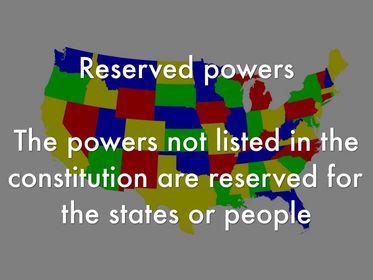
| Reserved Powers | powers that the Constitution does not give to the national govt. that are kept by the states |
| Concurrent Powers | powers shared by the state and federal govt. |
| Commerce Clause | grants Congress the ability to regulate commerce relationships with foreign countries, states, and indian tribes |
| Necessary and Proper Clause (elastic clause) | give Congress the right to make all laws "necessary and proper" to carry out its expressed power |
| Full Faith and Credit Clause (article 4) | addresses the duty that the states within the US have to respect the "public acts, records, and judicial proceeding of every other states" |
| Supremacy Clause (article 6) | establishes that the federal constitution, and federal law generally, take precedence over state laws, and even state constitutions |
| Free exercise Clause (1st amendment) | states that Congress shall make no laws respecting the establishment of religion |
| Establishment Clause (1st amendment) | limitation placed upon the US Congress preventing it from passing legislation respecting an establishment of religion |
| Due Process Clause (5th and 14th Amendment) | no person shall be deprived of life, liberty, or property without due process of law |
| Selective Corporation | a case by case process by which the liberties of the Bill of Rights are implied to the State govts. by the Due Process Clause f the 14th amendment. |
| Equal Protection Clause (14th Amendment) | all individuals shall have equal protection under the laws |




Want to create your own Flashcards for free with GoConqr? Learn more.