
5147760
Description

Flashcards by Anisha Rai, updated more than 1 year ago

|
Created by Anisha Rai
over 9 years ago
|
|
| Question | Answer |
| What is diffusion? | The spreading of particles of any substance in solution, or particles of a gas, resulting in a net movement from a region where they are of a higher concentration to a region with a lower concentration The greater the difference in concentration, the faster the rate of diffusion |
| What substances can move into and out of cells by diffusion? | Dissolved substances |
| How does oxygen required for respiration pass through cell membranes? | Diffusion |
| What is osmosis? | The diffusion of water from a dilute to a more concentrated solution through a partially permeable membrane that allows the passage of water molecules |
| What causes water to move into or out of the cell by osmosis? | Differences in the concentrations of the solutions |
| What is isotonic? | Having the same concentration inside and outside of the cell |
| What is hypotonic? | The solution is dilute The cell is concentrated |
| What is hypertonic? | The solution is concentrated The cell is dilute |
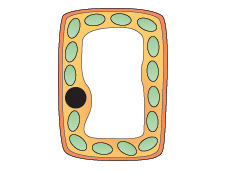
| What is turgor / turgid? | When a plant cell is fully inflated with water |
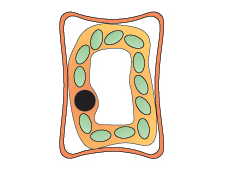
| What is plasmolysis / plasmolysed? | A plant cell that has lost water, causing the cell membrane to pull away from the inside of the cell wall |
| What is active transport? | Substances are sometimes absorbed against the concentration gradient. This requires use of energy from respiration |
| Give an example of how active transport can be used in nplants | To absorb ions from very dilute solutions e.g. by root hair cells |
| Give an example of how active transport can be used in animals | Sugar may be absorbed from low concentrations in the intestine and from low concentrations in the kidney tubules |
| How big is the surface area to volume ratio in a single-celled organism? | Relatively large |
| How do all the necessary exchanges occur in a single-celled organism | Via its surface membrane |
| Does the size and complexity of an organism increase or decrease the difficulty of exchanging materials? | Increase |
| How is the effectiveness of an exchange surface increased? | By having a large surface area By having an efficient blood supply (in animals) By being ventilated (in animals for gaseous exchange) |
| How is the small intestine in mammals adapted for exchanging materials? | Villi are folds within the wall where digested food molecules are exchanged between the gut and the bloodstream. Takes place by diffusion and active transport The folds increase the surface area They are made of a single layer of thin cells Beneath the villi is an extensive blood capillary network to distribute the absorbed food molecules |
| How are the lungs in mammals adapted for exchanging materials? | Alveoli in the lungs increase the surface area for exchange Millions in each lung Moist lining so oxygen dissolves first, speeding up diffusion in the blood One cell thick so gases do not have to diffuse very far |
| How are the roots in plants adapted for exchanging materials? | Tube-like protrusion provides greater surface area across which water and mineral ions can be exchanged Tube-like protrusion can penetrate between soil particles, reducing distance across which water and mineral ions must move Root hair cell contains lots of mitochondria, which release energy from glucose during respiration in order to provide the energy needed for active transport |
| How are leaves in plants adapted for exchanging materials? | The cells in the spongy mesophyll are loosely packed and covered by a thin film of water There are tiny pores, called stomata, in the surface of the leaf |
Want to create your own Flashcards for free with GoConqr? Learn more.