
5744168
Description

Flashcards by Vinuthna Vemireddy, updated more than 1 year ago

|
Created by Vinuthna Vemireddy
over 9 years ago
|
|
| Question | Answer |
| The word geometry means | to measure the earth |
| The Elements was written by | Euclid |
| line | extends infinitely in two opposite directions (<---> A B) |
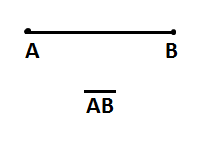
| line segment | is a portion of a line having two endpoints |
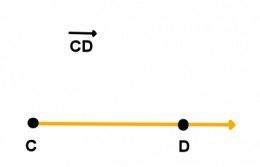
| ray | portion of a line having one endpoint |
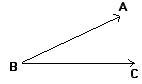
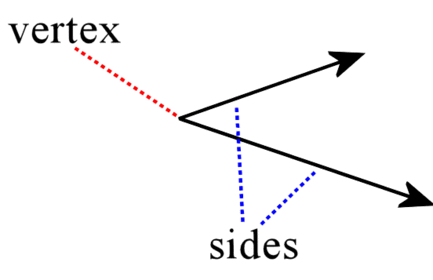
| angle | two rays sharing a common endpoint |
| vertex | common endpoint |
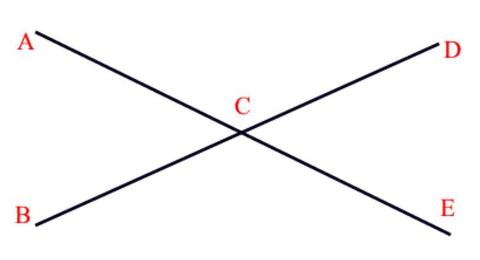
| intersecting lines | lines that have one point in common (only intersect at one point) |
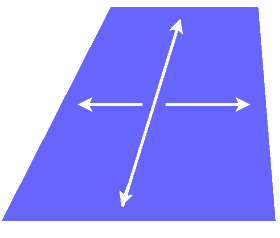
| plane | flat surface that extends infinitely in all directions |
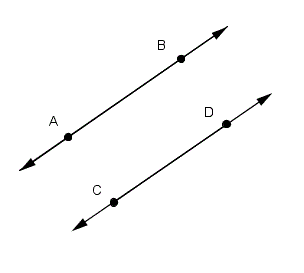
| parallel lines | lines in the same plan that never intersect |
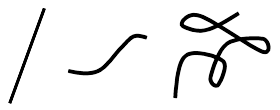
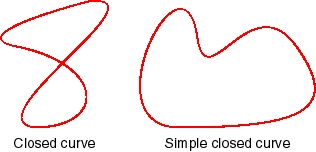
| curves | |
| closed curves | begins and end at the same point |
| simple closed curves | has no point of intersection |
| polygon | closed curve made up of line segments |
| quadrilateral | |
| parallelogram | both pairs of opposite sides are parallel |
| trapezoid | |
| Congruent | have the same shape and size |
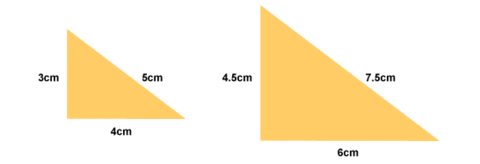
| similar shapes | have the same shape but not the same size |
| skew lines | two lines in space that don't intersect nor are parallel |
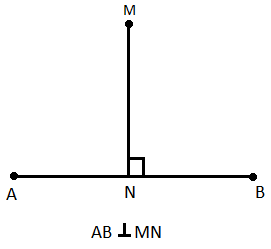
| perpendicular lines | lines that form a right angle when they intersect |
| complementary lines | two angles with a sum of 90º |
| supplementary angles | two angles with a sum of 180º |
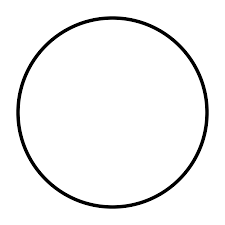
| circle is usually named by | the center |
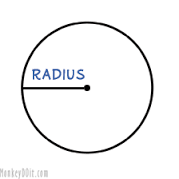
| radius | |
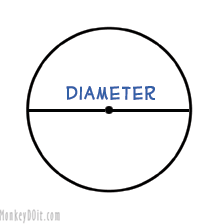
| diameter | |
| arc | |
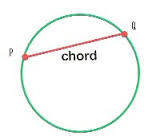
| chord | |
| the center of the circle is the... | vertex of the angle |
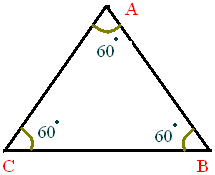
| the angles in a triangle total... | 180º |
| Equiangular triangles | have three congruent acute angles |
| equilateral triangles | have 3 congruent sides |
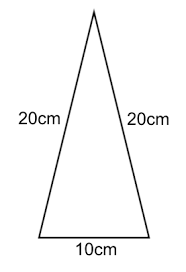
| isosceles triangles | have 2 congruent sides |
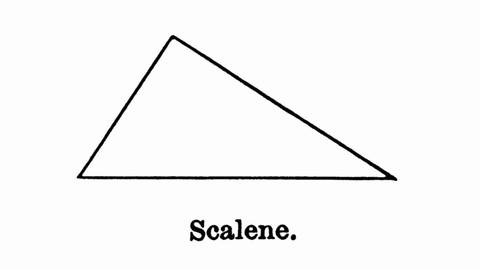
| scalene triangles | have no congruent sides |
| triangles are similar when.. | two angles of one are congruent to two angles of the other (abbreviated AA) |
| congruent triangles have... | the same shape and size (abbreviated SSS) |
| two triangles are congruent if... | two angles and the included side of the one triangle are congruent to the corresponding angles and the side of the triangle (abbreviated ASA) |
| perimeter of rectangle | P= 2L + 2W |
| perimeter of a square | P = 4s |
| perimeter of a triangle | P = a + b + c |
| Circumference (distance around the circle) | C = πd C = 2πr |
| area of a rectangle | A = lw |
| area of a square | A = s2 (side squared) |
| area of a parallelogram | A=bh |
| area of a triangle | A=1/2bh (heigh=altitude) |
| area of a trapezoid | A= h(b1 + b2)/2 |
| area of a circle | A= πr2 (radius squared) |
| surface area of a rectangular prism | SA= 2wl + 2wh +2lh |
| lateral surface area of a rectangular prism (lateral means side) | LA= 2wh + 2lh |
| surface area of a cube | SA= 6e2(squared) |
| lateral surface area of a cube | LA= 4e2 (squared) |
| surface area of a square pyramid | A= s2 + A= (1/2BI) * 4 |
| surface area of a cylinder | SA = 2πrh + 2πr2 |
| Volume | V = lwh |
| Volume of a cube | V= e3 |
| Volume of a square pyramid | V = 1/3s2h |
| Volume of a cylinder | V = πr2h |
| Volume of a cone | V= 1/3πr2h |
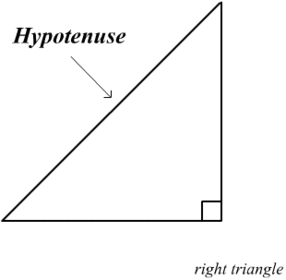
| hypotenuse | |
| Pythagorean's rule is | c2 = a2 + b2 |




Want to create your own Flashcards for free with GoConqr? Learn more.