
6683153
Description

Flashcards by Chelsea Cheeley, updated more than 1 year ago

|
Created by Chelsea Cheeley
about 10 years ago
|
|
| Question | Answer |
| What is the top number in visual acuity mean? | Distance between patient and chart |
| What does the bottom number in visual acuity mean? | Distance at which a normal eye can read letters |
| What is the visual acuity for legal blindness? | 20/200 |
| OS - oculus sinister | left eye |
| OD - oculus dexter | right eye |
| OU - oculus uterque | both eyes |
| During pinhole testing, what does improvement of vision mean? | Implies a functional problem (ex: refractive error) |
| During pinhole testing, what does a lack of improvement in vision mean? | Implies a structural problem (ex: optic nerve damage) |
| Myopia | Nearsightedness - difficulty seeing far away |
| Hyperopia | Farsightedness - difficulty seeing close up |
| Presbyopia | inability to focus on near objects (aging vision) |
| Diplopia | double vision |
| Scotomas | blind spot in visual field |
| Photophobia | pain with vision/light |
| Give one example of confrontation testing. | static finger wiggle test |
| Homonymous Hemianopsia | the loss of half of the field of view on the same side in both eyes |
| Bitemporal Hemianopsia | loss of vision in the outer (temporal or lateral) half of both the right and left visual fields |
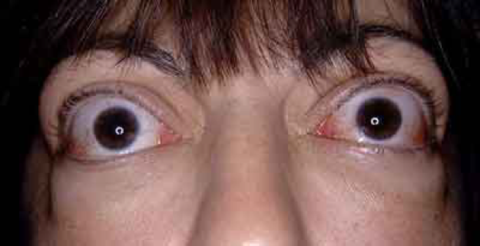
| Exophthalmos | protruding of eyeball |
| Enophthalmos | recession of eyeball |
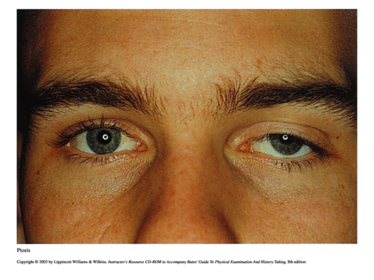
| Ptosis | Dropping of the upper eyelid. Interruption of CN III nerve supply. |
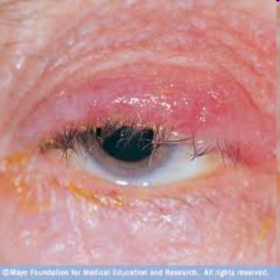
| Blepharitis | Inflammation of lid margin with redness, thickening and scales of crust |
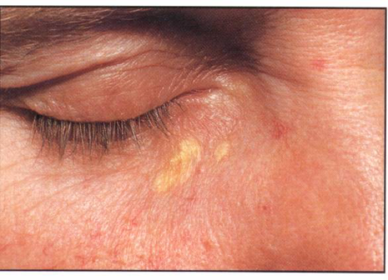
| Xanthelasma | Cholesterol deposits |
| Blepharitis | |
| Xanthelasma | |
| Exophthalmos | |
| Ptosis | |
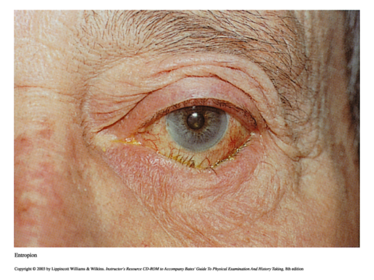
| Entropion | Lid droops inward, lower lash may irritate conj and cornea |
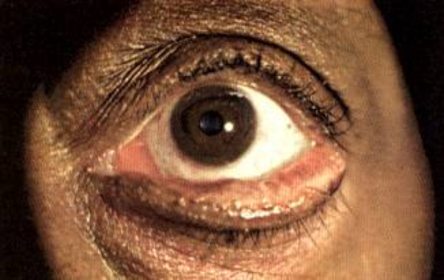
| Ectropion | Lid droops outward exposing palpebral conjunctiva - when punctum gets blocked it causes poor drainage and tearing |
| Entropion | |
| Ectropion | |
| Chalazion | Beady nodule inside the eyelid due to a blocked meibomian gland |
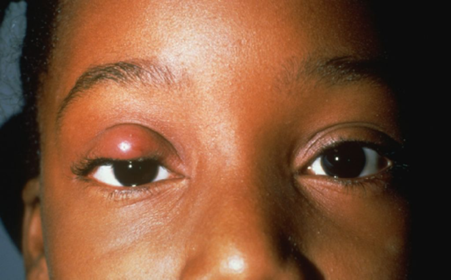
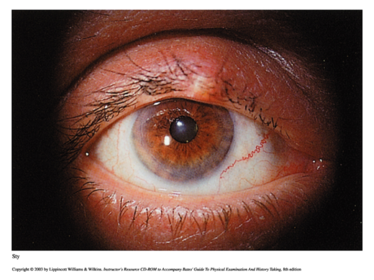
| Hordeolum | Sty - painful, tender infection around hair follicle lid margin |
| Chalazion | |
| Hordeolum | |
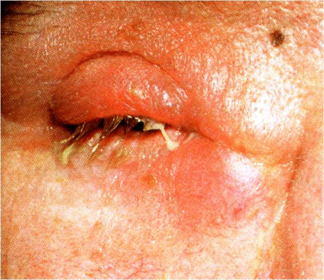
| Dacrocystitis | Inflammation of the lacrimal sac (painful, red and tender) |
| Dacrocystitis | |
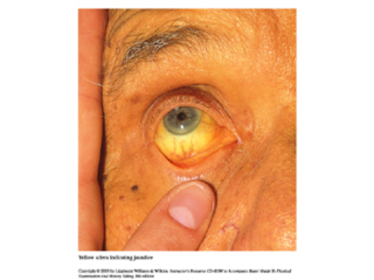
| Scleral Icterus (jaundice in eye) | |
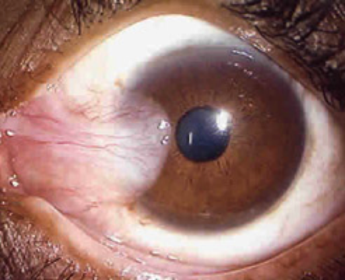
| Pterygium | |
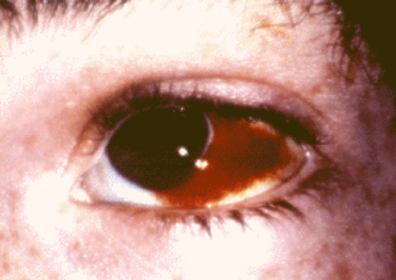
| Subconjunctival Hemorrhage | |
| Pterygium | A triangular thickening of the bulbar conjunctiva that grows slowly across the outer surface of the cornea (usually from the nasal side) |
| Conjunctivitis | diffuse dilatation of conjunctival vessels with redness that tends to be maximal peripherally |
| Strabismus | A deviation of the eyes from the normally conjugate position |
| Nystagmus | Fine, rhythmic oscillations of the eyes, normal for a few beats seen at terminal range of eye movement. Sustained indicates neurological condition. Lid lag can indicate hyperthyroidism |
| Miosis | constriction of the pupils |
| Mydriasis | dilation of pupils |
| Anisocoria | Unequal pupils |
| Accommodation | Ability of pupils to constrict when focus shifts from distance to close object |
| Convergence | Ability of eyes to move toward the nose symmetrically when following an object moving toward them. |
| PERRLA | Pupils Equal, Round, Reactive to Light and Accommodation |
| What muscle moves the eyes to the left and right? | Lateral Rectus & Medical Rectus |
| What muscle moves the eye up and down? | Superior Rectus and Inferior Rectus |
| Name the 6 cardinal gazes | 1. Medial Rectus 2. Lateral Rectus 3. Superior Rectus 4. Inferior Rectus 5. Superior Oblique 6. Inferior Oblique |
| What is the nerve innervation of lateral rectus? | Abducens nerve (CN VI) |
| What is the nerve innervation of superior oblique? | Trochlear nerve (CN IV) |
| What is the nerve innervation for the majority of the ocular muscles? | Oculomotor nerve (CN III) |
| Fundus | Posterior aspect of the eye seen through the ophthalmoscope |
| Retina | visual screen and inner layer of the eye |
| What does the optic disc contain? | optic nerve (CN II), retinal vein and arteries |
| Fovea | A small depression in the retinal surface where largest concentration of cones are contained therefore the central point of vision |
| Macula | yellow oval around the fovea - acts as a natural blocker of UV light and sunblock for the fovea |
| Physiologic cup | depression in the optic disc |
| What is the red reflex? | During a fundoscopic exam, it is the light reflecting off the retina. (absence of red reflex can mean cataracts or vitreous hemorrhage) |
| What are the two types of glaucoma? | 1. open angle glaucoma (2nd leading cause of blindness in Americans) 2. acute closed angle glaucoma |
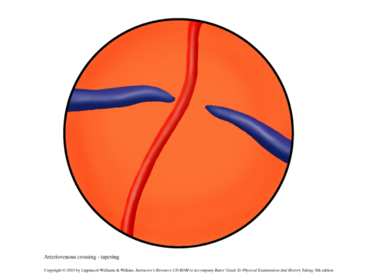
| A-V tapering | The vein appears to taper down on either side of the artery. |
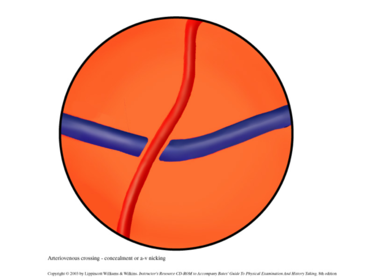
| A-V nicking | vein abruptly stops on either side of the artery |
| A-V tapering | |
| A-V nicking | |
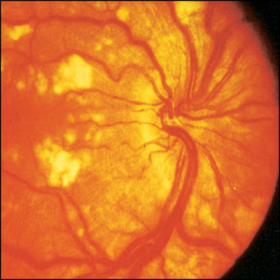
| Cotton-wool patches | |
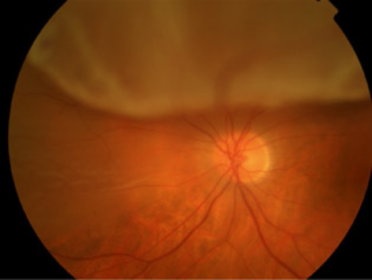
| Retinal Detachment | |
| What is a sit lamp examination and what does it examine? | Magnifying device to examine anterior portion of the eye. - cornea - anterior chamber - iris - lens |
| Conjunctiva | clear membrane covering the eye and the underside of the eyelids |
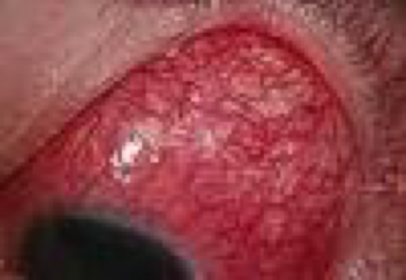
| Scleritis | |
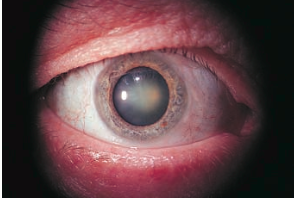
| Nuclear Cataract | looks gray when seen by a flashflight |
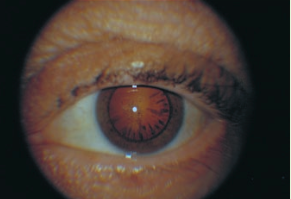
| Peripheral cataract | Produces spokelike shadows that point gray against black, as seen with a flashlight, or black against red with an ophthalmoscope |
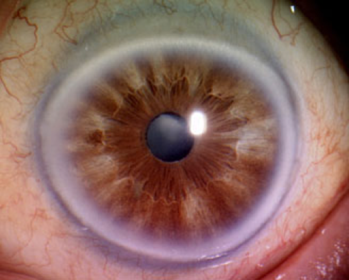
| Arcus senilis | Ring around the iris. Common in elderly, From cholesterol deposits, may indicate hyperlipidemia. |
| Arcus Senilis | |
| Peripheral Cataract | |
| Nuclear Cataract | |
| Angle Closure Glaucoma | a sudden elevation in intraocular pressure that occurs when the iris blocks the eye's drainage channel—the trabecular meshwork |
| Extraocular Movements | Testing the function of each ocular muscle and the cranial nerve that supplies it by asking the patient to move the eye in the direction controlled by that muscle (H) |
| Consensual reaction | pupillary constriction in the opposite eye |
| What does the swinging flashlight test examine for? | Used to test for impairment of optic nerves II and III |
Want to create your own Flashcards for free with GoConqr? Learn more.