
Flashcards
Peripheral Vascular
Cards in this deck (23)
- 1How do you grade the amplitude of arterial pulses?4+ Bounding
3+ Increased
2+ NORMAL
1+ Diminished
0 Absent, not palpable - 2How do you perform an upper extremities PV exam?INSPECT extremities and skin for color, cyanosis, swelling
INSPECT nails for color, clubbing, capillary refill
PALPATE radial and brachial pulses
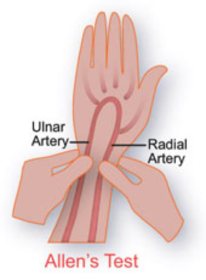
PALPATE for epitrochlear lymph nodes - 3What is an Allen Test?Helps evaluate arterial supply to hand
- 4How do you perform an Allen Test?- Have patient make a tight fist
- Compress both radial and ulnar arteries
- Ask patient to open hand: should be pale
- Release pressure over ulnar artery
- If collateral circulation is OK, palm gets pink in 2-3 sec - 5How do you perform a LOWER extremities PV testINSPECT extremities & skin for color, cyanosis, swelling
INSPECT nails for color, lesions, cap refill
PALPATE femoral pulse, inguinal lymph nodes
PALPATE popliteal, dorsalis pedis & posterior tibial pulses
PALPATE for edema - 6What is a normal capillary refill?Cap refill < 2 seconds
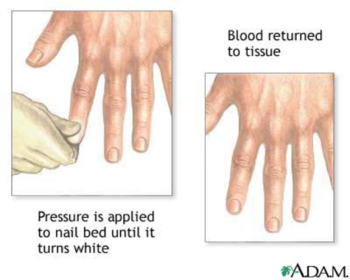
- 7—Delayed Capillary Refill
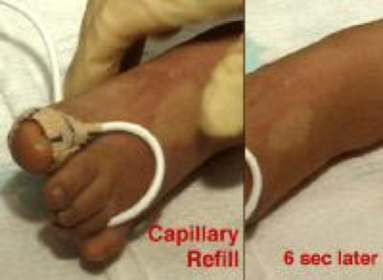
- 8What is Edema (2 types)?PITTING edema
-Dorsum of each foot
- Behind medial malleolus
- Anterior tibia (shins)
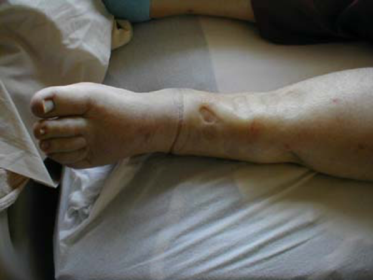
NON-PITTING edema - 9How do you grade pitting edema?1+ = Mild pitting, slight indentation, no perceptable swelling of the leg
2+ = Moderate pitting, indentation subsides rapidly
3+ = Deep pitting, indentation remains for a short time, leg looks swollen
4+ = Very deep pitting, indentation lasts a long time, leg is very swollen - 10—PITTING Lower Extremity Edema
- 11—NONPITTING Periorbital Edema
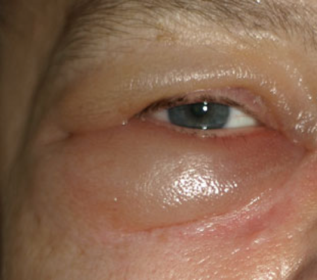
- 12What does a Homan's sign test for?Deep Vein Thrombosis
(support pt's thigh with one hand and foot with the other, bend leg slighty at the knee and firmly dorsiflex the ankle. Test is positive if there is deep calf pain) - 13What are types of venous insufficiency?Varicose veins
Venous stasis - 14—Varicose veins
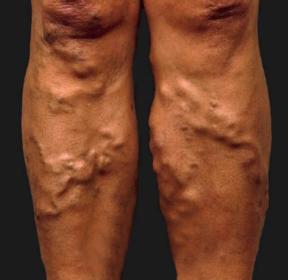
- 15—Venous stasis
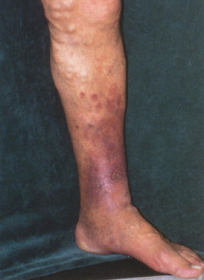
- 16—Venous Stasis Ulceration
"wet and goupy"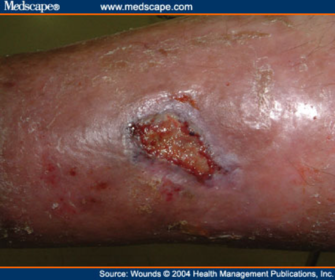
- 17What are some characteristics of arterial insufficiency?Shiny skin
cold to touch
loss of hair
reddish appearance to skin - 18Where are arterial ulcers normally seen?Seen over areas of vascular supply; commonly on the tops of toes
- ulcers are dry and PAINful - 19—Arterial Insufficiency
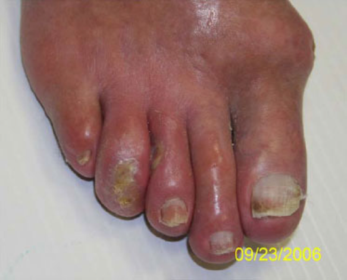
- 20—Arterial Ulcer
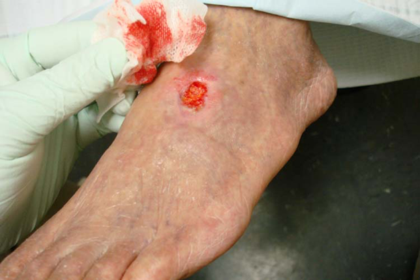
- 21What do you call the end stage of arterial disease?Gangrene (results in necrotic tissue)
- 22—Gangrene
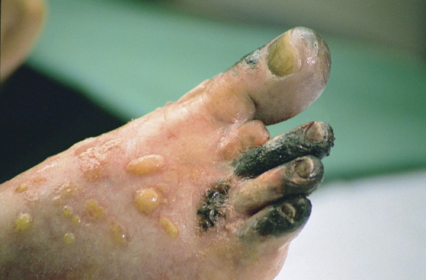
- 23—Diabetic Ulcer
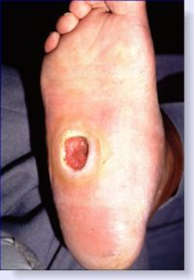
Information
- Description
- Physical Diagnosis Flashcards on Peripheral Vascular, created by Lisa Iwasaki on 24/10/2016.
- Created by
- Lisa Iwasaki
- Views
- 33
- Rating