
6827816
Description

Flashcards by Dolu Falowo, updated more than 1 year ago

|
Created by Dolu Falowo
over 9 years ago
|
|
| Question | Answer |
| Define rate of reaction What is it dependent on? | The change in concentration of a reactant or product in a given period of time The frequency of successful collisions |
| What does a Maxwell-Boltzmann distribution show? | A plot of the number of gaseous molecules against the energy they have at a fixed temperature |
| What is the rate equation? What is the rate equation for a general reaction? | An expression showing how the rate of reaction is linked to the concentrations of the reactants |
| Define order of reaction (with respect to a particular reactant) What is the overall order of reaction? | The power to which the concentration of this reactant is raised in the rate equation The sum of all the orders in the rate equation. |
| Define rate constant k | The proportionality constant which links the rate of reaction to the concentrations in the rate equation |
| What are the units for k when the overall order of reaction is: 1 2 3? | s-1 mol-1dm3s-1 mol-2dm6s-1 |
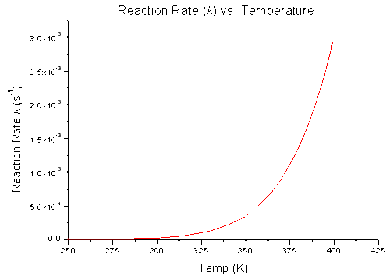
| How does the rate constant change with temperature? | As temperature increases, rate constant increases Rate constant increases exponentially as temperature increases |
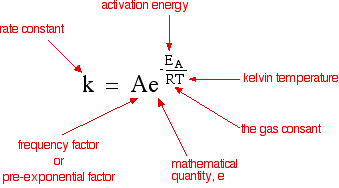
| What is the Arrhenius equation? Equation? Units? | It links the rate constant with activation energy and temperature. Temperature is in Kelvin Gas constant =8.31 J/K/mol Activation energy= J/mol Arrhenius constant= same units as rate constant. |
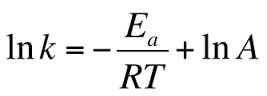
| How can the Arrhenius equation be plotted graphically? What are the features of the graph? | **ln k is plotted against 1/T** Gradient=-Ea/R Ln k intercept = ln A |
| How can the rate of reaction be measured? | Gas syringe Change in mass Colorimetry Sampling, quenching, and titrating Measuring pH using a pH meter |
| What is a gas syringe? | A gas syringe is a ground glass syringe which is attached to a sealed reaction vessel and measures the volume of gas produced |
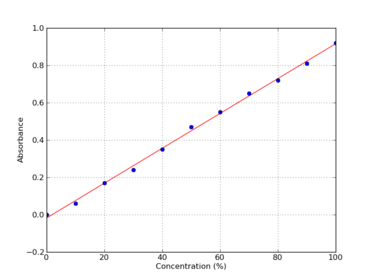
| What is and how does a colorimeter work? | It measures colour intensity of a solution. A calibration curve should be set up first with known concentrations of the reactant/product so that the colorimeter reading can be matched to the concentration. |
| How is colorimetry adapted for: initial rate monitoring continuous rate monitoring? | Initial: Several experiments are carried out changing the concentration of each reactant Continuous: 1 experiment is carried out and the colorimeter reading are converted to concentration using the calibration curve |
| How is sampling, quenching and titrating used to measure rate of reaction? | A sample is taken at various times and the reaction is quenched to stop the reaction (by rapid cooling/adding large volume of water/adding chemical to remove reactant). The sample is then titrated to find the concentration of the reactant/product. A graph of concentration against time can be plotted. |
| How can this be adapted for initial/continuous rate monitoring? | Initial rate monitoring for a product: Several experiments changing the concentration of each reactant are carried out and initial rate measurement is taken from the graphs of concentration against time. Continuous rate monitoring for a reactant: 1 experiment is carried out and a graph of concentration against time is plotted. |
| How can pH monitoring be used for measuring rate of reaction? | pH values can be taken over time and converted directly to [H+]. A graph of [H+] against time is plotted |
| What can be used for initial rate monitoring of a reactant/product? | Gas syringe Colorimeter pH meter & Quenching/titrating of hydrogen/hydroxide ions |
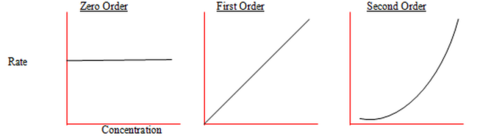
| Method? | 1) Pick 1 reactant (A) to determine its order of reaction. 2) Carry out several experiments at different concentrations for this reactant measuring quantity against time 3) Plot graphs of the measurable quantity against time 4) Draw a tangent at t=0s and determine initial gradient of this tangent. Repeat for other concentrations 5) Plot a final graph of the initial rate of reaction against concentration. The shape shows the order of reaction with respect to A. Repeat for other reactants |
| Graphs for 0, 1st and 2nd order (rate against concentration) | Make sure line touches y axis! |
| What can be used for continuous rate monitoring of reactants? | Hydrogen ions determined directly from pH measurements or by quenching/titrating Coloured reactant determined from colorimeter reading |
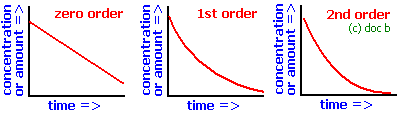
| Method? | 1) Allow reaction to progress and take reading (colorimeter/pH) or samples at various times 2) Any samples taken should be quenched and titrated. 3) Plot a graph of concentration against time for this reactant and the shape gives the order with respect to this reactant. |
| Graphs for 0, 1st and 2nd order (concentration against time) | Make sure line touches y axis! |
| What is a mechanism? | A series of reactions which shows how the reaction occurs. |
| What is the rate determining step? | The slowest step which dictates the overall rate of the reaction. The species that react in the rate-determining step are present at concentrations with non-zero orders in the rate equation (reactant that does not appear in rate equation/is 0 order is not in the RDS) |

Want to create your own Flashcards for free with GoConqr? Learn more.