
Flashcards
Unit 4: Key terms
Cards in this deck (27)
- 1ScalarA quantity that can be specified by a single number, or by the combination of a number and a unit of measurement.
- 2VectorA quantity that has both MAGNITUDE and DIRECTION
- 3Numerical quantitiesScalars that can be described by numbers alone
- 4ModulusThe magnitude of a vector
- 5Two vectors are equal if...they have the same direction and magnitude
- 6Parallel vectorsWhere vectors are pointing in the same direction
- 7Antiparallel vectorsVectors that point in the opposite directions
- 8Zero vectorA vector of ZERO magnitude, represented by the bold symbol 0
- 9Scaling a vectorFor any vector, v, and any scalar, m, the result of scaling v by m is represented by the product mv, and is the vector with magnitude |m||v| that is:
-Parallel to v is m > 0
-Antiparallel to v if m < 0
-Zero vector, 0 , if m = 0 - 10Vector additionThe general process of adding vectors
- 11ResultantThe outcome of adding vectors together
- 12Vector subtractionThe general process of adding an antiparallel vector to a vector
e.g. a + (-b) = a - b - 13CommutativeThe term used to describe the fact that in vector addition, the order in which the addition and subtraction of vectors is carried out has no influence on the final result
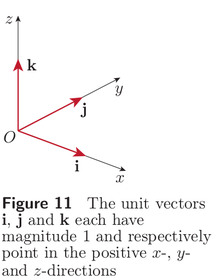
- 14Cartesian coordinatesA system consisting of three mutually perpendicular AXES that meet at a point O, called the ORIGIN
- 15AxesConventionally labelled as x, y and z, where the z-axis is oriented vertically.
Each axis is given a POSITIVE sense (as indicated by the arrows of the axes on a graph).
E.g. the Positive x-direction is parallel to the arrowed direction on the x-axis. The negative z-direction is antiparallel to the arrowed direction of the z-axis. - 16Ordered tripleGiving the 3 coordinate values in order (x, y, z) in a 3-D Cartesian coordinate system.
- 17Order PairSimilarly to an ordered triple, it gives the 2 coordinate values as (x, y)
- 18Right-handed system of CoordinatesThe handedness of a given Cartesian system. It is conventional to work with the right-handed system in both 2 dimensional and 3 dimensional Cartesian systems.
- 19Right-hand ruleThe method of determining the handedness of a Cartesian system:
(a) Point the straightened fingers of your right hand in the direction of the POSITIVE x-axis. Then rotate your wrist until you can bend your fingers in the direction of the POSITIVE y-axis.
(b) Extend the thumb of your right hand. If it points in the direction of the positive z-axis, the frame is right-handed. Otherwise, the system is left-handed. - 20Cartesian Unit VectorsA set of 3 special vectors, one directed parallel to each positive coordinate axis, and each having magnitude 1.
Conventionally labelled as "i" in the positive x-direction, "j" in the positive y-direction and "k" in the positive z-direction. - 21Cartesian component form of aIn three dimensions, any vector can be represented by a linear combination of the unit vectors i, j and k:
a = \(a_x\)i + \(a_y\)j + \(a_z\)k - 22Cartesian component vectors of aThe three vectors \(a_x\)i, \(a_y\)j and \(a_z\)k.
- 23Cartesian scalar components of a (or just Cartesian components of a)The 3 scalars \(a_x\), \(a_y\) and \(a_z\) involved in multiplying a Cartesian Unit vector by a scalar.
- 24Component formA three dimensional vector that can be specified in terms of its components as:
a = \(a_x\)i + \(a_y\)j + \(a_z\)k
or
a = ( \(a_x\), \(a_y\), \(a_z\)) - 25Position VectorA method of specifying a point with coordinates (x, y, z) in terms of a displacement from the origin of a Cartesian coordinate system to a given point. Usually expressed by the symbol r. May be treated in the same way as any other displacements.
r = xi + yj + zk or r = (x, y, z) - 26Vector-valued functionAn entity r(t) that gives a vector for each value of the variable t.
(In comparison to a real-valued function which gives a real value for each value of variable t) - 27—
Information
- Description
- MST224: Mathematical Methods (Unit 4: Vectors and Matrices) Flashcards on Unit 4: Key terms, created by Amarpreet Doal on 24/11/2016.
- Created by
- Amarpreet Doal
- Views
- 0
- Rating