
Flashcards
HODM Terms
Cards in this deck (102)
- 1Legitimate power/position powerauthority delegated to a position. Educators can expect learners to perform duties, otherwise they can discipline them,
- 2Power by rewardused when rewards are given or withheld
- 3Coercive powerenforced by inspiring fear. Use with care and in extreme cases only.
- 4Referent powerlearners follow an educator because they like them, respect them or identify with them. Charisma, friendliness work here.
- 5Expert powerbased on knowledge and expertise
- 6independence strategiessolutions to deal with problems of large classes that motivate learners to become independent learners.
- 7gain learners' respect through...academic proficiency (knowledge) and professional proficiency (application of teaching methodology)
- 8communication definitiontransmitting of an idea by someone (the sender) and the understanding thereof by another (the receiver). Includes all processes by which people influence each other.
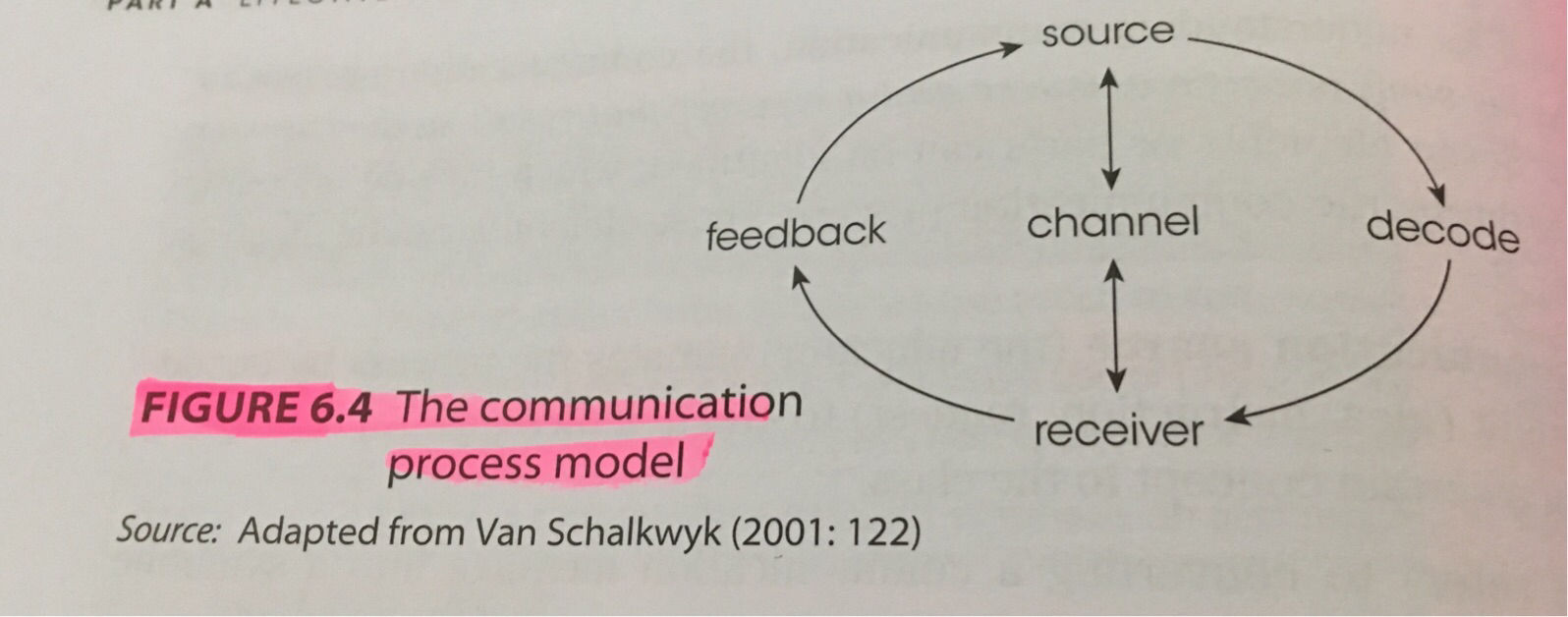
- 9communication process is described as the....steps between a source and a receiver that result in the transfer of meaning.
- 10marginal listeningreceiver gives speaker only partial attention. Dangerous and offensive
- 11evaluative listening uses....time from slowness of speech or quickness of listening to judge and evaluate message.
- 12projective listeninglistener purposefully avoids evaluating message while still being spoken. Uses empathy first.
- 13self imagepicture that learners have of themselves
- 14self conceptidea that learners have of themselves
- 15self esteemthe feeling that learners experience from their self image and self concept.
- 16misbehaviourwhen learner's behaviour is at odds with educator's fair expectations
- 174 themes of 20-step discipline model1 Prevention
2 redirection
3 consequences
4 team-support - 18intrinsic motivation results when...perceived competence and perceived control are experienced simultaneously
- 19co-operative learninga team approach to learning where each member of the group is dependent on other members to accomplish a learning task.
- 20skills required for co-operative learning?CTLC
communication, trust, leadership, conflict resolution. - 212 types of co-operative learningpeer tutoring - learners work together to help each other master tasks => individual products
group investigations - work together on tasks => produce group products - 22Learning styleA consistent pattern of behavior that a learner uses to approach and master learning content
- 23Teaching styleThe educator's consistent personal approach to teaching, irrespective of the media, method or content used
- 24Field-dependent learnersGlobal, holistic and relational approach. Right brain learning.
- 25Field-independent learnersAnalytical, verbal and sequential style. Left brain learning.
- 26LegislationLaw made by an organ of state vested with legislative authority.
SA - national legislative authority lies with parliament. - 27Common lawNot originally written down, and not enacted by legislature, but over time has become accepted as underlying basic laws of society.
Can be altered by legislation. - 28legal subjectany "person" recognised in law
- 292 classes of legal subject1) natural persons (all humans)
2) Juristic persons - other entities the law recognises - 30material lawdetermines content and meaning of legal rules. Divided into public and private law
- 31procedural lawmanner in which material law is enforced
- 32public lawregulates organisation of the state and state's relationship with individuals.
Authoritative nature with organ of state in authority to act in public interest. - 33constitutional lawestablishes state organs and involves the working and relationships of them.
- 34administrative lawsum total of legal rules that grant people or institutions in authority the power to take action; and ensure that such action is within boundaries of law. Regulates actions of state administration.
- 35Problems of large classes?PIPRIDMV
Purpose, Improvement, Progress, Reading, Independence, Discussion, Motivation, Variety - 36Nonverbal behaviour typesKCOPHOT
Kinesics, Chronemics, Oculesics, Proxemics, Haptics, Objectives, Time - 37Kinesicsmovement of limbs, hands and feet, facial expression and posture.
- 38ChronemicsPauses, hesitations and silences that fall between verbal statements
- 39OculesicsEye movements
- 40HapticsHow we use touch to communicate
- 41ProxemicsHow a person places in relation to another during communication. Factors: Intimacy, public or private situation, personal choice.
- 42ObjectivesHow we select and make use of physical objects in non-verbal communication. Includes physical appearance and clothing.
- 43Timedifferent cultures place different emphasis on acts related to time.
- 44Communication process (7 steps)SEMCDRF
Source, Encode, Message, Channel, Decode, Receiver, Feedback - 45Communication process modelEnter text here...
- 46Good relationships made with...?OCISM
Openness (honesty), Caring, Interdependence (rather than dependency), Separateness (develop individually), Mutual meeting of needs. - 474 key beliefs for good relationship to form?PEPA
Personal responsibility, Extended teacher role, Persistent with learners, All learners can learn (optimism) - 48Which learner feelings most determine their success in school and life?CAP
Connectedness, Autonomy, Power - 494 conditions for 20 step discipline model to work?GRRA
Goals (of school aligned with classroom), Role of educator established, Role of learner defined, Approach must be aimed at helping learners to grow into more advanced ways of behaving - 504 themes of 10 step discipline model?PRCT
Prevention, Redirection, Consequences, Team-assistance. - 51Educator can create positive classroom environment by showing:CECC EUE (Sick, eeeew!)
Clarity (in tasks), Enthusiasm, Care, Consistency, Encouragement, Utilisation (of failures as learning experiences), Expectations (that learners will succeed). - 52Learner motivation improved by:IDMC
Inclusion (everyone respected), Developing attitude, Meaning (for learners), Competence (of learners). - 53Improve intrinsic motivation by:BIMP
Balance (between easy & challenging tasks) Instructional support,
Model activities,
Predictable learning environments - 54Dimensions of learner motivation:IRES
Interest
Relevance (to their personal needs)
Expectancy (of success)
Satisfaction (intrinsic and extrinsic motivation) - 55Why use cooperative learning?pg 125-126
- 56Which skills are most needed for cooperative learning?CTLC
Communication
Trust
Leadership
Conflit resolution - 57Facets of culture?processes of social and human interactions
body of knowledge
continuously modified over time
system of beliefs, attitudes and norms
have verbal and nonverbal patterns of communication. - 58Multiple intelligences are?(Meals in the bin)
MIILLS - BN
Musical, Interpersonal, Intrapersonal, Linguistic, Logical-mathematical, Spatial-visual, Bodily-kinaesthetic, Naturalist
pg 139 - 592 Learning styles are?Field-dependent: right brain. Holistic, global and relational approach.
Field-independent: left brain. Analytical, verbal and sequential learning - 60Lawrules of conduct that are accepted as binding in society. Law maintains and restores legal balance in a society.
- 612 routes to adopt policy?White Paper
Flowing from enabling legislation
NB: policy is not law and is not mandatory - 62Legislation applicable to educators?LESS
Labour relations act
Employment of educators act
South African schools act
South African council for educators act - 63a delictan unlawful, culpable (intentional or negligent) act or omission committed by a person which infringes on the rights of another or causes them harm. (Private law)
Includes defamation, assault and invasion of privacy - 64positive duty vs negative duty (right to education)positive - must provide effective education
negative - educator must not interfere with (must protect) child's right to education. - 65provide quality education with frameworkAAAA
Availability - schools and teachers
Accessibility - for all, without discrimination
Acceptability - are you contributing to aim of education?
Adaptability - to social change. Promote diversity. - 66administrative law applicable for educators when...completing register, formulates classroom rules or when disciplining or punishing learners.
- 67vertical relationshipone where power is unequal - one person has more power (power over) the other.
- 68administrative actionconduct of people in authority. Any decision taken (or failure to do so) by an organ of state when performing duties. (schools are organs of state)
- 69JUST administrative action is...LRF
Lawful
Reasonable
Fair - 70Lawfulmust comply with prescripts of the law
- 71ReasonableDecision taken must be correct and based on objective facts and circumstances. A reasonable effect or result.
- 72Fair (procedurally fair)Correct procedure followed as laid out. Person in power must act impartially and subordinate party must be given chance to defend themselves.
- 73intra vireswithin the power, conferred by law
- 74discipline differs from punishment how?discipline is intrinsic, punishment is external
discipline educative, punishment punitive
discipline is about self control - self-actualisation, punishment to exercise control over - 75self-disciplinelearner capable of using own reason to determine best course of action and not give into desires
- 76punishmentcorrective measure or penalty to suffer consequences in order to maintain orderliness of school
- 77establish positive discipline with... 4PODF
Positive & supportive environment
Obtain knowledge on how to respond to misbehaviour
Distinguish btwn discipline and punishment
Focus on relationships - 78disciplinary powers mainly derived from...Common law and in loco parentis principle. Legislation starting to do so: national education policy act
- 79education law sources regulating punishment?Constitution, legislation, common law (natural justice, reasonableness and fairness) and Case Law
- 80punishment with legal implications:minor sanctions
corporal punishment
Detention - 81corporal punishmentany deliberate act against a child that inflicts pain or physical discomfort to punish or contain him/her.
- 82boni mores principle used totest for unlawfulness. Was harm caused unjustified in the circumstances?
- 83negligencefailure to exercise necessary degree of care for the safety and well-being of others. May occur as a result of a failure to act when there is duty to act, or as a result of acting in an improper manner.
- 84guilty of negligence iffailed to provide proper supervision
failed to aid injured or ill
permit to play unsafe games
failed to provide adequate instructions
took unreasonable risks - 85test for negligence?reasonable person test (diligens paterfamilias).
- 86define reasonable personan average person who has a certain minimum knowledge and certain mental capacities that enable him/her to appreciate the dangerous potential of certain actions or behaviour
- 87test for negligence rests on 2 pillars...reasonable foreseeability and reasonable preventability
- 88contributory fault has two formsintent and negligence
- 89contributory negligenceinjured person failed to exercise required standard of care for his/her own safety
- 90What is used to deal with a scenario in which an educator has sexual relations with a learner?Employment of educators act
- 91Which act allows random searches?Schools act 84
- 92Education law sources that regulate sexual misconduct are (3)Constitution
Common Law
Legislation - 93Rapenon-consensual sexual penetration of any genital organ or anus. With a person under 12, is always considered rape.
- 94Sexual assault > sexual violationcause penetration of any object into or beyond the genital organs or anus of another person. Also includes oral genital violation.
- 95statutory rapeacts of consensual sexual penetration with children 12-15 years old.
- 96employment of the classroom manager is regulated by (2)Labour relations act
Employment of educators act - 97strikepartial or complete refusal to work, or the retardation of work by persons employed, for the purpose of remedying a grievance or resolving a dispute
- 98lockoutexclusion by the employer of the employee from the employer's workplace, for the purpose of compelling the employees to accept a demand.
- 99a protected strikecomplies with provisions of chapter 4 of labour relations act
- 1003 kinds of fair dismissalOIM
Operational reasons, Incapacity, Misconduct (repeated) - 101misconducta breakdown in the employment relationship
- 102actions to take against educators guilty of misconduct? (9)Counselling
verbal warning
written warning
final written warning
fine not + 1 month salary
suspension w/out pay (not + 3 months)
demotion
combination of above
Dismissal
Information
- Description
- Teaching Flashcards on HODM Terms, created by Matthew Leonard on 22/04/2017.
- Created by
- Matthew Leonard
- Views
- 0
- Rating