
Flashcards
Secure Communications and Network Protocol
Cards in this deck (49)
- 1TCP/IP (Transmission Control Protocol/Internet Protocol)Primary protocol suite used on most networks and the Internet
- 2Remote Access Security ManagementProactively managing the risks of providing access of private networks to users outside the gateway with remote access security solutions
- 3Secure communication protocolsProtocols that provide security services for application-specific communication channels
- 4Simple Key Management for Internet Protocol (SKIP)An encryption tool used to protect sessionless independent entities of data.
Enable to encrypt any subprotocol of TCP/IP.
Establishes a long-term key once and then requires no further communication to exchange keys. - 5Software IP Encryption (SWIPE)A layer 3 protocol that provides authentication, integrity and confidentiality using an encapsulation method
- 6Secure Remote Procedure Call (SRPC)An authentication service that produces public and private keys to client and servers.
- 7Secure Socket Layer (SSL)A popular encryption protocol developed to protect the communications between a web server and a web browser.
Is superseded by TLS. - 8Transport Layer Security (TLS)Functions similarly to SSL but with a stronger encryption and authentication protocols.
- 9SSL & TLS featuresSupports secure client / server communications while preventing tampering and eavesdropping.
Supports one-way authentication.
Supports two-way authentication using digital certificates.
Can be implemented at lower layers to operate as a VPN. - 10Secure Electronic Transfer (SET)Specifically developed to secure online financial transactions. Based on RSA encryption and DES.
Has the support of major credit card companies such as Visa and Mastercard. - 11Authentication ProtocolsControl how logon credentials are exchanged and whether they are encrypted during transport
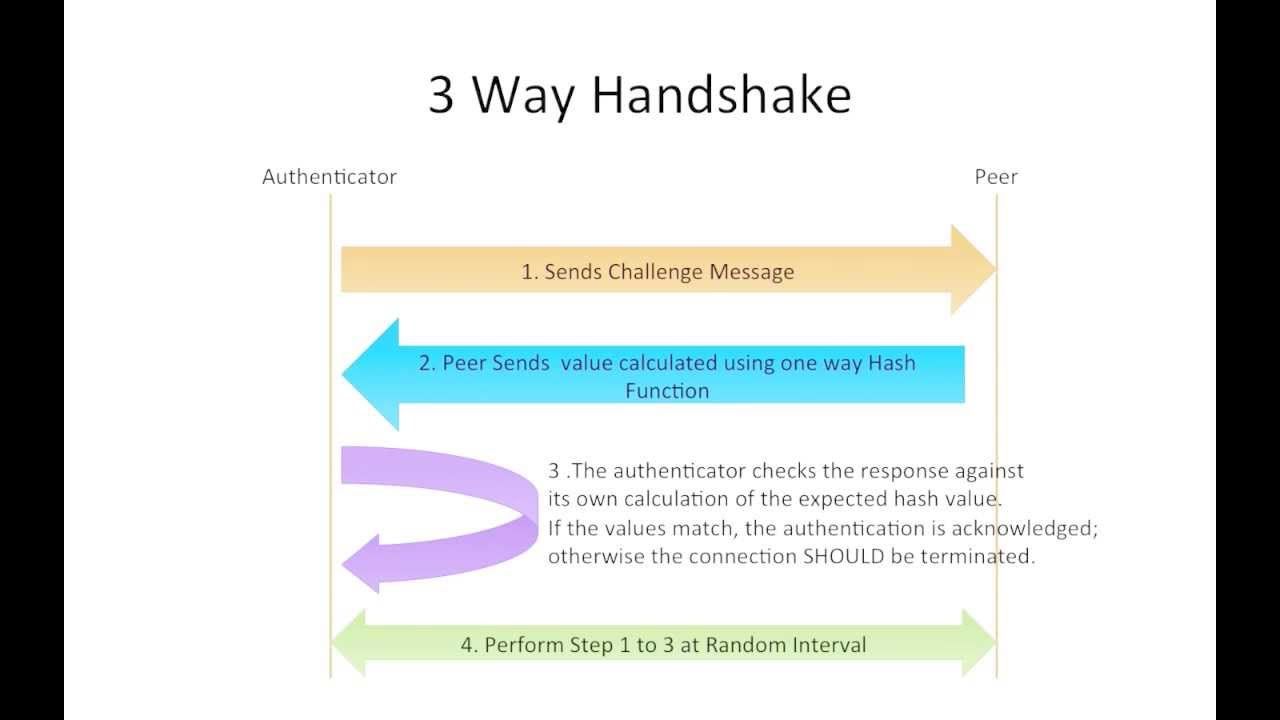
- 12Challenge Handshake Authentication Protocol (CHAP)An authentication protocol that encrypts usernames and passwords. It uses a challenge-response dialogue to authenticate the user.
Periodically reauthenticates the remote system through the established connection to verify persistent identity of the user. - 13Point-to-Point Protocol (PPP)a family of network protocols that provide a standard way to transport multi-protocol data over two directly connected (point-point) computers
- 14Challenge Handshake Authentication Protocol 3-Way Handshake
- 15Password Authentication Protocol (PAP)An authentication protocol for Point-to-Point Protocol (PPP).
Transmits credentials in plain-text without encryption.
Has the lowest compared to the other two authentication protocols. - 16Extensible Authentication Protocol (EAP)A framework for authentication instead of an actual protocol. Can support multiple authentication mechanisms ranging from token cards to public key authentication.
Permits third-party vendors to create custom authentication schemes.
Can be employed from PPP to wireless networks. - 17Secure Voice CommunicationsSecuring voice communications becomes an increasingly important issue as it moves to the network by employing digital devices and VoIP.
- 18Voice over Internet Protocol (VoIP)A technology that encapsulates audio into data packets, transmits them across an IP network and unencapsulates them back into audio at the other end of the connection.
Some VoIP systems are plain-form communications others are highly encrypted. - 19Potential Attacks that VoIP are susceptible to...- VoIP phishing (vishing) or Spam over Internet Telephony (SPIT) attacks.
- DoS attacks or OS attacks against the VoIP host systems
- Man-in-the-Middle attacks
- VLAN and VoIP hopping
- Decoding unencrypted VoIP traffic - 20Spam over Internet Telephony (SPIT)is unsolicited bulk messages broadcast over VoIP to phones connected to the Internet. SPIT is not much of a problem yet because IP telephony is not widely used.
- 21Man-in-the-Middle (MitM) attackis one in which the attacker intercepts and relays messages between two parties who believe they are communicating with each other
- 22VishingSimilar to phishing;
collecting private information over the telephone system for unethical purposes - 23Countermeasures to protect against VoIP exploitations- request proof of identity or have someone who would recognise the caller
- require callback authorizations
- classify information
-restrict dial-in and dial-out codes
- log and audit activities
- deploy DISA technologies - 24Private Branch Exchange (PBX)An enterprise telephone system that switches calls between enterprise users on local lines while allowing all users to share a certain number of external phone lines.
- 25IP telephonyThe technologies that use the IP's packet-switched connections to exchange voice, fax and other forms of information that were traditionally been carried over circuit-switched connections.
- 26circuit switchingcircuit switched networks require dedicated end-to-end point connections during calls
- 27packet switchingoccurs when the data is moved in separate small blocks, packets, and sent across intermediary networks to a destination address. When received packets are reassembled in the proper sequence to make up the message.
- 28A phreaker or phreakAbuses phone systems by gaining unauthorized access, typically to make free long-distance calls, to tap phone lines or other malicious activities.
Typically equipped with a "box" designed to fool the network in some way. - 29A blue boxInteracts directly with the backbones of a telephone system.
- 30A black boxAllowed the user to make free calls from a home phone. Are often custom built circuit boards to manipulate line voltages.
- 31white boxIs used to control the phone system. Can be a custom built device or a piece of equipment mostly used by telephone repair personnel.
- 32A red boxAllowed the user to make free calls from a pay phone by simulating tones of coins being deposited.
- 33Social engineeringA means by which an unknown, untrusted and unauthorized person gains the trust of someone within an organization in order to open to a back door to gain network access and exploit voice communications.
- 34Direct Inward System Access (DISA)A system designed to help manage external access and external control of a PBX by assigning access codes to users.
- 35Forms of remote of access- using a modem to dial up directly to a remote access server
- connecting to a network over the Internet via VPN
- connecting to a terminal server system through a thin client connection - 36Remote access techniques- service specific
- remote control
- screen scraper / scraping
- remote node operation - 37service specific remote accessGives users the ability to remotely connect to and manipulate or interact with a single service
- 38remote control remote accessGrants a remote user the ability to fully control another system that is physically distant from them
- 39screen scraping / scraping- sometimes used to refer to remote control, remote access, or remote desktop services
- also refers to technology that allows an automated tool to interact with a human-friendly interface - 40remote node operationanother name for dial-up connectivity. A remote system connects to a remote server which in turn provides network services and possible Internet access
- 41remote access security goals- remote access users must be authenticated before being granted access
- all remote communications should be protected from eavesdropping and interception - 42tunnelingprotects the contents of protocol packets by encapsulating them in packets of another protocol. The virtual path or tunnel exists between the encapsulating and de-encapsulating entities at the ends of the communication.
- 43Virtual Private Network (VPN)A VPN link establishes a private protected path between one or more network devices. It can be established over any other network connection: LAN, WLAN, etc.
- 44The 4 common VPN protocolsPPTP,
L2F,
L2TP,
and IPSec - 45Point-to-Point Tunneling Protocol (PPTP)Is an encapsulation protocol developed from the dial-up PPP protocol.
Creates a point-to-point tunnel between two systems and encapsulates PPP packets.
Offers protection through the same PPP-supported authentication protocols - 46Layer 2 Forwarding Protocol (L2F)is a mutual authentication tunneling mechanism that does not offer encryption.
- 47Network Address Translation (NAT)is the virtualization of IP addresses. NAT translates the IP addresses of internal clients to leased public IP addresses outside a private environment.
- 48Denial of Service (DoS) attacksA resource consumption attack that prevents legitimate users from accessing targeted systems or resources.
DoS attacks typically flood servers with traffic to overwhelm the victim resources. - 49Safeguards and countermeasures against DoS attack- firewalls, routers and intrusion detection systems that detect and block DoS traffic
- disable echo replies on external systems
- disable broadcast features
Information
- Description
- Material is mostly from CISSP Study Guide textbook and techtarget.com's online tech dictionary
- Created by
- Dani B · Jun 2017
- Updated
- Jun 17, 2017
- Views
- 5
- Rating