
Mind map
PHONETICS AND PHONOLOGY

Map content
PHONETICS AND PHONOLOGY
some DIFFERENCEs BETWEEN PHONETICS AN PHONOLOGY
- is the study of the cognitive processes that turn words into instructions to hand down to the physical body parts that produce the sounds.
- is the study of how the "commands" end up translating into specific articulator and vocal tract movements.
THE VOCAL TRACT
Place of Articulation
- Bilabial
- Bilabial consonants occur when you block/constrict airflow out of the mouth by bringing your lips together. English contains the following three bilabial consonants:
- Labio-Dental
- Labio-dental consonants occur when you block/constrict airflow by curling your lower lip back and raising it to touch your upper row of teeth. English contains the following two labio-dental sounds:/f/ as in “fro” and “calf“/v/ as in “vine” and “have”
- Dental
- Dental consonants occur when you block/constrict airflow by placing your slimy tongue against your upper teeth. English contains the following two labio-dental sounds: /θ/ as is “thick” and “bath“/ð/ as in “the” and “rather
- Alveolar
- The alveolar ridge is where your teeth meet your gums. You create Alveolar consonants when you raise your tongue to the alveolar ridge to block or constrict airflow.
- Post-Alveolar
- When you retract your tongue back just a bit from the alveolar ridge, the sounds change enough to be recognized as distinct consonants. The post-alveolar english consonants are as follows: /ʃ/ as in “shot” or “brash” /ʒ/ as in “vision” or “measure”/tʃ/ as in “chick” or “match” /dʒ/ as in “jam” or “badge“
- Glottal
- The glottis is actually two vocal folds (i.e. vocal cords). It acts as a sort of bottle cap to your windpipe. Glottal consonants aren’t actually consonants; they just play consonant roles in the language. In English, the following things happen at the glottis:/h/ as in “hi” and “Bahamas.” Say these words and notice how you’re not actually constricting or blocking airflow for this /h/ sound. You’re just exhaling a little bit harder than you would for a normal vowel sound in transition to the following vowel sound./?/ – This is actually the culprit behind many of the “silent syllables” we discussed in the first lesson. For example, in the phrase “wha(t) time is it?” the /t/ in “what” is dropped and the vowel sound before it is closed at the glottis.
- Velar
- Behind your hard palate you have the velum or soft palate. Unlike the bony hard palate in front of it, the this consists of soft, mucousy tissue. English has the following velar consonants: /ŋ/ as in “going” and “uncle” (note that the ‘n sound’ in these words is NOT made at the alveolar ridge, which is why it is distinct from /n/)./k/ as in “kite” and “back“/g/ as in “good” and “bug“/w/ as in “wet” and “howard”
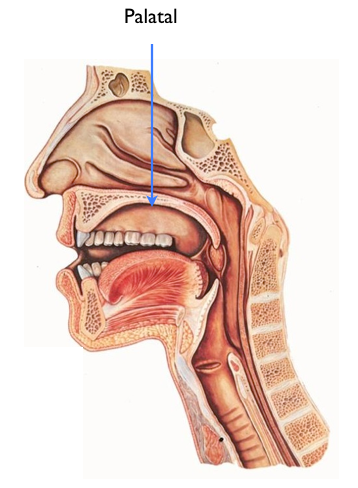
- Palatal
- The roof of your mouth is the hard palate. You may know it as “the place that burns like hell when I eat pizza that is too hot.” You create Palatal consonants when you raise the tongue to this point and constrict airflow. English has only one palatal consonant: /j/ as in “yes” and “bayou”
- Bilabial
Manner of Articulation
- Nasal
- examples: /m/ – “mad” and “clam” – oral passage is blocked by closing the lips (bilabial)./n/ – “no” and “man‘ – oral passage is blocked by pressing tongue tip against the alveolar ridge (alveolar)./ŋ/ – “going” and “funk” – Oral passage is blocked by pressing the the back of your tongue against the soft palate (velar).
- Stop
- nglish contains the following stop consonants. /p/ – purse and rap – oral passage is blocked by closing the lips (bilabial)./b/ – “back” and “cab” – oral passage is blocked by closing the lips (bilabial)./t/ – “tab” and “rat” – oral passage is blocked by pressing the tongue tip against the alveolar ridge (alveolar)/d/ – “dip” and “bad” – oral passage is blocked by pressing the tongue tip against the alveolar ridge (alveolar)/k/ – “kite” and “back” – block airflow with the back of the tongue against the soft palate (velar)./g/ – “good” and “bug” – block airflow with the back of the tongue against the soft palate (velar).
- Fricative
- or example, you create a /t/ stop consonant when you block airflow completely with your tongue against the alveolar ridge. But if you let up with the tongue a bit and let the air seep through, you make an /s/ fricative consonant. The English fricative sounds are as follows: /f/ – “fro” and “calf“- air is forced through the upper teeth and lower lip (labiodental)/v/ – “vine” and “have” – air is forced through the upper teeth and lower lip (labiodental)/θ/ – “thick” and “bath” – air is forced through upper teeth and tongue (dental)/ð/ – “the” and “rather” – air is forced through upper teeth and tongue (dental)/s/ – “suit” and “bus” – air is forced through tongue and alveolar ridge (alveolar)/z/ – “zit” and “jazz” – air is forced through tongue and alveolar ridge (alveolar)/ʃ/ – “shot” and “brash” – air is forced through the tongue and point just beyond alveolar ridge (post-alveolar)/ʒ/ – “vision” and “measure” – air is forced through the tongue and point just beyond alveolar ridge (post-alveolar)/h/ – “happy” and “hope” – actually /h/ isn’t a fricative. It’s technically not even a real consonant sound since there’s no constriction/obstruction of airflow.
- Affricate
- When stop consonants mix with fricative consonants, the result is an affricate consonant. Affricate consonants start as stop sounds with air building up behind an articulator which then releases through a narrow channel as a fricative (instead of a clean burst as stops do). The English affricate sounds are: /tʃ/ – “chick” and “match” – air is blocked with tongue just beyond the alveolar ridge (post-alveolar), then released as a fricative./dʒ/ – “jam” and “badge” – air is blocked with tongue just beyond the alveolar ridge (post-alveolar), then released as a fricative.
- Approximant
- The resulting sound is more like a fast vowel than anything else. For example, the /w/ approximant is like a fast /u/ sound (say /u/ + /aɪ/ really fast and you get the word “why”). Notice how your tongue never actually comes in contact with the top of your mouth. There are three English approximants: /w/ – “wet” and “howard” – back of tongue raises to velum (but not too close!) and lips are rounded (velar)/j/ – “yes” and “bayou” – tongue raises to hard palate (but not too close!) (palatal)/ɹ/ – “right” and “roar” – tongue raises to hard palate (but not too close) (alveolar/post-alveolar)
- Lateral
- Lateral consonants are when the tongue blocks the the middle of your mouth so that air has to pass around the sides. You create this when you There is one lateral consonant in English /l/ – “luck”- place the tip of the tongue at the alveolar ridge (alveolar)
- Nasal
Vowels
- short vowels
- Long Vowels
- examples
- late /leɪt/
- tub /tʌb/
- seal /si:l/
- bike /baɪk/
- boat /bəʊt/
- juice /ʤu:s/
- bus /bʌs//
- hat /hæt/
CONSONANTS
- Examples
- ð brothers
- z Zoo
- v cave
- θ Think
- s Sight
- p cap
- h High
- ʒ treasure,
- b Bag
- ʃ shop
- t Time
- f fish
- k cash
- g grass
- ʈʃ church
- sounds
- Examples
Images and files in the map







Information
- Description
- Mind Map on PHONETICS AND PHONOLOGY, created by laura bojaca lopez on 27/08/2017.
- Created by
- laura bojaca lopez · Aug 2017
- Updated
- Apr 6, 2018
- Views
- 25
- Rating