
Mind map
Structure in 5´s
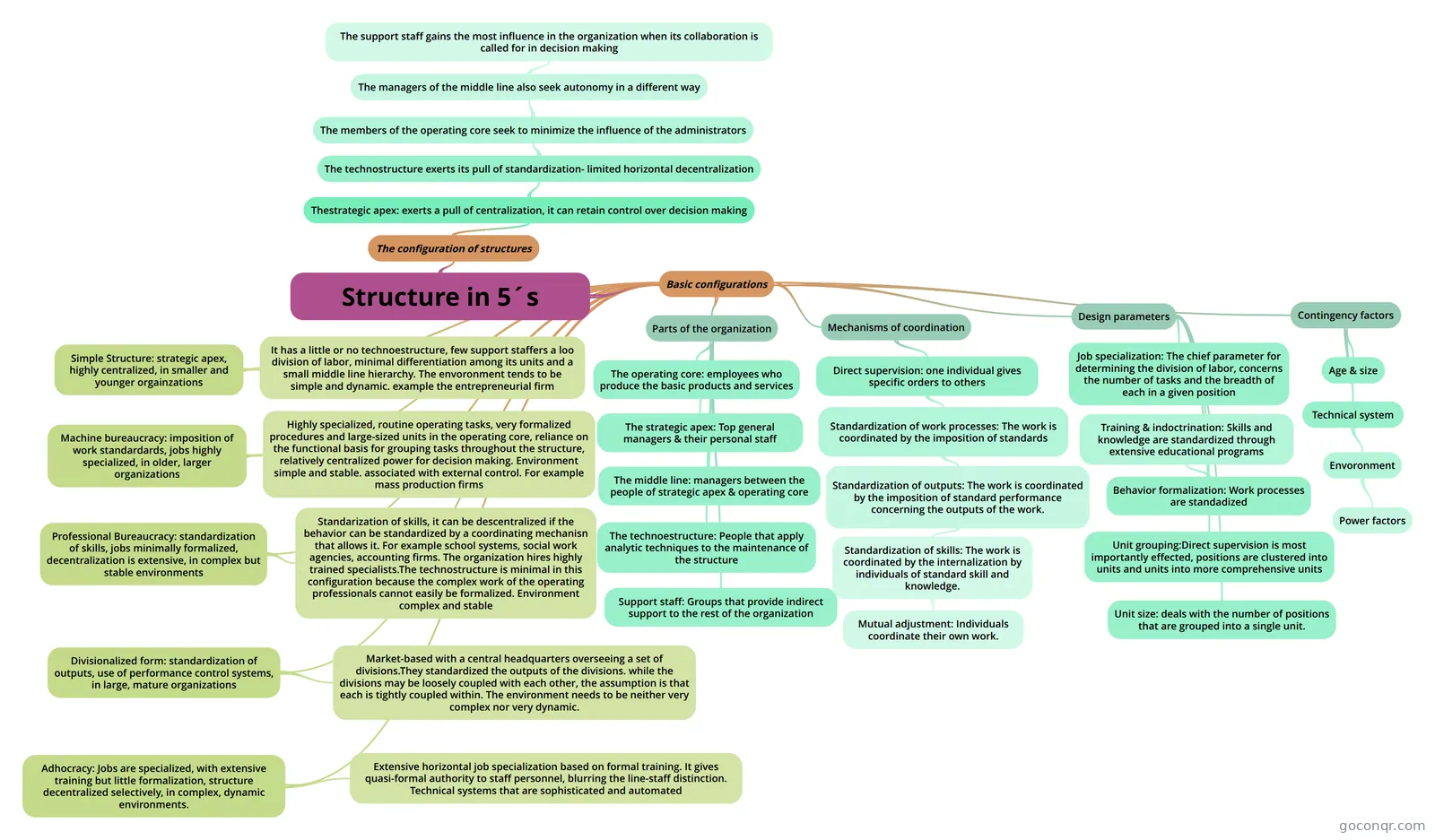
Mind map: Mintzberg organizational structures
Map content
Structure in 5´s
Basic configurations
- Parts of the organization
- The operating core: employees who produce the basic products and services
- The strategic apex: Top general managers & their personal staff
- The middle line: managers between the people of strategic apex & operating core
- The technoestructure: People that apply analytic techniques to the maintenance of the structure
- Support staff: Groups that provide indirect support to the rest of the organization
- Mechanisms of coordination
- Direct supervision: one individual gives specific orders to others
- Standardization of work processes: The work is coordinated by the imposition of standards
- Standardization of outputs: The work is coordinated by the imposition of standard performance concerning the outputs of the work.
- Standardization of skills: The work is coordinated by the internalization by individuals of standard skill and knowledge.
- Mutual adjustment: Individuals coordinate their own work.
- Standardization of skills: The work is coordinated by the internalization by individuals of standard skill and knowledge.
- Standardization of outputs: The work is coordinated by the imposition of standard performance concerning the outputs of the work.
- Standardization of work processes: The work is coordinated by the imposition of standards
- Direct supervision: one individual gives specific orders to others
- Design parameters
- Job specialization: The chief parameter for determining the division of labor, concerns the number of tasks and the breadth of each in a given position
- Behavior formalization: Work processes are standadized
- Training & indoctrination: Skills and knowledge are standardized through extensive educational programs
- Unit grouping:Direct supervision is most importantly effected, positions are clustered into units and units into more comprehensive units
- Unit size: deals with the number of positions that are grouped into a single unit.
- Contingency factors
- Age & size
- Technical system
- Envoronment
- Power factors
- Envoronment
- Simple Structure: strategic apex, highly centralized, in smaller and younger orgainzations
- It has a little or no technoestructure, few support staffers a loo division of labor, minimal differentiation among its units and a small middle line hierarchy. The envoronment tends to be simple and dynamic. example the entrepreneurial firm
- Machine bureaucracy: imposition of work standardards, jobs highly specialized, in older, larger organizations
- Highly specialized, routine operating tasks, very formalized procedures and large-sized units in the operating core, reliance on the functional basis for grouping tasks throughout the structure, relatively centralized power for decision making. Environment simple and stable. associated with external control. For example mass production firms
- Professional Bureaucracy: standardization of skills, jobs minimally formalized, decentralization is extensive, in complex but stable environments
- Standarization of skills, it can be descentralized if the behavior can be standardized by a coordinating mechanisn that allows it. For example school systems, social work agencies, accounting firms. The organization hires highly trained specialists.The technostructure is minimal in this configuration because the complex work of the operating professionals cannot easily be formalized. Environment complex and stable
- Divisionalized form: standardization of outputs, use of performance control systems, in large, mature organizations
- Market-based with a central headquarters overseeing a set of divisions.They standardized the outputs of the divisions. while the divisions may be loosely coupled with each other, the assumption is that each is tightly coupled within. The environment needs to be neither very complex nor very dynamic.
- Adhocracy: Jobs are specialized, with extensive training but little formalization, structure decentralized selectively, in complex, dynamic environments.
- Extensive horizontal job specialization based on formal training. It gives quasi-formal authority to staff personnel, blurring the line-staff distinction. Technical systems that are sophisticated and automated
- Parts of the organization
The configuration of structures
- Thestrategic apex: exerts a pull of centralization, it can retain control over decision making
- The technostructure exerts its pull of standardization- limited horizontal decentralization
- The members of the operating core seek to minimize the influence of the administrators
- The managers of the middle line also seek autonomy in a different way
- The support staff gains the most influence in the organization when its collaboration is called for in decision making
- The managers of the middle line also seek autonomy in a different way
- The members of the operating core seek to minimize the influence of the administrators
- The technostructure exerts its pull of standardization- limited horizontal decentralization
- Thestrategic apex: exerts a pull of centralization, it can retain control over decision making
Information
- Description
- Mind Map on Structure in 5´s, created by Karen Almaraz on 12/03/2018.
- Created by
- Karen Almaraz
- Views
- 1
- Rating