
Mind map
Patent License Negotiation: Best Practices
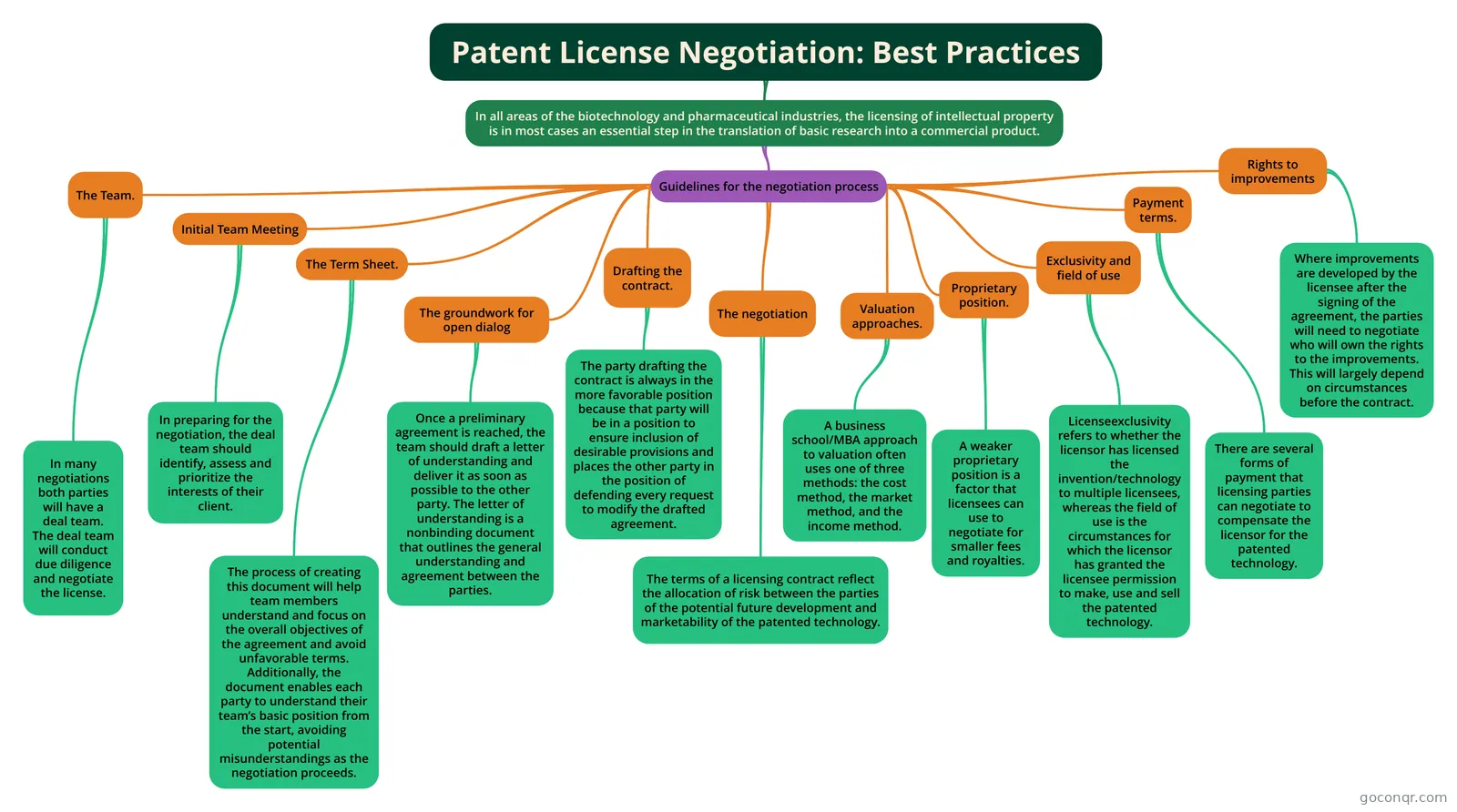
Mind map: Patent license negotiation best practices
Map content
Patent License Negotiation: Best Practices
In all areas of the biotechnology and pharmaceutical industries, the licensing of intellectual property is in most cases an essential step in the translation of basic research into a commercial product.
- Guidelines for the negotiation process
- The Team.
- In many negotiations both parties will have a deal team. The deal team will conduct due diligence and negotiate the license.
- Initial Team Meeting
- In preparing for the negotiation, the deal team should identify, assess and prioritize the interests of their client.
- The Term Sheet.
- The process of creating this document will help team members understand and focus on the overall objectives of the agreement and avoid unfavorable terms. Additionally, the document enables each party to understand their team’s basic position from the start, avoiding potential misunderstandings as the negotiation proceeds.
- The groundwork for open dialog
- Once a preliminary agreement is reached, the team should draft a letter of understanding and deliver it as soon as possible to the other party. The letter of understanding is a nonbinding document that outlines the general understanding and agreement between the parties.
- The negotiation
- The terms of a licensing contract reflect the allocation of risk between the parties of the potential future development and marketability of the patented technology.
- Drafting the contract.
- The party drafting the contract is always in the more favorable position because that party will be in a position to ensure inclusion of desirable provisions and places the other party in the position of defending every request to modify the drafted agreement.
- Valuation approaches.
- A business school/MBA approach to valuation often uses one of three methods: the cost method, the market method, and the income method.
- Proprietary position.
- A weaker proprietary position is a factor that licensees can use to negotiate for smaller fees and royalties.
- Exclusivity and field of use
- Licenseexclusivity refers to whether the licensor has licensed the invention/technology to multiple licensees, whereas the field of use is the circumstances for which the licensor has granted the licensee permission to make, use and sell the patented technology.
- Payment terms.
- There are several forms of payment that licensing parties can negotiate to compensate the licensor for the patented technology.
- Rights to improvements
- Where improvements are developed by the licensee after the signing of the agreement, the parties will need to negotiate who will own the rights to the improvements. This will largely depend on circumstances before the contract.
- The Team.
- Guidelines for the negotiation process
Information
- Description
- Patent
- Created by
- Jimmy Ruano
- Views
- 22
- Rating
More on Patent License Agreements and Negotiation