
Mind map
Practitioner’s Section Patent License Negotiation: Best Practices
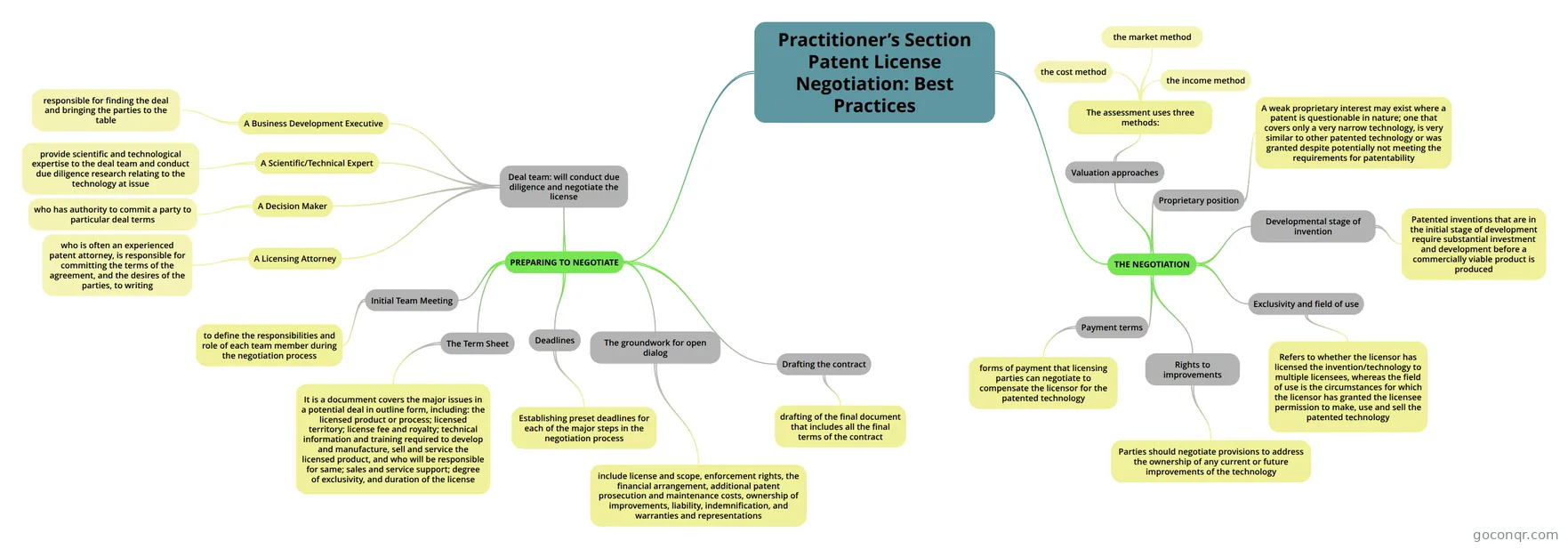
Mind map: Patent license negotiation best practices
Map content
Practitioner’s Section Patent License Negotiation: Best Practices
PREPARING TO NEGOTIATE
- Deal team: will conduct due diligence and negotiate the license
- A Scientific/Technical Expert
- provide scientific and technological expertise to the deal team and conduct due diligence research relating to the technology at issue
- A Business Development Executive
- responsible for finding the deal and bringing the parties to the table
- A Decision Maker
- who has authority to commit a party to particular deal terms
- A Licensing Attorney
- who is often an experienced patent attorney, is responsible for committing the terms of the agreement, and the desires of the parties, to writing
- A Scientific/Technical Expert
- Initial Team Meeting
- to define the responsibilities and role of each team member during the negotiation process
- The Term Sheet
- It is a documment covers the major issues in a potential deal in outline form, including: the licensed product or process; licensed territory; license fee and royalty; technical information and training required to develop and manufacture, sell and service the licensed product, and who will be responsible for same; sales and service support; degree of exclusivity, and duration of the license
- Deadlines
- Establishing preset deadlines for each of the major steps in the negotiation process
- The groundwork for open dialog
- include license and scope, enforcement rights, the financial arrangement, additional patent prosecution and maintenance costs, ownership of improvements, liability, indemnification, and warranties and representations
- Drafting the contract
- drafting of the final document that includes all the final terms of the contract
- Deal team: will conduct due diligence and negotiate the license
THE NEGOTIATION
- Valuation approaches
- The assessment uses three methods:
- the cost method
- the market method
- the income method
- The assessment uses three methods:
- Proprietary position
- A weak proprietary interest may exist where a patent is questionable in nature; one that covers only a very narrow technology, is very similar to other patented technology or was granted despite potentially not meeting the requirements for patentability
- Developmental stage of invention
- Patented inventions that are in the initial stage of development require substantial investment and development before a commercially viable product is produced
- Exclusivity and field of use
- Refers to whether the licensor has licensed the invention/technology to multiple licensees, whereas the field of use is the circumstances for which the licensor has granted the licensee permission to make, use and sell the patented technology
- Payment terms
- forms of payment that licensing parties can negotiate to compensate the licensor for the patented technology
- Rights to improvements
- Parties should negotiate provisions to address the ownership of any current or future improvements of the technology
- Valuation approaches
Information
- Description
- Mind Map on Practitioner’s Section Patent License Negotiation: Best Practices, created by cesar piñeros on 15/10/2018.
- Created by
- cesar piñeros
- Views
- 3
- Rating
More on Patent License Agreements and Negotiation