
Mind map
How to teach writing
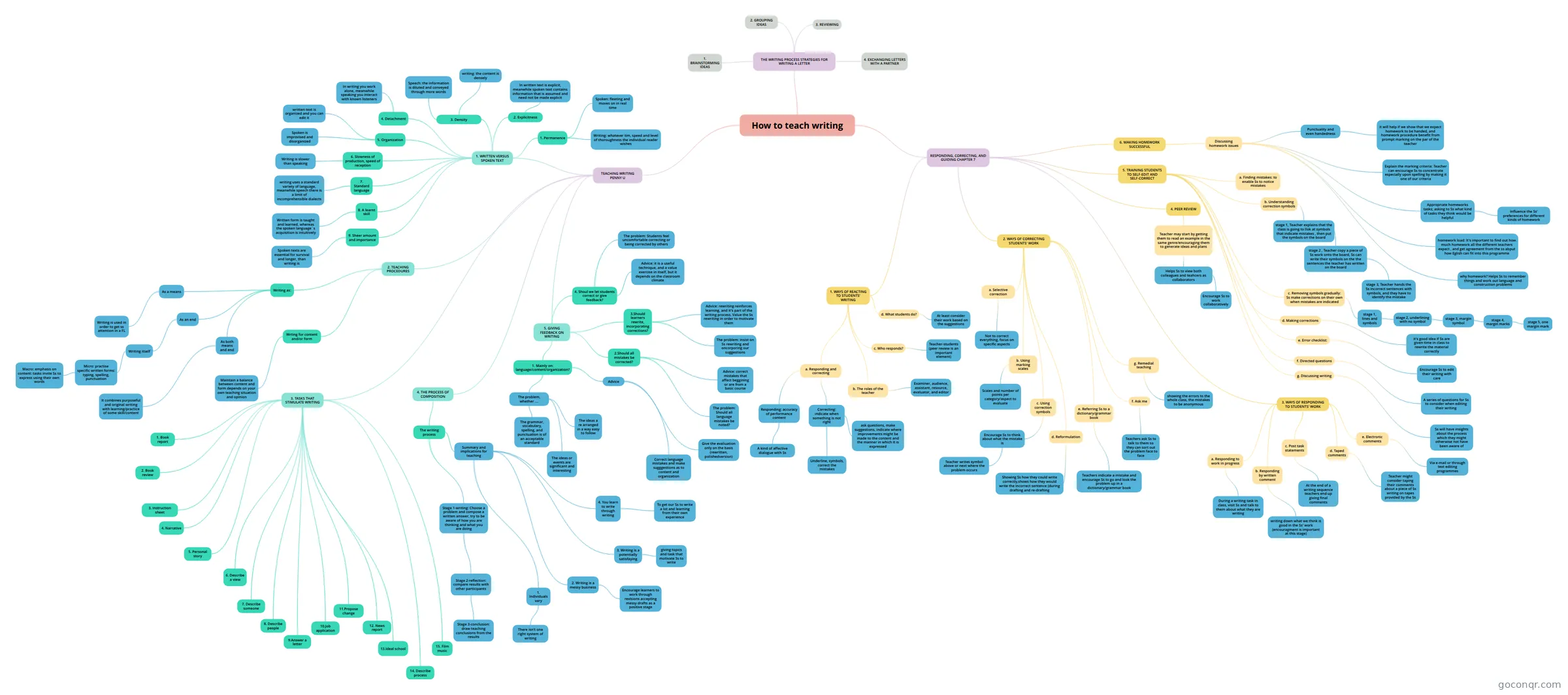
Mind map: How to teach writing
Map content
How to teach writing
TEACHING WRITING PENNY U
- 2. TEACHING PROCEDURES
- Writing as:
- As a means
- Writing is used in order to get ss attention in a FL
- As an end
- Writing itself
- Micro: practise specific written forms: typing, spelling, punctuation
- Macro: emphasis on content: tasks invite Ss to express using their own words
- Micro: practise specific written forms: typing, spelling, punctuation
- Writing itself
- As both means and end
- It combines purposeful and original writing with learning/practice of some skill/content
- As a means
- Wrting for content and/or form
- Maintain a balance between content and form depends on your own teaching situation and opinion
- Writing as:
- 4. THE PROCESS OF COMPOSITION
- The writing process
- Summary and implications for teaching
- 1. Individuals vary
- There isn't one right system of writing
- 2. Writing is a messy business
- Encourage learners to work through revisions accepting messy drafts as a positive stage
- 3. Writing is a potentially satisfaying
- giving topics and task that motivate Ss to write
- 4. You learn to write through writing
- To get our Ss to write a lot and learning from their own experience
- 1. Individuals vary
- Stage 1-writing: Choose a problem and compose a written answer, try to be aware of how you are thinking and what you are doing
- Stage 2-reflection: compare results with other participants
- Stage 3-conclusion: draw teaching conclusions from the results
- Stage 2-reflection: compare results with other participants
- Summary and implications for teaching
- The writing process
- 5. GIVING FEEDBACK ON WRITING
- 1. Mainly on: language/content/organization?
- The problem, whether ....
- The ideas or events are significant and interesting
- The ideas a re arranged in a way easy to follow
- The grammar, vocabulary, spelling, and punctuation is of an acceptable standard
- Advice
- Correct language mistakes and make sugggestions as to content and organization
- Give the evaliuation only on the basis (rewritten, polishedversion)
- The problem, whether ....
- 2.Should all mistakes be corrected?
- The problem: Should all language mistakes be noted?
- Advice: correct mistakes that affect beggining or are from a basic course
- 3.Should learners rewrite, incorporating corrections?
- The problem: insist on Ss rewriting and oncorporing our suggestions
- Advice: rewriting reinforces learning, and it's part of the writing process. Value the Ss rewriting in order to motivate them
- 4. Shoul we let students correct or give feedback?
- The problem: Students feel uncomfortable correcting or being corrected by others
- Advice: it is a useful technique, and a value exercise in itself, but it depends on the classroom climate
- 1. Mainly on: language/content/organization?
- 1. WRITTEN VERSUS SPOKEN TEXT
- 1. Permanence
- Writing: whatever tim, speed and level of thoroughness the individual reader wishes
- Spoken: fleeting and moves on in real time
- 3. Density
- writing: the content is densely
- Speech: the information is diluted and conveyed through more words
- 2. Explicitness
- In written text is explicit, meanwhile spoken text contains information that is assumed and need not be made explicit
- 4. Detachment
- In writing you work alone, meanwhile speaking you interact with known listeners
- 5. Organization
- written text is organized and you can edit it
- Spoken is improvised and disorganized
- 6. Slowness of production, speed of reception
- Writing is slower than speaking
- 7. Standard language
- writing uses a standard variety of language, meanwhile speech there is a limit of incomprehensible dialects
- 8. A learnt skill
- Written form is taught and learned, whereas the spoken language´s acquisition is intuitively
- 9. Sheer amount and importance
- Spoken texts are essential for survival and longer, than writing is
- 1. Permanence
- 3. TASKS THAT STIMULATE WRITING
- 1. Book report
- 2. Book review
- 3. Instruction sheet
- 4. Narrative
- 5. Personal story
- 6. Describe a view
- 7. Describe someone
- 8. Describe people
- 9.Answer a letter
- 10.Job application
- 11.Propose change
- 12. News report
- 13.Ideal school
- 14. Describe process
- 15. Film music
- 2. TEACHING PROCEDURES
RESPONDING, CORRECTING, AND GUIDING CHAPTER 7
- 2. WAYS OF CORRECTING STUDENTS' WORK
- a. Selective correction
- Not to correct everything, focus on specific aspects
- b. Using marking scales
- Scales and number of points per category/aspect to evaluate
- c. Using correction symbols
- Encourage Ss to think about what the mistake is
- Teacher writes symbol above or next where the problem occurs
- Encourage Ss to think about what the mistake is
- d. Reformulation
- Showing Ss how they could write correctly,shows how they would write the incorrect sentence (during drafting and re-drafting
- e. Referring Ss to a dictionary/grammar book
- Teachers indicate a mistake and encourage Ss to go and look the problem up in a dictionary/grammar book
- f. Ask me
- Teachers ask Ss to talk to them so they can sort out the problem face to face
- g. Remedial teaching
- showing the errors to the whole class, the mistakes to be anonymous
- a. Selective correction
- 4. PEER REVIEW
- Teacher may start by getting them to read an example in the same genre/encouraging them to generate ideas and plans
- Helps Ss to view both colleagues and teahcers as collaborators
- Encourage Ss to work collaboratively
- Helps Ss to view both colleagues and teahcers as collaborators
- Teacher may start by getting them to read an example in the same genre/encouraging them to generate ideas and plans
- 1. WAYS OF REACTING TO STUDENTS' WRITING
- a. Responding and correcting
- Responding: accuracy of performance content
- A kind of affective dialogue with Ss
- Correcting: indicate when something is not right
- Underline, symbols, correct the mistakes
- ask questions, make suggestions, indicate where improvements might be made to the content and the manner in which it is expressed
- Responding: accuracy of performance content
- b. The roles of the teacher
- Examiner, audience, assistant, resource, evaluator, and editor
- c. Who responds?
- Teacher-students (peer review is an important element)
- d. What students do?
- At least consider their work based on the suggestions
- a. Responding and correcting
- 3. WAYS OF RESPONDING TO STUDENTS' WORK
- a. Responding to work in progress
- During a writing task in class, visit Ss and talk to them about what they are writing
- b. Responding by written comment
- writing down what we think is good in the Ss' work (encouragment is important at this stage)
- c. Post task statements
- At the end of a writing sequence teachers end up giving final comments
- d. Taped comments
- Teacher might consider taping their comments about a piece of Ss writing on tapes provided by the Ss
- e. Electronic comments
- Via e-mail or through text editing programmes
- a. Responding to work in progress
- 6. MAKING HOMEWORK SUCCESSFUL
- Discussing homework issues
- why homework? Helps Ss to remember things and work out language and construction problems
- homework load: It's important to find out how much homework all the different teachers expect , and get agreement from the ss abput how Eglish can fit into this programme
- Appropriate homeworks tasks; asking to Ss what kind of tasks they think would be helpful
- Influence the Ss' preferences for different kinds of homework
- Explain the marking criteria: Teacher can encourage Ss to concentrate especially upon spelling by making it one of our criteria
- Punctuality and even handedness
- it will help if we show that we expect homework to be handed, and homework procedure benefit from prompt marking on the par of the teacher
- Discussing homework issues
- 5. TRAINING STUDENTS TO SELF-EDIT AND SELF-CORRECT
- a. Finding mistakes: to enable Ss to notice mistakes
- b. Understanding correction symbols
- stage 1, Teacher explains that the class is going to llok at symbols that indicate mistakes , then put the symbols on the board
- stage 2 , Teacher copy a piece of Ss work onto the board, Ss can write their symbols on the the sentences the teacher has written on the board
- stage 3, Teacher hands the Ss incorrect sentences with symbols, and they have to identify the mistake
- stage 2 , Teacher copy a piece of Ss work onto the board, Ss can write their symbols on the the sentences the teacher has written on the board
- stage 1, Teacher explains that the class is going to llok at symbols that indicate mistakes , then put the symbols on the board
- c. Removing symbols gradually: Ss make corrections on their own when mistakes are indicated
- stage 1, lines and symbols
- stage 2, underlining with no symbol
- stage 3, margin symbol
- stage 4, margin marks
- stage 5, one margin mark
- stage 4, margin marks
- stage 3, margin symbol
- stage 2, underlining with no symbol
- stage 1, lines and symbols
- d. Making corrections
- it's good idea if Ss are given time in class to rewrite the material correctly
- e. Error checklist:
- Encourage Ss to edit their writing with care
- f. Directed questions
- A series of questions for Ss to consider when editing their writing
- g. Discussing writing
- Ss will have insights about the process which they might otherwise not have been aware of
- 2. WAYS OF CORRECTING STUDENTS' WORK
THE WRITING PROCESS STRATEGIES FOR WRITING A LETTER
- 1. BRAINSTORMING IDEAS
- 2. GROUPING IDEAS
- 3. REVIEWING
- 4. EXCHANGING LETTERS WITH A PARTNER
Information
- Description
- Mind Map on How to teach writing, created by grace leaon on 03/11/2018.
- Created by
- grace leaon
- Views
- 1
- Rating